Tabular DI | Data Interpretation | Commodities | Reasoning | Part - 20 | Bharath Kumar
TL;DR
The session teaches how to analyze monthly billing data using Tableau.
Transcript
hi everyone welcome to the session in this session I will continue tablet data and preparation problem and these are some more uh some of the important model listen carefully first of all you need to read the information which is provided in the question and after that you need to solve the questions accordingly first of all the information which i... Read More
Key Insights
- 💁 The analysis emphasizes the necessity of thoroughly understanding the information presented before attempting to solve problems.
- 🤩 Careful observation is key to quickly identifying billing trends and answers without extensive calculations.
- 🪚 The importance of correct data entry in tables is highlighted, as it directly impacts problem-solving accuracy.
- 🌍 Real-world application of average calculations and variances in billing demonstrates practical financial management skills.
- 🔨 Visual tools like Tableau can enhance clarity in billing data interpretation, emphasizing visualization in data analysis.
- 🥳 Calculating ratios could leverage spending analysis for better budgeting decisions over time.
- ⚾ Engaging with data analytically encourages effective decision-making based on historical billing patterns.
Install to Summarize YouTube Videos and Get Transcripts
Explore YouTube Video Summarizer or Get YouTube Transcript Extractor
Questions & Answers
Q: What are the four commodities involved in the billing analysis?
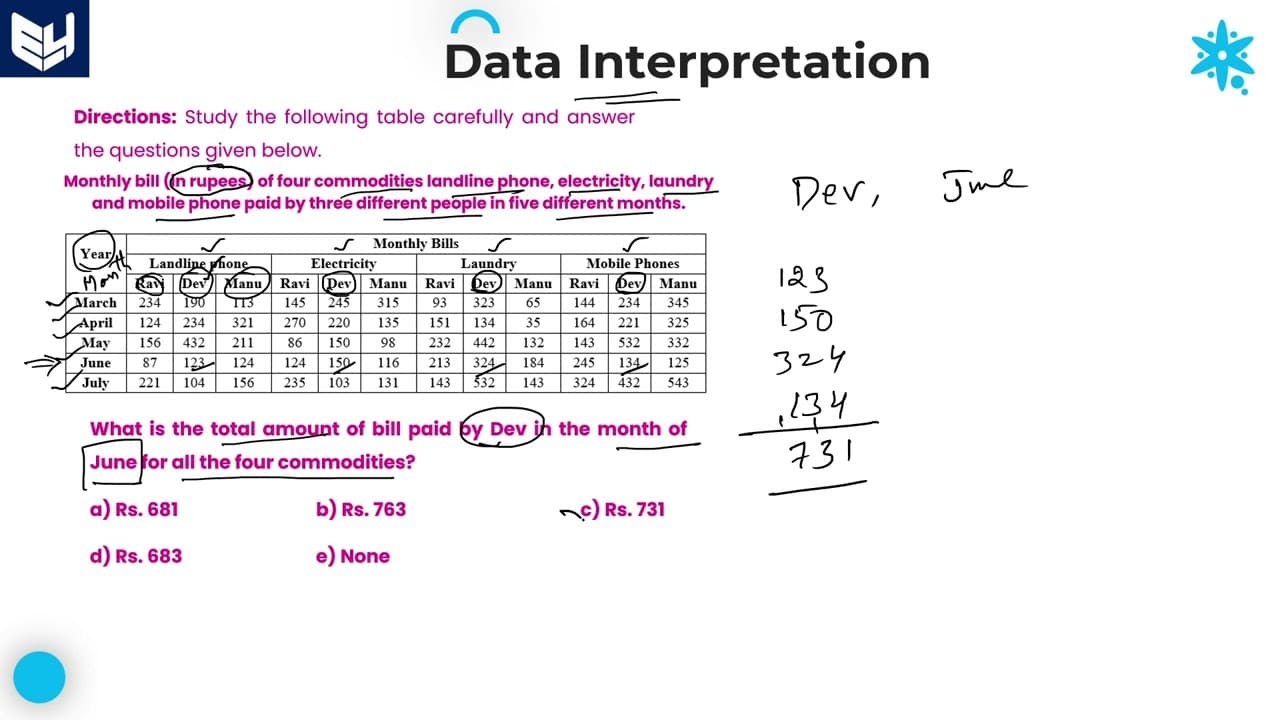
The four commodities in the billing analysis are landline phone, electricity, laundry, and mobile phone. These bills are tracked for three individuals—Ravi, Dev, and Manu—across five months, allowing for comparative analysis and budgeting insights through a Tableau visualization.
Q: How do you calculate the total bill paid by Dev in June?
To find Dev's total bill in June, sum all individual bill amounts for the commodities: landline (123), electricity (150), laundry (324), and mobile phone (134). Adding these amounts together results in a total of 731 rupees, which is identified as option C in the analysis.
Q: What formula is used to determine the average electricity bill paid by Manu?
The average is calculated using the formula: average = sum of observations / number of observations. For Manu’s electricity bills over five months (315, 135, 98, 116, and 131), the total is 795, which is then divided by 5 to yield an average of 159 rupees, indicating option C as the correct answer.
Q: What is the significance of identifying second highest and lowest bills?
Identifying the second highest mobile phone bill and the lowest electricity bill is crucial for understanding spending trends. This analysis helps to highlight areas where costs can be reduced or managed better, showcasing the importance of careful observation over complicated calculations in data analysis.
Summary & Key Takeaways
-
The session covers a detailed analysis of monthly bills across different commodities paid by three individuals over five months.
-
Key focus is placed on reading the provided information carefully to efficiently solve questions related to the billing table.
-
Various types of problems are demonstrated, including calculating totals, averages, and differences between bill amounts.
Read in Other Languages (beta)
Share This Summary 📚
Summarize YouTube Videos and Get Video Transcripts with 1-Click
Try YouTube Summary with ChatGPT & Claude or YouTube Transcript Generator