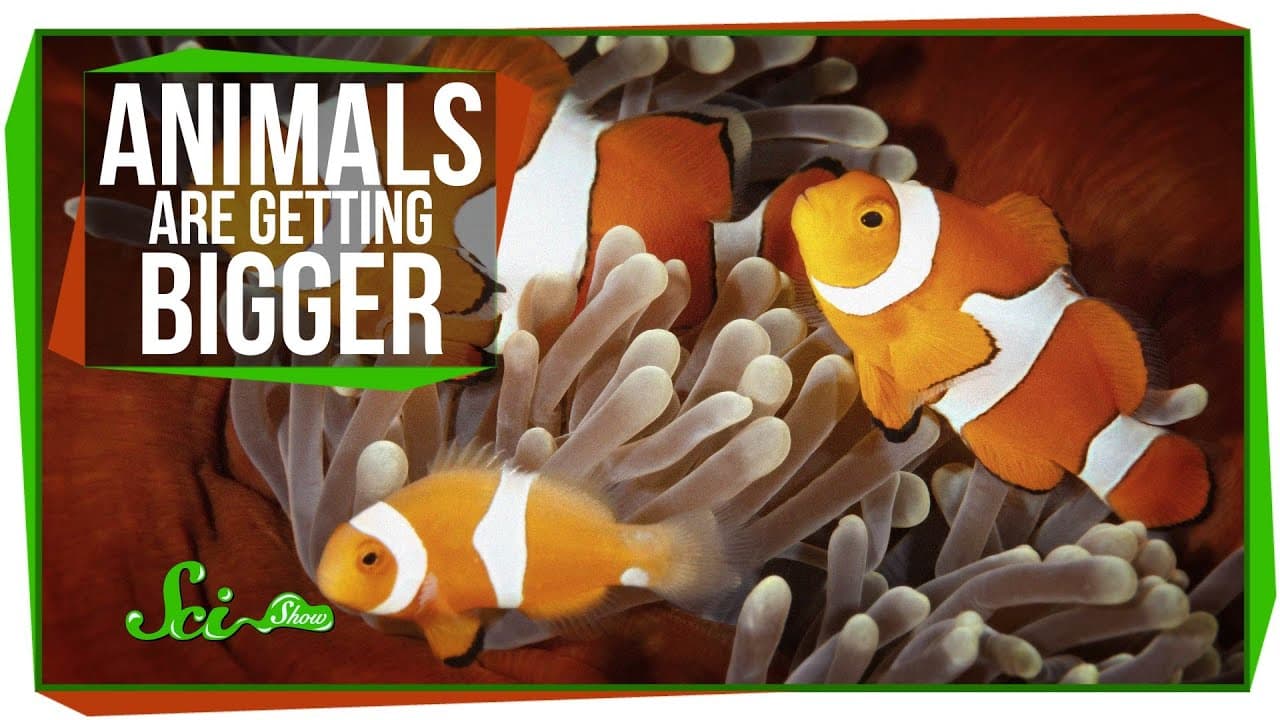
Why Are Marine Animals Getting Bigger Over Time?
TL;DR
Marine animals have increased in size by an average of 150 times over the past 542 million years, supporting Cope's Rule that natural selection favors larger species. This growth is linked to greater genetic diversity, enabling larger animals to travel farther and evolve into new species. The study analyzed data from 17,208 genera, revealing a dramatic increase in the maximum size of marine creatures.
Transcript
There are some situations in life where it’s probably better to be big -- like if you’re a rugby player, or a piano mover, or a sumo wrestler. But size can have an evolutionary advantage, as well. In the animal kingdom, a bigger body size, or biovolume, has often been found to go along with greater biological fitness -- that is, the ability to thri... Read More
Key Insights
- 💗 Marine animals have been increasing in size over the past 542 million years, with their biovolume growing by an average of 150 times.
- 🔶 The increase in size is associated with greater genetic diversity, allowing larger animals to travel farther, expand their ranges, and diverge into different populations.
- 🌥️ Cope's Rule, which suggests that natural selection favors larger animals, is supported by the findings of this study.
- 👖 The researchers analyzed a massive database of body measurements from marine animals spanning 542 million years.
- 🖐️ Genetic diversity plays a crucial role in the creation of new species, and larger animals are more likely to undergo speciation processes.
- 💥 The maximum size of marine creatures has exploded 100,000 times during the studied period, while the minimum size decreased by a factor of 10.
- 👥 The study focuses on marine animals, and it is unclear why the findings do not apply to other groups such as insects.
Install to Summarize YouTube Videos and Get Transcripts
Explore YouTube Video Summarizer or Get YouTube Transcript Extractor
Questions & Answers
Q: What is Cope's Rule?
Cope's Rule is the hypothesis that body size has increased in organisms over evolutionary time. It suggests that natural selection has favored larger animals, leading to an increase in biovolume.
Q: How did the researchers determine the increase in size in marine animals?
The researchers compiled body measurements from a massive database of marine animals, covering a time span of 542 million years. They entered the data into a computer model and found a pattern of increased biovolume over time.
Q: Why did larger animals tend to become more genetically diverse?
Larger animals have the ability to travel farther, expand their home ranges, and diverge into different populations. This increased their genetic diversity, leading to the creation of new species.
Q: What is the significance of this study?
The study provides empirical evidence supporting Cope's Rule and sheds light on the link between size, genetic diversity, and speciation in marine animals. It contributes to our understanding of evolutionary processes and the factors driving biodiversity.
Summary & Key Takeaways
-
Researchers from Stanford University found that marine animals have been getting bigger over the past 542 million years, with their biovolume increasing by 150 times.
-
The increase in size is linked to increased genetic diversity, as larger animals can travel farther, expand their home ranges, and diverge into different populations.
-
The study provides evidence supporting Cope's Rule, which suggests that natural selection has favored larger animals over time.
Read in Other Languages (beta)
Share This Summary 📚
Summarize YouTube Videos and Get Video Transcripts with 1-Click
Try YouTube Summary with ChatGPT & Claude or YouTube Transcript Generator
Explore More Summaries from SciShow 📚
Summarize YouTube Videos and Get Video Transcripts with 1-Click
Try YouTube Summary with ChatGPT & Claude or YouTube Transcript Generator