Solving Quantum Cryptography
TL;DR
Quantum computers threaten current encryption; post-quantum cryptography is crucial.
Transcript
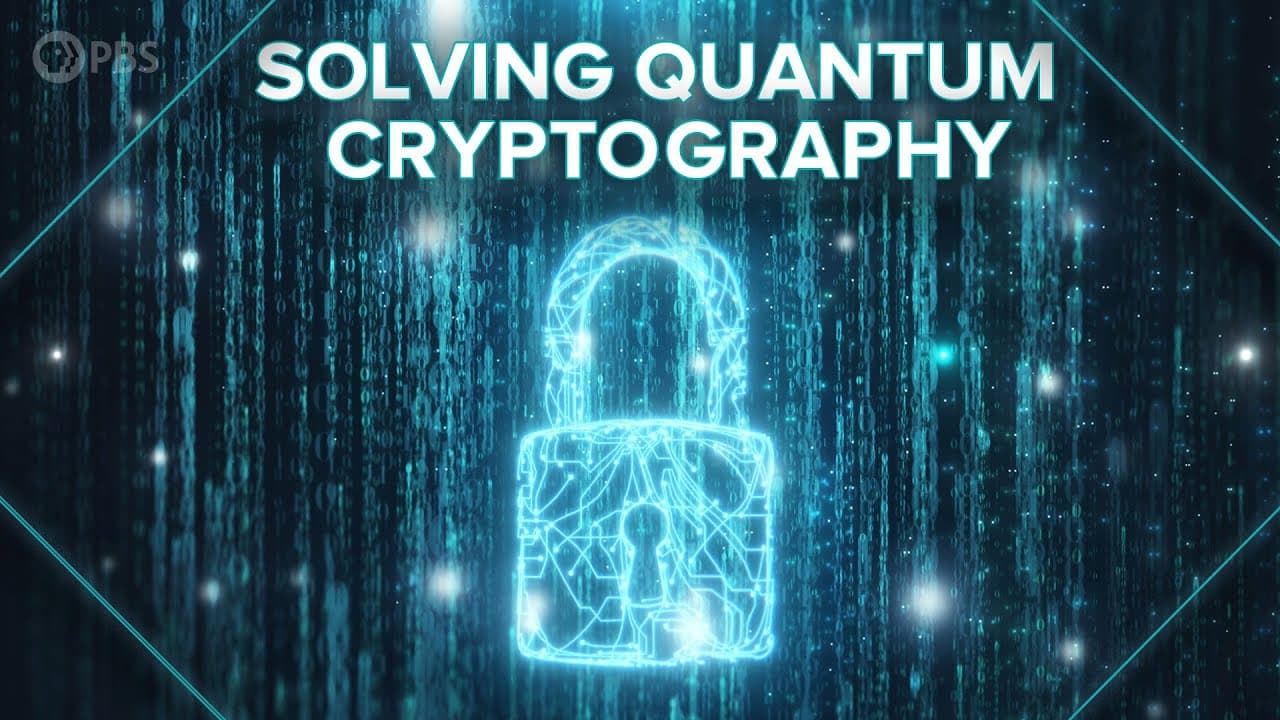
Your extensive posting history on r/birdswitharms and your old fanfiction-heavy livejournal are both one tiny math problem away from becoming public knowledge. That math problem is prime number factoring, and the new era of quantum computers may lay bare your indiscretions, as well as collapse the entire digital economy. Unless we get us some post-... Read More
Key Insights
- Quantum computers, like Google's Sycamore, threaten the security of current encryption systems by potentially factoring prime numbers rapidly.
- Shor's algorithm enables quantum computers to factor prime numbers exponentially faster than classical computers, posing a risk to RSA encryption.
- Post-quantum cryptography aims to develop algorithms resistant to quantum attacks, with NIST selecting finalists for new encryption standards.
- The McEliece cryptosystem, a NIST finalist, uses error correction in large matrices to resist quantum attacks, but requires large public keys.
- Lattice-based cryptosystems, like NTRU and CRYSTALS-KYBER, are potential post-quantum solutions, but also require large public keys.
- Quantum key distribution could offer secure encryption based on quantum physics, but requires a quantum internet, which is challenging to develop.
- The longevity and robustness of post-quantum algorithms are uncertain, as both quantum and classical computers may eventually crack them.
- The development of quantum-resistant cryptography is urgent to protect digital information from future quantum computing advancements.
Install to Summarize YouTube Videos and Get Transcripts
Explore YouTube Video Summarizer or Get YouTube Transcript Extractor
Questions & Answers
Q: What is the main threat posed by quantum computers to current encryption?
Quantum computers threaten current encryption systems primarily because they can efficiently factor large prime numbers using Shor's algorithm. This capability undermines the security of RSA encryption, which relies on the difficulty of prime factorization to protect data. The rapid advancement of quantum computing technology necessitates the development of new cryptographic methods to safeguard digital information.
Q: How does Shor's algorithm work to factor prime numbers?
Shor's algorithm exploits a mathematical structure called periodicity to factor prime numbers efficiently. It uses quantum superposition and entanglement to perform parallel computations, identifying the period of a function related to the number being factored. This period reveals the prime factors, allowing quantum computers to solve the problem exponentially faster than classical methods, which rely on trial division or parallel processing.
Q: What is post-quantum cryptography?
Post-quantum cryptography refers to cryptographic algorithms designed to be secure against the capabilities of quantum computers. These algorithms aim to replace current systems vulnerable to quantum attacks, such as those based on prime factorization. NIST is currently evaluating potential candidates for post-quantum standards, focusing on algorithms that do not rely on structures exploitable by quantum computing, such as the McEliece cryptosystem and lattice-based methods.
Q: What challenges do post-quantum cryptographic algorithms face?
Post-quantum cryptographic algorithms face several challenges, including the need for large public keys, which can slow down network transactions. Additionally, the robustness of these algorithms against both quantum and classical attacks remains uncertain. As quantum computing technology advances, there is a risk that new methods may eventually compromise these algorithms, necessitating ongoing research and development to ensure long-term security.
Q: What is the McEliece cryptosystem, and how does it work?
The McEliece cryptosystem is a post-quantum cryptographic method that uses error correction in large matrices to secure data. It encodes messages into a matrix, adds errors, and uses key matrices to decode them. Without the keys, removing the errors is computationally infeasible. This system is resistant to quantum attacks due to its lack of exploitable periodicity, but it requires large public keys, posing a challenge for practical implementation.
Q: What are lattice-based cryptosystems, and why are they considered for post-quantum cryptography?
Lattice-based cryptosystems rely on the complexity of lattice problems, such as the shortest vector problem, to secure data. These systems are considered for post-quantum cryptography because they lack known quantum algorithms that can solve them efficiently. However, they also require large public keys, similar to the McEliece cryptosystem, which can impact their practical deployment in current network infrastructures.
Q: What role does quantum key distribution play in future cryptographic security?
Quantum key distribution (QKD) offers a theoretically secure method of encryption based on the principles of quantum mechanics. It enables secure communication by allowing two parties to share a secret key with guaranteed security, as any eavesdropping attempt would disturb the quantum states used, revealing the intrusion. However, implementing QKD requires a quantum internet, which is currently a significant technological challenge.
Q: Why is the development of post-quantum cryptography urgent?
The development of post-quantum cryptography is urgent because quantum computers are advancing rapidly and may soon be capable of breaking current encryption methods. Without quantum-resistant algorithms, sensitive data, including financial transactions and personal communications, could be compromised. Developing and implementing secure post-quantum cryptographic standards is essential to protect digital information from future quantum computing threats.
Summary & Key Takeaways
-
Quantum computers pose a significant threat to current encryption methods, especially those based on prime number factorization like RSA. Shor's algorithm allows quantum computers to factor primes exponentially faster than classical computers, necessitating the development of post-quantum cryptography.
-
Post-quantum cryptography seeks to create algorithms resistant to quantum attacks. NIST is evaluating potential candidates, including the McEliece cryptosystem and lattice-based cryptosystems, though they face challenges like large public key sizes.
-
While quantum key distribution offers a theoretically secure alternative based on quantum physics, it requires a quantum internet, which is difficult to achieve. In the meantime, post-quantum cryptography is the best hope against quantum threats.
Read in Other Languages (beta)
Share This Summary 📚
Summarize YouTube Videos and Get Video Transcripts with 1-Click
Try YouTube Summary with ChatGPT & Claude or YouTube Transcript Generator
Explore More Summaries from PBS Space Time 📚





Summarize YouTube Videos and Get Video Transcripts with 1-Click
Try YouTube Summary with ChatGPT & Claude or YouTube Transcript Generator