Heterdyne wave analyzer | Electrical Instruments ( EIM ) | Lec - 23
TL;DR
Learn about heterodyne wave analyzers for precise frequency selection in radio frequency ranges.
Transcript
hi everyone in this video you are going to learn heterodyne wave an laser heterodyne is nothing but mixing of two different frequencies heterodyne hetero means different dining means mixing two different frequencies we are mixing in the wave and Laser what is the use of heterodaining or heteroning different frequencies till now we have seen the wav... Read More
Key Insights
- 👋 Heterodyne wave analyzers are essential tools for accurately measuring and selecting radio frequencies, particularly in technical applications.
- 📡 The mixing process in heterodyne analysis is critical for frequency isolation, enabling clearer signal interpretation and analysis.
- 🖐️ Adjustable attenuators play a vital role in ensuring signal integrity, reducing the impact of unwanted noise and interference during measurement.
- 👻 Utilizing dual mixers allows for enhanced precision in frequency selection, making wave analyzers more effective in challenging environments.
- 📳 These analyzers are widely implemented in industrial settings, particularly for monitoring machinery noise and vibrations to mitigate operational risks.
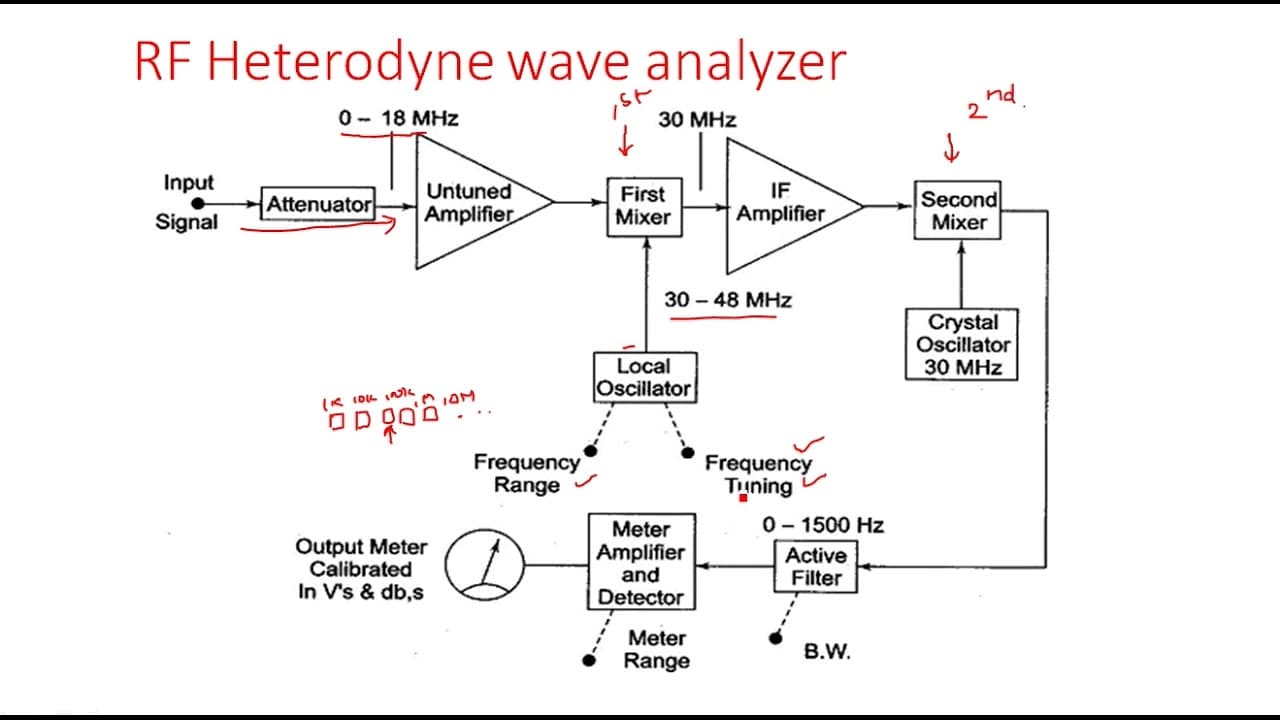
- 🚫 The detailed block diagrams clarify the complex operations of heterodyne technology, illustrating how each component contributes to overall functionality.
- 🎨 Precision in the design of filters and amplifiers within the analyzer is paramount, as it determines the clarity of the output signals and the accuracy of the frequency readings.
Install to Summarize YouTube Videos and Get Transcripts
Explore YouTube Video Summarizer or Get YouTube Transcript Extractor
Questions & Answers
Q: What is heterodyne technology and how does it function in wave analysis?
Heterodyne technology involves mixing two distinct frequencies to create a new intermediate frequency. This process enables precise analysis of radio frequency signals. In a heterodyne wave analyzer, the incoming signal is mixed with a local oscillator frequency, allowing the resultant frequency to be adjusted and monitored for accurate data collection and interpretation.
Q: What is the role of the adjustable attenuator in a heterodyne wave analyzer?
The adjustable attenuator is crucial for controlling the input signal strength to prevent noise interference and loading effects on subsequent circuitry. It ensures that only the desired signal passes through, optimizing the mixing process and enhancing the overall accuracy of the frequency analysis conducted by the analyzer.
Q: How does the mixing process in a heterodyne wave analyzer contribute to frequency selection?
The mixing process entails combining the incoming signal with a locally generated signal from a lock-in oscillator. Through this mixing, frequency differences are created, allowing for precise selection of the desired frequency components. This process is essential for isolating specific frequencies among a broad range, ensuring effective analysis and measurement.
Q: Can you explain the significance of using two mixers in the heterodyne wave analyzer?
Using two mixers enhances the precision of frequency selection in a heterodyne wave analyzer. Each mixer processes the signal in stages, allowing for improved filtering and accuracy. By cascading the mixers, the system can achieve a more refined intermediate frequency, leading to better detection and interpretation of the input signals.
Q: What are the applications of heterodyne wave analyzers in industry?
Heterodyne wave analyzers are extensively used in industries for electrical sound and vibration measurements. They help identify excessive noise and vibrations from machinery, allowing for corrective actions to be taken. This is critical for maintaining compliance with safety standards and ensuring operational efficiency in equipment.
Q: How does the output of the heterodyne wave analyzer get represented?
The output from a heterodyne wave analyzer is generally represented on an indicator meter, calibrated in terms of voltage or decibel levels. This allows users to visually assess the amplitude and frequency components of the signals analyzed, aiding in diagnostics and performance evaluations.
Summary & Key Takeaways
-
Heterodyne technology involves mixing two different frequencies to create a single frequency component, which is essential in wave analysis for radio frequencies.
-
The operation of a heterodyne wave analyzer includes several stages, such as mixing input signals with local oscillator frequencies to achieve precise frequency selection and amplitude indication.
-
Applications of heterodyne wave analyzers span various industries, particularly in monitoring sound and vibrations from heavy machinery, ensuring operations remain within permissible limits.
Read in Other Languages (beta)
Share This Summary 📚
Summarize YouTube Videos and Get Video Transcripts with 1-Click
Try YouTube Summary with ChatGPT & Claude or YouTube Transcript Generator