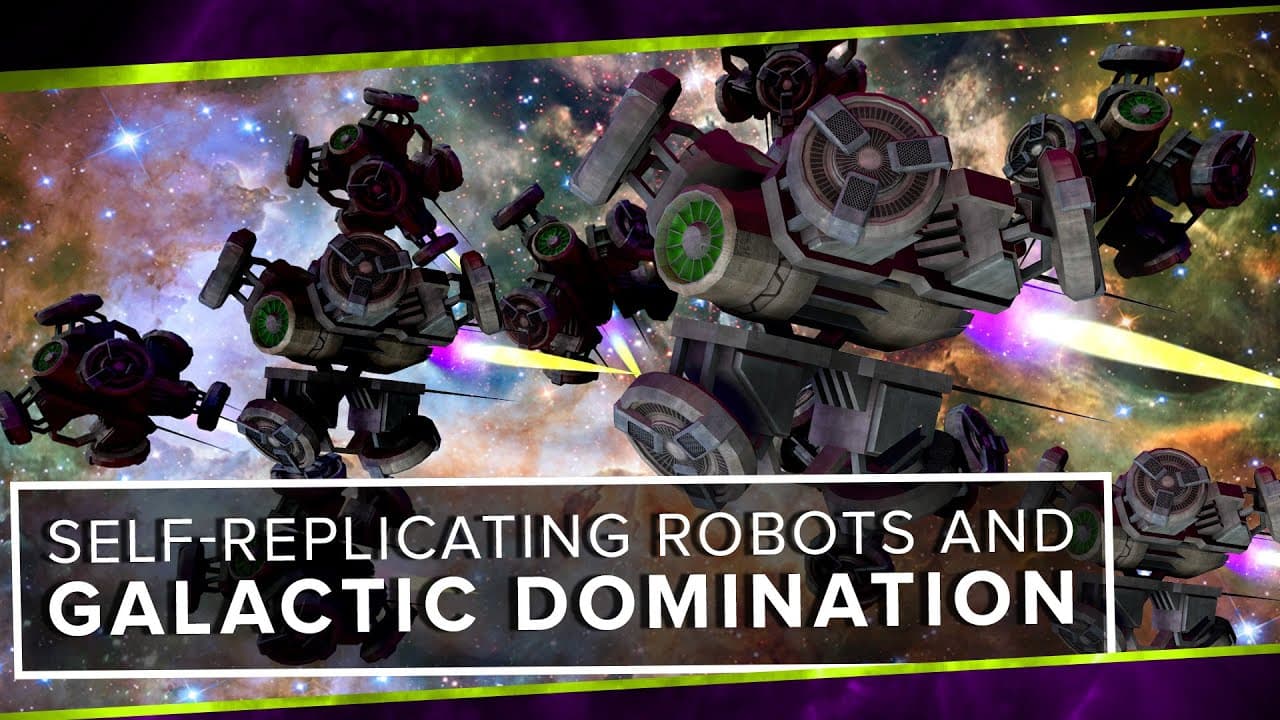
Self-Replicating Robots and Galactic Domination
TL;DR
Von Neumann probes could reshape the galaxy through self-replication.
Transcript
[MUSIC PLAYING] This episode is supported by the Great Courses Plus. Space is big, maybe even too big to be easily colonized by real, living aliens. But what about almost-living machines? I mean spacecraft capable of replicating themselves and exponentially spreading across the galaxy. I'm talking about Von Neumann probes. Our galaxy is depressingl... Read More
Key Insights
- Von Neumann probes are theoretical self-replicating spacecraft capable of spreading exponentially across the galaxy, potentially reshaping it.
- Despite the Milky Way's age, no evidence of advanced civilizations or their technology, like Von Neumann probes, has been observed.
- The Fermi Paradox questions why we haven't encountered advanced civilizations, suggesting they either self-destruct or find interstellar travel too challenging.
- Von Neumann machines could revolutionize space development, enabling large-scale automatable operations like asteroid mining and terraforming.
- John Von Neumann laid the groundwork for self-replicating automata, envisioning universal assemblers capable of building a variety of machines.
- Modern advancements in 3-D printing and nanotechnology make the concept of self-replicating machines more feasible.
- The potential for Von Neumann probes to cover the galaxy in 10 million years challenges the notion that no civilization has attempted it.
- The rarity of technological civilizations capable of building such probes may explain the lack of evidence for their existence.
Install to Summarize YouTube Videos and Get Transcripts
Explore YouTube Video Summarizer or Get YouTube Transcript Extractor
Questions & Answers
Q: What are Von Neumann probes?
Von Neumann probes are theoretical self-replicating robotic spacecraft capable of traveling between star systems. They can extract resources at their destinations to build copies of themselves, allowing them to exponentially spread across the galaxy. This concept challenges the Fermi Paradox by suggesting that such probes should have already populated the galaxy if advanced civilizations existed.
Q: How do Von Neumann probes relate to the Fermi Paradox?
The Fermi Paradox questions why we haven't encountered evidence of advanced civilizations despite the galaxy's age. Von Neumann probes, as self-replicating machines, should have already populated the galaxy if any civilization had built them. Their absence suggests that technological civilizations are rare or that none have chosen to build such probes.
Q: What advancements make Von Neumann probes feasible?
Modern advancements in zero-g 3-D printing, material science, nanofabrication, and automation software nearing AI make the concept of Von Neumann probes more feasible. These technologies enable the creation of machines that can replicate themselves and build a variety of other machines, potentially revolutionizing space development and making galactic colonization possible.
Q: What is the role of John Von Neumann in this concept?
John Von Neumann was a Hungarian mathematician and physicist who laid the theoretical groundwork for self-replicating automata. He envisioned universal assemblers capable of building a variety of machines, including themselves. This concept, now known as Von Neumann machines, forms the basis for the idea of self-replicating probes that could explore and colonize the galaxy.
Q: What are some proposed uses for Von Neumann machines?
Von Neumann machines could be used for large-scale automatable space operations, such as asteroid mining, Dyson swarm construction, and terraforming. These self-replicating machines could revolutionize space development by enabling the efficient and autonomous execution of complex tasks, potentially reshaping the galaxy and supporting human expansion into space.
Q: Why haven't we seen evidence of Von Neumann probes?
The absence of Von Neumann probes suggests that technological civilizations capable of building them are rare or that no civilization has chosen to build them. This challenges assumptions about the prevalence of advanced civilizations and suggests that humanity may be among the first to consider such possibilities, highlighting the rarity of life capable of achieving this technological milestone.
Q: What challenges does the Fermi Paradox present?
The Fermi Paradox presents the challenge of explaining why we haven't encountered evidence of advanced civilizations despite the galaxy's age and the potential for life to evolve elsewhere. It suggests that civilizations may self-destruct, find interstellar travel too challenging, or choose not to expand, leaving the galaxy seemingly devoid of technological life.
Q: What is the significance of the Anthropic Principle in this context?
The Anthropic Principle suggests that in any universe capable of producing intelligence, there must be someone, somewhere, asking why they are alone. This principle highlights the possibility that humanity may be among the first technological civilizations to explore the galaxy, emphasizing the rarity and uniqueness of our existence and the potential for us to be pioneers in the universe.
Summary & Key Takeaways
-
Von Neumann probes are self-replicating machines that could potentially colonize the galaxy by building copies of themselves and spreading across star systems. Despite the galaxy's age, no evidence of such technology has been found, raising questions about the Fermi Paradox and the existence of advanced civilizations.
-
The concept of self-replicating machines was proposed by John Von Neumann, who envisioned universal assemblers capable of creating a variety of machines, including themselves. Modern advancements in technology make this concept more feasible, suggesting a future where such machines could revolutionize space development.
-
The lack of evidence for Von Neumann probes may indicate that technological civilizations are rare or that no civilization has chosen to build them. This challenges assumptions about the prevalence of advanced civilizations and suggests that humanity may be among the first to consider such possibilities.
Read in Other Languages (beta)
Share This Summary 📚
Summarize YouTube Videos and Get Video Transcripts with 1-Click
Try YouTube Summary with ChatGPT & Claude or YouTube Transcript Generator
Explore More Summaries from PBS Space Time 📚

Summarize YouTube Videos and Get Video Transcripts with 1-Click
Try YouTube Summary with ChatGPT & Claude or YouTube Transcript Generator