How to Solve for an Unknown Area in a Rectangle
TL;DR
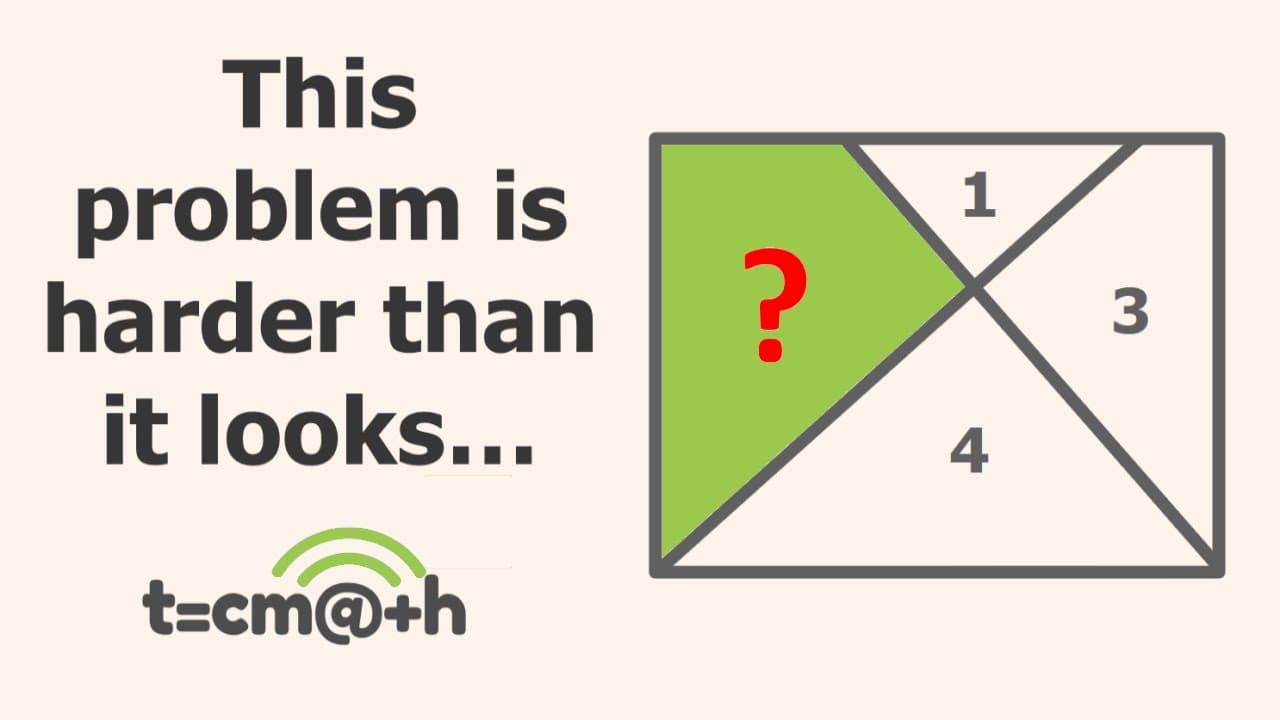
To find the unknown area in a rectangle divided by intersecting lines, use the properties of similar triangles. By comparing the areas and understanding that the ratio of the areas corresponds to the square of the side lengths, you can calculate the unknown area by summing known areas and applying the area ratios. The final area result is 4 square units.
Transcript
good day and welcome to the techmath channel my name's Josh we have a little problem here today where we have a rectangle that has two intersecting lines drawn through it which breaks the rectangle up into four different parts here this part has an area of one this part has an area of three this part has an area four your job is to find the unknown... Read More
Key Insights
- ❓ The problem involves finding the unknown area in a divided rectangle.
- 🔺 The two triangles within the rectangle are identified as similar using angle relationships.
- 🥳 The ratio of areas in similar triangles is proportional to the ratio of side lengths squared.
- ❓ By comparing the areas and side lengths, the unknown area can be calculated.
- 🍳 The solution involves breaking down the rectangle into smaller rectangles and subtracting known areas.
Install to Summarize YouTube Videos and Get Transcripts
Explore YouTube Video Summarizer or Get YouTube Transcript Extractor
Questions & Answers
Q: How can similar triangles be identified in the given problem?
Similar triangles can be identified by comparing the angles formed by parallel lines and the intersecting lines. In this case, the triangles with areas 1 and 4 are similar.
Q: Why is the ratio of areas in similar triangles important in solving the problem?
The ratio of areas in similar triangles is important because it is proportional to the ratio of the side lengths squared. This allows us to compare the areas and calculate the unknown area.
Q: How is the unknown area calculated using the concept of similar triangles?
By identifying the ratio of areas between the two similar triangles, the ratio of side lengths can be determined. This allows us to calculate the area of the smaller rectangle and the original rectangle, and subtract the known areas to find the unknown area.
Q: Are there alternative methods to solve the problem?
Yes, there may be multiple approaches to solving the problem. Viewers are encouraged to share their alternative methods in the comments section.
Summary & Key Takeaways
-
The problem involves finding the unknown area in a rectangle divided by intersecting lines.
-
Two triangles within the rectangle are identified as similar, allowing for a comparison of their areas.
-
By understanding the ratio of areas to side lengths in similar triangles, the unknown area can be calculated.
Read in Other Languages (beta)
Share This Summary 📚
Summarize YouTube Videos and Get Video Transcripts with 1-Click
Try YouTube Summary with ChatGPT & Claude or YouTube Transcript Generator
Explore More Summaries from tecmath 📚


Summarize YouTube Videos and Get Video Transcripts with 1-Click
Try YouTube Summary with ChatGPT & Claude or YouTube Transcript Generator