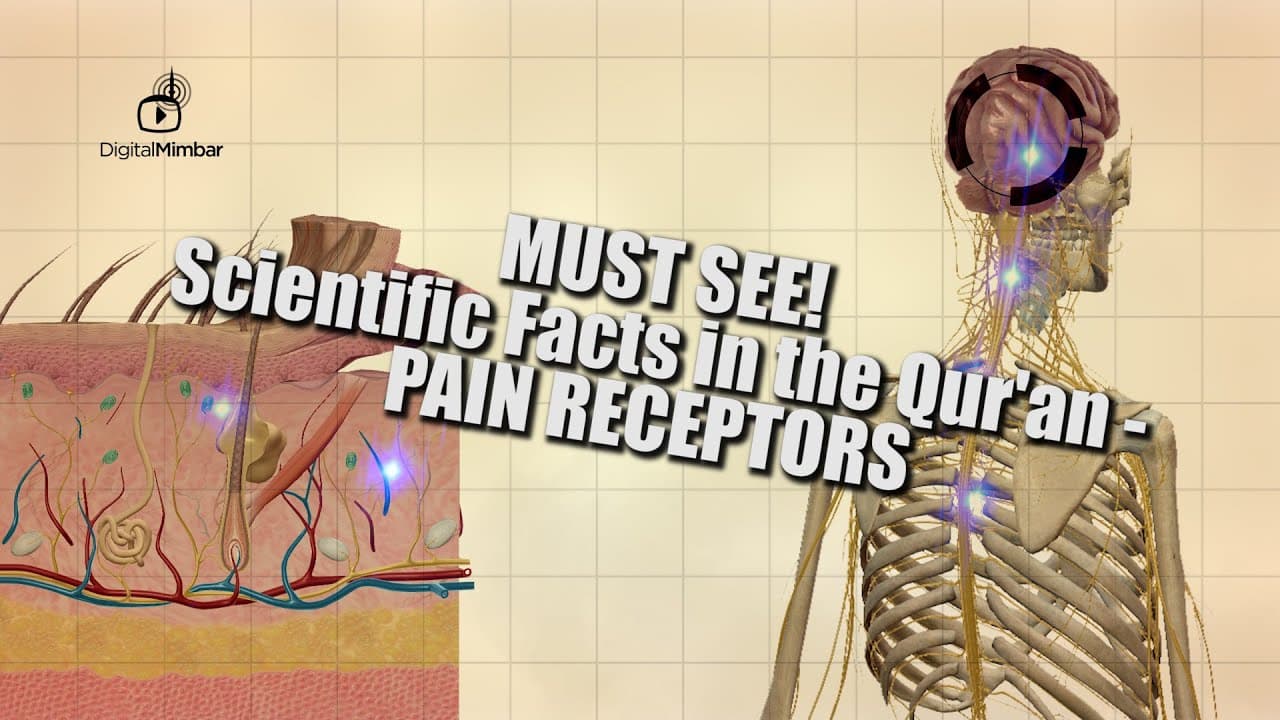
MUST SEE! Scientific Facts in the Qur'an - Pain Receptors
TL;DR
The Quran contains scientific facts about the sense of touch, specifically regarding pain receptors in the skin and their role.
Transcript
the Quran is not a book of science but a book of science yet it contains some undeniable facts related to science it wasn't until recently that pain receptors in the skin were discovered without these pain receptors a person would not be able to feel pain Allah mentioned this in the Quran over, 1400 years ago Allah said indeed those who disbelieve ... Read More
Key Insights
- 👨🎨 The Quran contains scientific knowledge about pain receptors in the skin that was discovered only recently.
- 🖐️ The skin's role extends beyond protection, as it plays a vital role in perceiving touch sensations.
- 👻 Touch receptors in the skin send signals to the spinal cord and brain, allowing us to sense and respond to our environment.
- ❓ Different areas of the body have varying sensitivity due to the presence of specialized touch receptors.
- 👨🎨 The skin also registers pain, warmth, and cold, with pain receptors being the most numerous.
- 👨🎨 Burns can damage the skin, affecting its ability to perceive touch and causing varying degrees of pain.
- 🫨 Third-degree burns, akin to the punishment described in the Quran, destroy the entire thickness of the skin and eliminate pain receptors.
Install to Summarize YouTube Videos and Get Transcripts
Explore YouTube Video Summarizer or Get YouTube Transcript Extractor
Questions & Answers
Q: How does the Quran mention pain receptors in the skin?
In a verse, Allah states that those who disbelieve will feel the punishment in a fire, with their skins being roasted and replaced repeatedly. This indicates Allah's knowledge of the dependence of pain on the skin and its receptors.
Q: What is the role of the skin in our body?
The skin acts as a protective barrier between our internal body systems and the outside world. It perceives touch sensations, providing us with information about the environment, such as temperature, pain, and pressure.
Q: How is the sense of touch significant?
Touch allows us to navigate the world around us. It enables us to feel the ground when we walk, sense sharp objects, and feel the warmth of the sun on our skin. It provides essential information for our survival and interaction with the environment.
Q: How does the structure of the skin contribute to touch perception?
The skin has three layers: the epidermis, dermis, and subcutaneous tissue. The epidermis is the outer layer and contains touch receptors. The dermis houses various touch receptors, blood vessels, nerve endings, and sweat glands. The subcutaneous tissue, composed of fat and connective tissue, acts as insulation and cushioning.
Summary & Key Takeaways
-
The Quran, despite being a religious book, contains scientific facts about the sense of touch, specifically pain receptors in the skin.
-
Pain receptors in the skin were discovered recently, but the Quran mentioned their existence over 1400 years ago.
-
Our skin acts as a protective barrier and allows us to perceive touch sensations such as pain, temperature, and pressure.
Read in Other Languages (beta)
Share This Summary 📚
Summarize YouTube Videos and Get Video Transcripts with 1-Click
Try YouTube Summary with ChatGPT & Claude or YouTube Transcript Generator
Explore More Summaries from Digital Mimbar 📚


Summarize YouTube Videos and Get Video Transcripts with 1-Click
Try YouTube Summary with ChatGPT & Claude or YouTube Transcript Generator