What is AMOC and could it trigger a tipping point
TL;DR
AMOC may be weakening because Greenland meltwater freshens the North Atlantic, reducing density and sinking, risking a slower, weaker current. The cold blob near Greenland warns of potential rapid, irreversible changes, while scientists use RAPID moorings to monitor current strength and assess future impacts on Europe and global climate.
Transcript
Picture the world 100 or 200 years from now, and what would you imagine? Hotter temperatures, melting glaciers, or Alpine places without the snow. But with heat waves happening across Europe this summer, it's not even that hard to visualize. Now picture Europe in a deep freeze, where temperatures hit -20° C in London. Both of these scenarios might ... Read More
Key Insights
- AMOC is a global heat transport system that moves heat from the tropics to higher latitudes, influencing climate patterns across the planet.
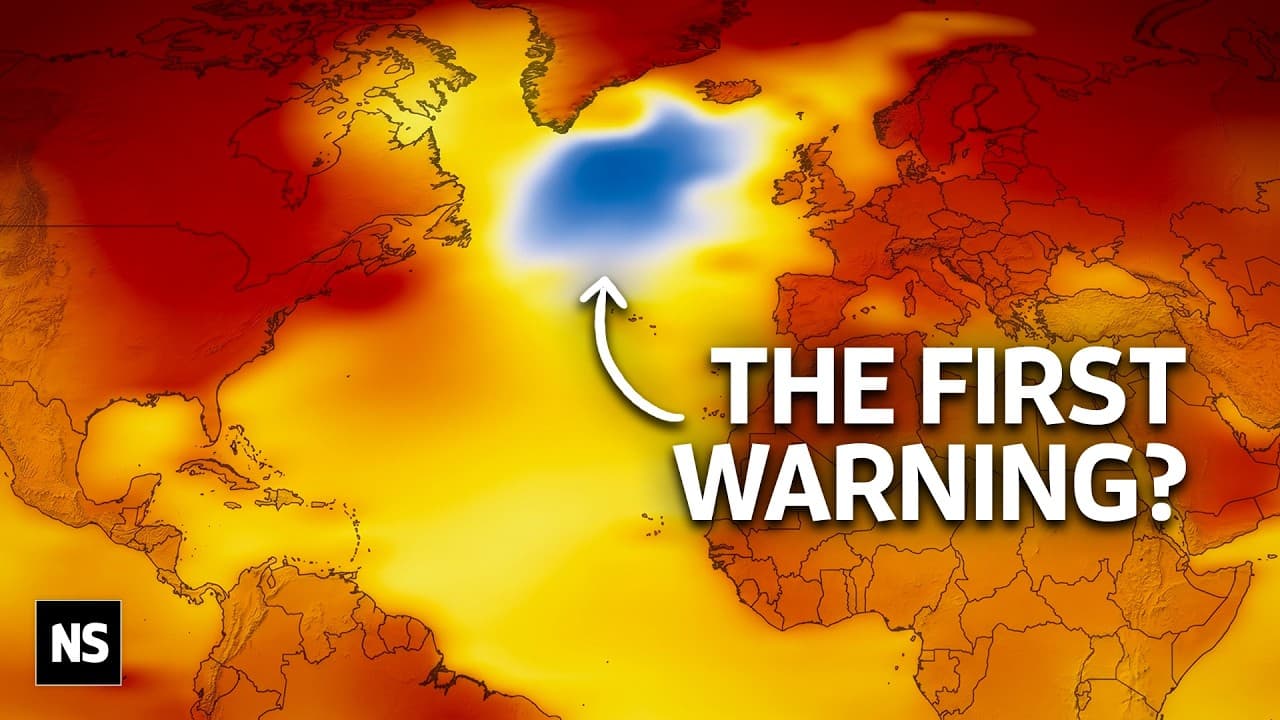
- The cold blob is a region south of Greenland where temperatures are cooling while the rest of the world warms, potentially indicating AMOC changes.
- Meltwater from Greenland reduces salinity and density in the North Atlantic, weakening the sinking process that drives AMOC.
- The Gulf Stream and North Atlantic Drift transport warm salty water northward, which then sinks and completes the overturning circulation.
- A weakening AMOC would cool the North Atlantic and could disrupt regional climates, including Western Europe, with broader global implications.
- RAPID is a network of deep water moorings that measure temperature, salinity, and velocity to estimate AMOC strength, enabling trend detection.
- Scientists face challenges in proving long term trends due to only two decades of direct measurements, requiring inference from multiple data sources.
- The video frames climate change as potentially non linear, with tipping points where gradual changes abruptly flip to new states.
Install to Summarize YouTube Videos and Get Transcripts
Explore YouTube Video Summarizer or Get YouTube Transcript Extractor
Questions & Answers
Q: What does AMOC stand for and why is it important for climate?
AMOC stands for Atlantic Meridional Overturning Circulation. It is described as a giant heat pump moving warm water northward and returning cold water southward along the ocean floor. This circulation distributes heat and carbon, helping to keep Western Europe milder than its latitude would suggest, and plays a major role in global climate regulation.
Q: What is the cold blob and what might it indicate about AMOC?
The cold blob is a patch in the North Atlantic just south of Greenland where temperatures have fallen while the rest of the planet warms. It is thought to be evidence that the AMOC is slowing down, which could signal a shift toward a less stable climate system with potential negative impacts globally.
Q: How does Greenland meltwater affect AMOC?
Meltwater from Greenland enters the North Atlantic and lowers salinity, making the water less dense. Less dense water sinks more slowly, weakening the overturning circulation and potentially reducing the northward transport of heat that keeps Europe warmer.
Q: Why is the AMOC considered a tipping point system?
The AMOC is considered a tipping point system because climate change might push it from a gradual change to a rapid, irreversible shift. Once a tipping point is crossed, the system could flip to a different state, with significant and long lasting consequences for weather, ecosystems, and economies.
Q: What role do RAPID moorings play in studying AMOC?
RAPID provides an observing system with long moorings that measure temperature, salinity, pressure, and flow across the Atlantic between the Canary Islands and Florida. By combining these sensors, scientists estimate the strength of the AMOC and monitor changes over time, despite the limited duration of direct measurements.
Q: What would happen if AMOC weakens for Europe and North America?
If the AMOC weakens, the North Atlantic would cool, reducing the warming impact that helps keep Western Europe milder. This could alter regional climates, affect crop yields, and influence weather extremes, with cascading effects on health, economy, and marine ecosystems.
Q: Why is there uncertainty about long term trends in AMOC?
There is uncertainty because direct, long term measurements from moorings have only spanned about 20 years so far. Scientists must rely on a combination of in situ observations, models, and indirect evidence to infer long term trends and assess potential tipping points.
Q: What is the broader message about climate change in this video?
The video emphasizes that climate change may not be a smooth, linear process. Some systems like AMOC could change abruptly if pushed toward a tipping point, creating more extreme weather and disruption. Monitoring and understanding these changes is essential to anticipate impacts and prepare accordingly.
Summary & Key Takeaways
-
The video explains the Atlantic Meridional Overturning Circulation, or AMOC, as a global heat pump that redistributes warm water and affects Europe’s climate.
-
Scientists identify a cooling patch called the cold blob in the North Atlantic, which may signal AMOC slowdown and a possible tipping point.
-
RAPID is an observing system using long moorings to measure temperature, salinity, and flow to estimate AMOC strength and track long term trends.
Read in Other Languages (beta)
Share This Summary 📚
Summarize YouTube Videos and Get Video Transcripts with 1-Click
Try YouTube Summary with ChatGPT & Claude or YouTube Transcript Generator
Explore More Summaries from New Scientist 📚


Summarize YouTube Videos and Get Video Transcripts with 1-Click
Try YouTube Summary with ChatGPT & Claude or YouTube Transcript Generator