What Is PDF For? PDF Document Exchange Explained, Computerphile
TL;DR
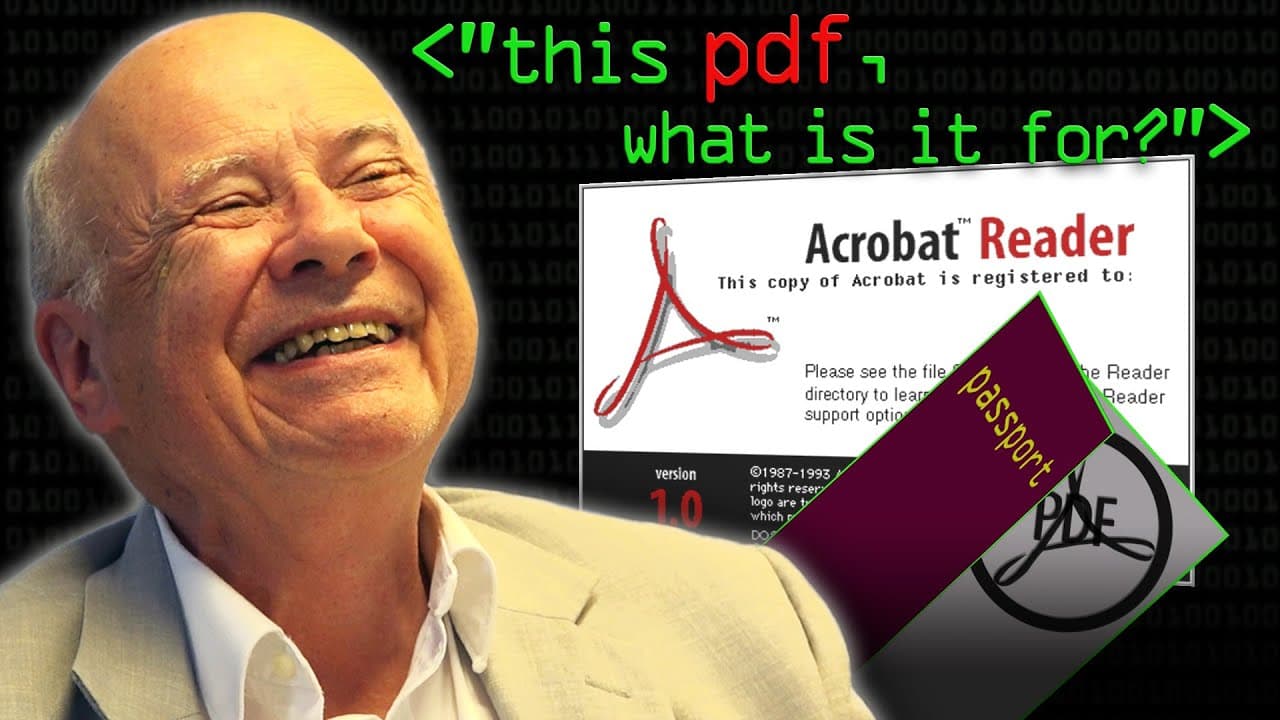
PDF is a general, high-quality document interchange format that preserves accurate, scalable graphics across different software, platforms, sizes, and resolutions. Newspapers valued reliable printing and previews, while engineers used PDF for scalable AutoCAD output. Adobe supported adoption by making Acrobat Reader free after spending $100 million on PDF. Read on to understand why PDF succeeded despite its difficult start.
Transcript
PDF has established itself as an interchange format now did people get it straight away as to what it was for was it like PostScript was relatively a howling roaring success from day one I mean people gonna wait to buy postscript in 1985 I'm not kidding they were pressing checks into Steve Jobs and John Moores hands saying how much how much I want ... Read More
Key Insights
- 😀 PDF faced initial challenges in market adoption but eventually became a widely used format.
- 📜 PDF's versatility in document exchange and scalability made it valuable for various industries.
- 🥶 Offering Acrobat Reader for free played a crucial role in PDF's widespread adoption.
- 💋 The success of PDF was celebrated within Adobe, marking a significant shift in revenue dominance from Photoshop to PDF.
- 👤 PDF's journey demonstrates the importance of understanding user needs and providing accessible solutions.
- 💨 PDF's success paved the way for its continued dominance in document interchange.
- ✋ The format's ability to maintain high-quality graphics across different sizes and resolutions was highly valued by users.
Install to Summarize YouTube Videos and Get Transcripts
Explore YouTube Video Summarizer or Get YouTube Transcript Extractor
Questions & Answers
Q: What is PDF for?
PDF is designed for exchanging documents through a general, high-quality format. It addresses problems caused by different software versions, Mac and PC systems, and people who prefer programs other than Microsoft Word.
Q: Why use PDF instead of sending Word files?
Word files could look different when opened with another version or on a different platform, such as Macintosh instead of PC. PDF provided a standard interchange route that was not tied to everyone using the same word-processing setup.
Q: Why is PDF useful for newspapers?
Newspapers need accurate documents that can print on enormous sheets while also being previewed at smaller sizes. PDF lets one document move between different sizes and resolutions while maintaining its quality.
Q: Why do engineers value PDF?
Engineers value PDF because its sophisticated, scalable graphics model preserves smooth shapes when drawings are enlarged. The speaker specifically describes PDF as useful for AutoCAD output, including architectural drawings and electronic circuit diagrams.
Q: Does a PDF lose quality when enlarged?
PDF is designed to preserve the quality of its scalable graphics as they are enlarged. A smooth circle should remain a smooth circle rather than breaking into dots, even when scaled to a much larger size.
Q: Why did Adobe make Acrobat Reader free?
Adobe concluded that people needed a reader to adopt PDF and that the reader had to be free. Charging for it would cause people to reject the format rather than use it.
Q: Was PDF successful immediately?
No, PDF was described as a long, uphill struggle rather than an overnight success. This contrasted with PostScript, which people were eager to buy from its launch in 1985.
Q: How much had Adobe spent on PDF during its early adoption struggle?
John Warnock told the speaker that Adobe had already spent $100 million on PDF. Despite the difficult adoption process, Adobe remained convinced that the format was the right solution.
Summary & Key Takeaways
-
Definition: PDF is a general, high-quality format for exchanging documents across different software versions and computer platforms.
-
Compare: PDF faced a long uphill adoption struggle, unlike PostScript, which was a roaring success from its launch in 1985.
-
When: Around 1996, a San Francisco immigration official asked the speaker what PDF was for.
-
Who: John Warnock and Chuck Geschke chose the Nottingham group as one of the first PDF beta test sites in early 93.
-
Number: Adobe had already spent $100 million on PDF during its difficult early adoption period.
-
Tool: Free Acrobat Reader gave people a way to read PDF files and helped encourage adoption.
-
Definition: PDF uses a sophisticated, scalable graphics model that preserves smooth shapes when documents are enlarged.
-
Who: Newspapers valued PDF for accurate printing, small previews, and movement between different sizes and resolutions.
-
Who: Engineers valued PDF for scalable AutoCAD output, including architectural drawings and electronic circuit diagrams.
-
Compare: Word files could vary across software versions, Macintosh and PC systems, while PDF offered a standard route for document exchange.
Read in Other Languages (beta)
Share This Summary 📚
Summarize YouTube Videos and Get Video Transcripts with 1-Click
Try YouTube Summary with ChatGPT & Claude or YouTube Transcript Generator
Explore More Summaries from Computerphile 📚




Summarize YouTube Videos and Get Video Transcripts with 1-Click
Try YouTube Summary with ChatGPT & Claude or YouTube Transcript Generator