What Are Penrose Patterns and Their Significance?
TL;DR
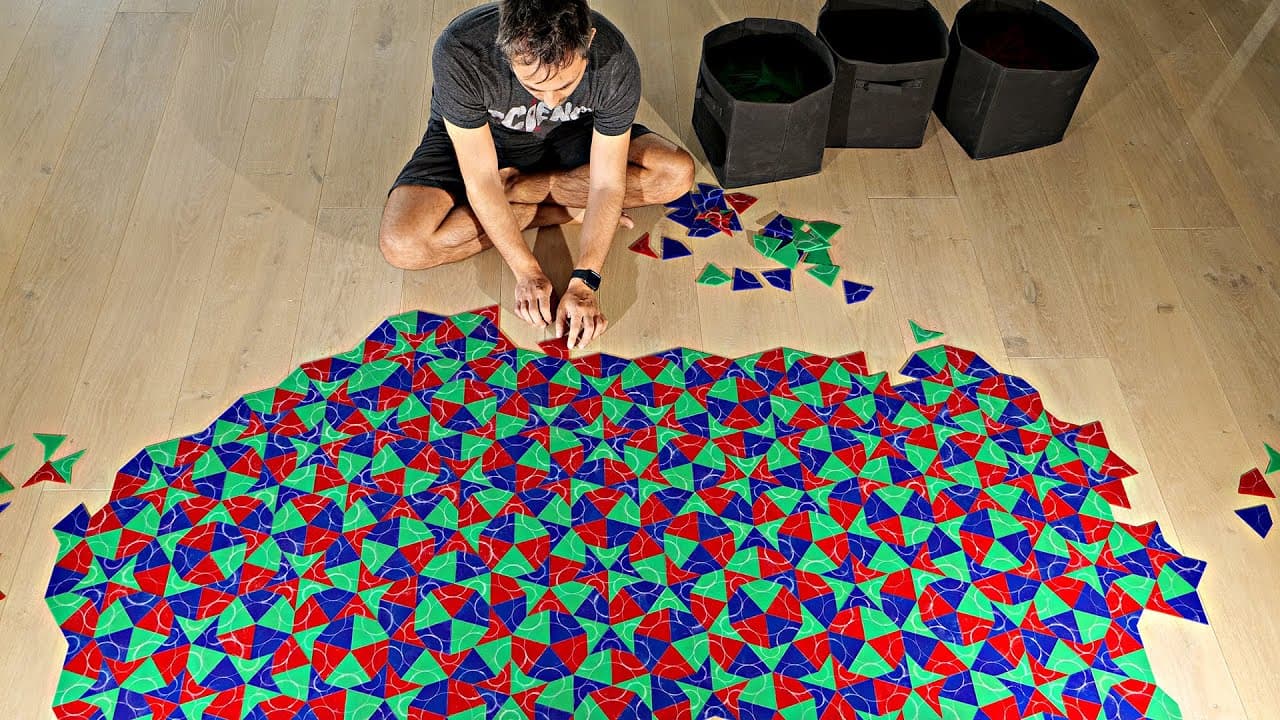
Penrose patterns are aperiodic tilings discovered by Roger Penrose, which allow for infinite patterns without repeating. These patterns challenge conventional notions of periodicity and symmetry in materials, leading to the discovery of quasi-crystals, a type of solid structure that defies traditional crystallography rules. Johannes Kepler's work on geometric arrangements laid the foundation for these significant advancements.
Transcript
a portion of this video was sponsored by lastpass this video is about a pattern people thought was impossible and a material that wasn't supposed to exist the story begins over 400 years ago in prague i'm now in prague and the czech republic which is perhaps my favorite european city that i've visited so far i'm going to visit the kepler museum bec... Read More
Key Insights
- 🪹 Johannes Kepler's discoveries, such as ellipses as planetary orbits and nested spheres for the solar system model, revolutionized our understanding of the universe.
- 😚 Kepler's investigations into optimizing the stacking of cannonballs contributed to the development of hexagonal close packing as an efficient arrangement.
- 🔮 Penrose tilings, inspired by Kepler's pentagon pattern, are a type of aperiodic tiling that led to the discovery of quasi-crystals, challenging established theories of crystal structure.
- 🥺 The discovery of quasi-crystals by Dan Schechtman initially faced skepticism but ultimately led to groundbreaking research and was recognized with a Nobel Prize.
Install to Summarize YouTube Videos and Get Transcripts
Explore YouTube Video Summarizer or Get YouTube Transcript Extractor
Questions & Answers
Q: What is the significance of Johannes Kepler's discoveries in relation to the solar system?
Kepler's realization that planetary orbits are ellipses revolutionized our understanding of the solar system and laid the foundation for modern astronomy.
Q: How did Kepler's fascination with geometry extend to practical applications?
Besides his astronomical pursuits, Kepler also explored practical questions, such as optimizing the stacking of cannonballs to minimize deck space on ships.
Q: What are Penrose tilings and why are they significant?
Penrose tilings are a type of aperiodic tiling that cannot repeat the same pattern infinitely. They have symmetries based on pentagons and have been used to create materials called quasi-crystals.
Q: How did the discovery of quasi-crystals challenge established theories of crystal structure?
Quasi-crystals, like Penrose tilings, defy the traditional principles of crystal structure. They have been found to possess long-range order based on vertex matching rules rather than edge-based rules.
Summary & Key Takeaways
-
Johannes Kepler, a famous scientist, discovered that planetary orbits are ellipses and utilized the concept of nested spheres and platonic solids to model the solar system.
-
Kepler's conjecture about the hexagonal close packing of cannonballs was proven correct after 400 years.
-
Kepler's investigations into pentagons led to the creation of the Penrose tiling pattern, a unique aperiodic tiling of the plane that defies periodicity.
Read in Other Languages (beta)
Share This Summary 📚
Summarize YouTube Videos and Get Video Transcripts with 1-Click
Try YouTube Summary with ChatGPT & Claude or YouTube Transcript Generator
Explore More Summaries from Veritasium 📚






Summarize YouTube Videos and Get Video Transcripts with 1-Click
Try YouTube Summary with ChatGPT & Claude or YouTube Transcript Generator