Magic T junction | S matrix | Example cases | Microwave Engineering | Lec-67
TL;DR
The video explores various input-output cases of the S Matrix for a Magic T Junction.
Transcript
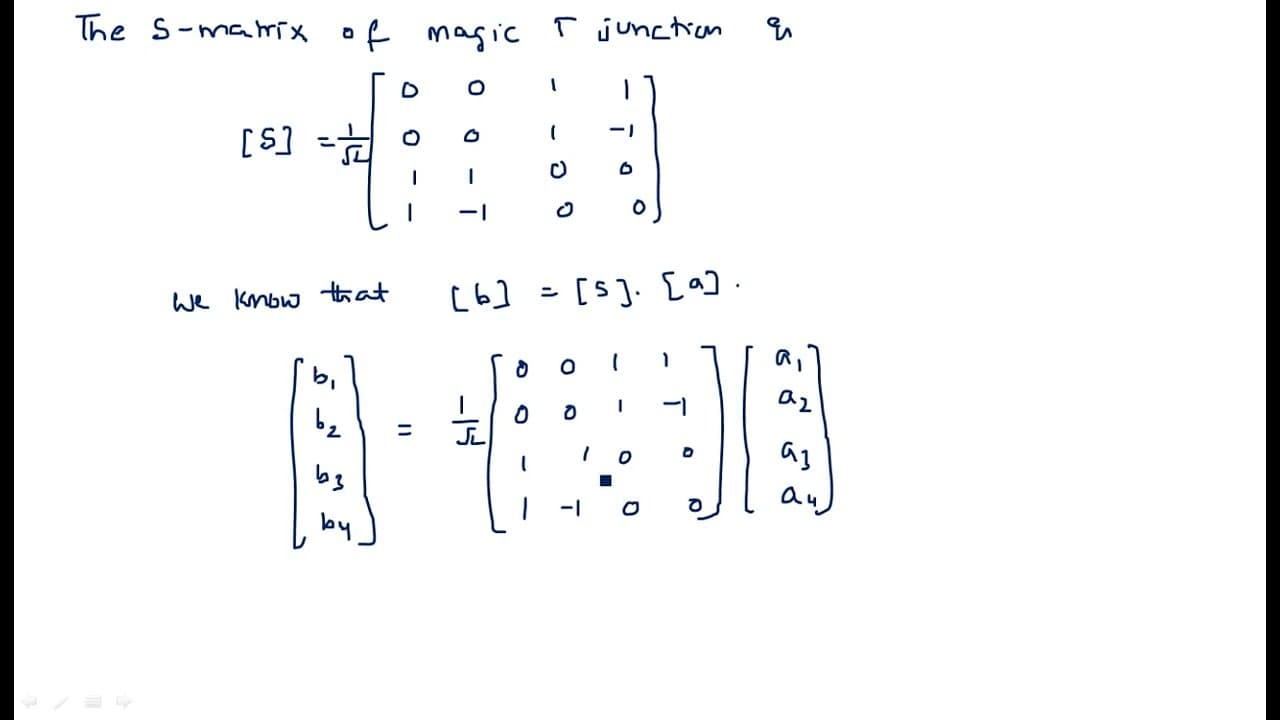
hi everyone in this video I am going to calculate various cases for S Matrix of Magic Tree Junction so various cases means what happens when input is applied at Port 1 which Port is acting as output Port what happens when input is operated Port 2 and Port 3 something like that we are taking different different cases and observing the characteristic... Read More
Key Insights
- 🇸🇹 The S Matrix of the Magic T Junction provides a structured way to analyze signal interactions across four distinct ports.
- ✈️ Different input configurations lead to unique output behaviors, revealing properties of H-plane and E-plane junctions effectively.
- 🔠 Outputs from Ports 1 and 2 are affected similarly when inputs are applied to Port 3, illustrating symmetrical behavior in certain situations.
- 🦖 The intersection of signals at Port 1 from Ports 3 and 4 highlights the Magic T Junction's ability to favor specific output pathways.
- 🚙 Isolated behavior is significant in ensuring that interference does not occur between certain ports during signal transmission.
- 📡 Additive properties ensure that the outputs reflect the combination of signals applied at multiple inputs, enhancing signal processing capabilities.
- 🥺 The junction's design leads to unique operational characteristics, making it a valuable component in advanced electronics.
Install to Summarize YouTube Videos and Get Transcripts
Explore YouTube Video Summarizer or Get YouTube Transcript Extractor
Questions & Answers
Q: What is the significance of the S Matrix in the context of the Magic T Junction?
The S Matrix, or scattering matrix, is crucial for analyzing the relationship between incoming and outgoing signals in the Magic T Junction. It encapsulates how an incident wave at one port influences reflected waves at other ports, providing a clear framework for understanding signal behavior in complex circuits.
Q: What happens when the input is applied at Port 3 of the Magic T Junction?
When an input is applied at Port 3 with no signals at the other ports, output signals are observed at Ports 1 and 2, with their values derived from the non-zero input. There is no output from Ports 3 and 4, illustrating the characteristics of the H-plane property of the junction.
Q: How does the input at Port 4 affect the outputs at other ports?
Input at Port 4 results in outputs at Ports 1 and 2, which are equal but opposite in phase. This behavior demonstrates the E-plane properties of the Magic T Junction, indicating how signals can be divided and manipulated based on the port configuration.
Q: What is the outcome when equal inputs are applied at Ports 3 and 4?
When equal inputs are applied at Ports 3 and 4, the output appears solely at Port 1, demonstrating additive properties where the junction combines incoming signals to produce a specific output without benefiting other ports.
Q: Can you explain the isolated nature of Ports 1 and 2?
Ports 1 and 2 are termed isolated because when an input is applied at either, there is no output from the opposite port. This unique behavior highlights the Magic T Junction's ability to prevent signal interference between these co-linear ports.
Q: What does the term "additive property" refer to in this context?
The additive property indicates that when multiple ports receive inputs, the outputs will reflect the mathematical sum of the inputs at the respective output port. It illustrates the junction's capacity to integrate signals effectively while ensuring specific output configurations.
Q: Why is the Magic T Junction referred to as "magic"?
The term "magic" is attributed to the junction's unique characteristics, where inputs at certain ports do not produce outputs from others despite being co-linear, highlighting a deliberate design aimed at specific signal routing without interference.
Q: What conclusions can be drawn from the analysis of various input scenarios?
The various case studies demonstrate that the Magic T Junction can selectively route signals, create isolation, and support additive properties. Understanding these behaviors provides insight into optimizing electronic circuit designs and signal distribution.
Summary & Key Takeaways
-
The Magic T Junction's S Matrix is a 4x4 representation used to analyze signal inputs and outputs from four ports, establishing relationships for incident and reflected waves.
-
Several scenarios are examined, including inputs at specific ports, leading to insights on how outputs are influenced by these inputs, showcasing unique properties of the junction.
-
The analysis concludes with a summary of key characteristics of the Magic T Junction, emphasizing the independence of certain ports when specific inputs are applied.
Read in Other Languages (beta)
Share This Summary 📚
Summarize YouTube Videos and Get Video Transcripts with 1-Click
Try YouTube Summary with ChatGPT & Claude or YouTube Transcript Generator