The mad scientist of music | Mark Applebaum
TL;DR
Boredom can ignite creativity in music composition by prompting composers to explore new roles and methods. By questioning traditional definitions of music and taking on diverse roles such as inventor and visual artist, composers can transform familiar works and create engaging experiences. This approach urges one to prioritize whether their work is interesting, rather than simply adhering to conventional expectations.
Transcript
Translator: Joseph Geni Reviewer: Thu-Huong Ha I thought if I skipped it might help my nerves, but I'm actually having a paradoxical reaction to that, so that was a bad idea. (Laughter) Anyway, I was really delighted to receive the invitation to present to you some of my music and some of my work as a composer, presumably because it appeals to my w... Read More
Key Insights
- 🎶 Boredom can serve as a catalyst for creativity and invention, pushing us to ask new questions in our disciplines.
- 🎹 Boredom with traditional music led the speaker to reimagine and personalize well-known compositions like Beethoven's, making them more interesting to him.
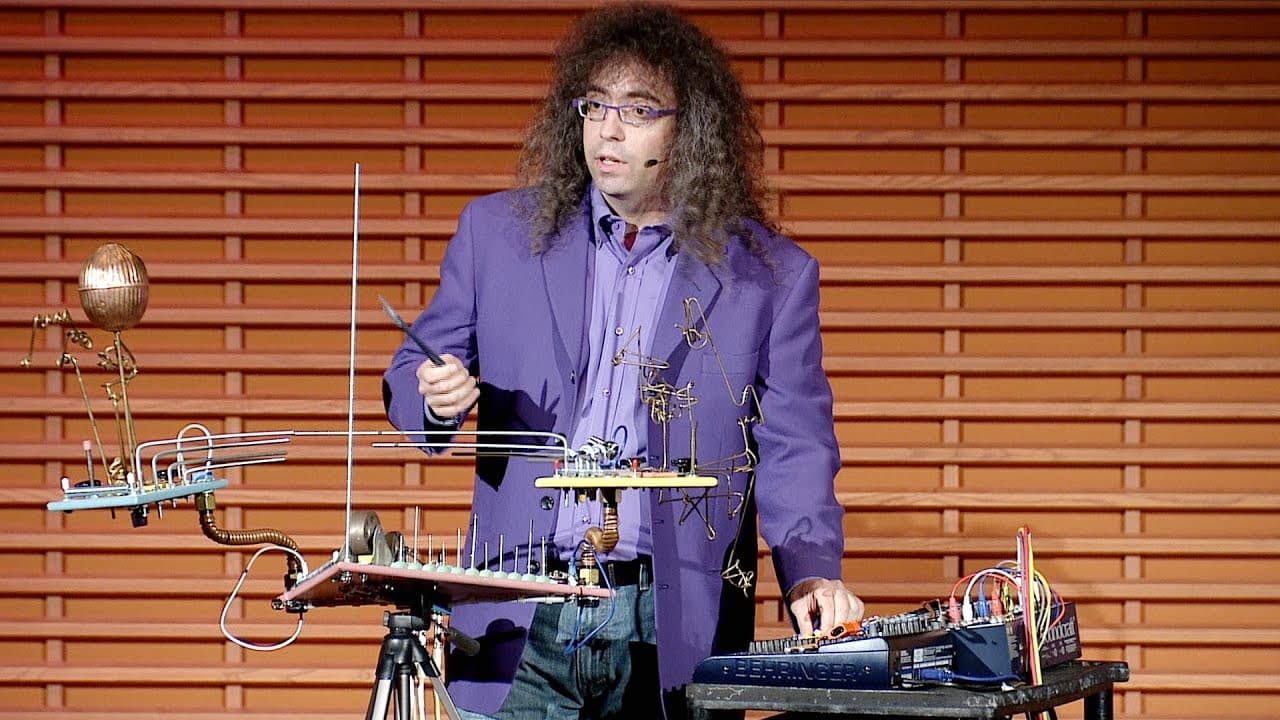
- 🎻 Boredom with familiar instruments inspired the speaker to design and construct their own unique instrument, resulting in a new sound world and the role of an inventor.
- 📝 Boredom with traditional notation led the speaker to explore alternative methods of notating music, such as creating pictographic scores and adapting everyday objects into musical notation.
- 🎨 Boredom with traditional definitions of music pushed the speaker to incorporate elements of visual art into their compositions, taking on the role of a visual artist.
- 🎭 The speaker also explores the role of a performance artist, incorporating theatrical elements into their compositions and taking on roles such as inventing unusual instruments or directing conductors without players.
- 💡 The fundamental question we should ask in our disciplines is not "Is it music?" but "Is it interesting?" Allowing creativity to push us in interesting directions can result in diverse roles and interdisciplinary work.
- 🧠 The speaker encourages embracing different roles in our work, even if they are adjacent or distant from our professional definition, as a way to push boundaries and foster innovation.
Install to Summarize YouTube Videos and Get Transcripts
Explore YouTube Video Summarizer or Get YouTube Transcript Extractor
Questions & Answers
Q: What is the focus of the speaker's presentation?
The speaker's focus is on boredom and how it has influenced his creativity and pushed him to take on various roles as a composer.
Q: How does the speaker transform the piece of music by Beethoven?
The speaker improvises and makes changes to the melody of Beethoven's piece to make it more interesting and less boring for himself.
Q: What role does the speaker take on when he plays his own instrument, the Mouseketeer?
The speaker takes on the role of an inventor and claims to be the world's greatest Mouseketeer player.
Q: How does the speaker challenge traditional notions of music composition?
The speaker creates unconventional musical scores using pictographic notations, adapted subway maps, and wristwatches, pushing the boundaries of what is considered music.
Q: What role does the speaker take on when incorporating theatric elements in his performances?
The speaker takes on the role of a performance artist, creating pieces with unconventional instrumentation and theatrical elements that blur the line between music and other art forms.
Q: What is the speaker's opinion on the question of whether his works can be considered music?
The speaker believes that the question of whether his works are music is not important. Instead, he focuses on whether his creations are interesting and personally engaging to him.
Summary
Composer and inventor Joel Engel talks about how he used boredom as a catalyst for creativity and invention in his work. He shares examples of how he transformed boring pieces of music into something more interesting and personalized, and how he eventually created his own instrument. He also discusses his role as a visual artist, scavenger, designer, performance artist, dramaturge, and choreographer, and how these different roles have expanded his creative possibilities. He emphasizes the importance of asking the question "Is it interesting?" rather than just "Is it music?" in order to push the boundaries of creativity.
Questions & Answers
Q: What was the focus of Joel Engel's presentation?
Joel Engel's presentation focused on how he used boredom as a catalyst for creativity and invention in his work as a composer.
Q: What role did Engel take on when he performed a piece by Beethoven?
When Joel Engel performed a piece by Beethoven, he took on the role of an interpreter.
Q: Why did Engel find Beethoven's piece boring?
Engel found Beethoven's piece boring because he had practiced it as a child and was tired of it.
Q: How did Engel transform Beethoven's piece to make it more interesting to him?
Engel transformed Beethoven's piece by substituting certain melodies and improvising on them, adding his own personal touch to the music.
Q: What did Engel do when he got bored of playing traditional instruments?
When Joel Engel got bored of playing traditional instruments, he started designing and constructing his own instruments, such as the Mouseketeer.
Q: What is interesting about the Mouseketeer instrument?
The Mouseketeer instrument, created by Joel Engel, has a unique sound world and allows him to take on the role of an inventor. He can play it in various ways and use live electronics to change the sounds.
Q: What are some other roles Engel has taken on in his work?
Besides being a composer and inventor, Joel Engel has also taken on the roles of a visual artist, scavenger, designer, performance artist, dramaturge, and choreographer.
Q: How has Engel incorporated visual art into his compositions?
Engel has incorporated visual art into his compositions by creating scores with pictographic notations, adapting everyday objects like wristwatches into musical scores, and using unconventional graphical representations in his scores.
Q: What is Engel's approach to creativity and pushing boundaries in his work?
Engel's approach to creativity is to ask the question "Is it interesting?" rather than just "Is it music?" He believes in exploring different roles and challenging the conventional definition of music composition, allowing his creativity to push him in innovative directions.
Q: What is the main takeaway from Engel's presentation?
The main takeaway from Joel Engel's presentation is to consider changing the fundamental question in one's discipline and to explore different roles in order to expand creative possibilities. It's important to focus on what is interesting rather than adhere to traditional definitions or paradigms.
Summary & Key Takeaways
-
The speaker discusses how they used boredom as a catalyst for creativity and invention in their work as a composer.
-
The speaker takes on different roles, such as interpreter, inventor, visual artist, performance artist, and dramaturge, in order to make their music more interesting and less boring.
-
The speaker encourages the audience to change the fundamental question in their own discipline and consider taking on different roles in their work.
Read in Other Languages (beta)
Share This Summary 📚
Summarize YouTube Videos and Get Video Transcripts with 1-Click
Try YouTube Summary with ChatGPT & Claude or YouTube Transcript Generator
Explore More Summaries from TED 📚

Summarize YouTube Videos and Get Video Transcripts with 1-Click
Try YouTube Summary with ChatGPT & Claude or YouTube Transcript Generator