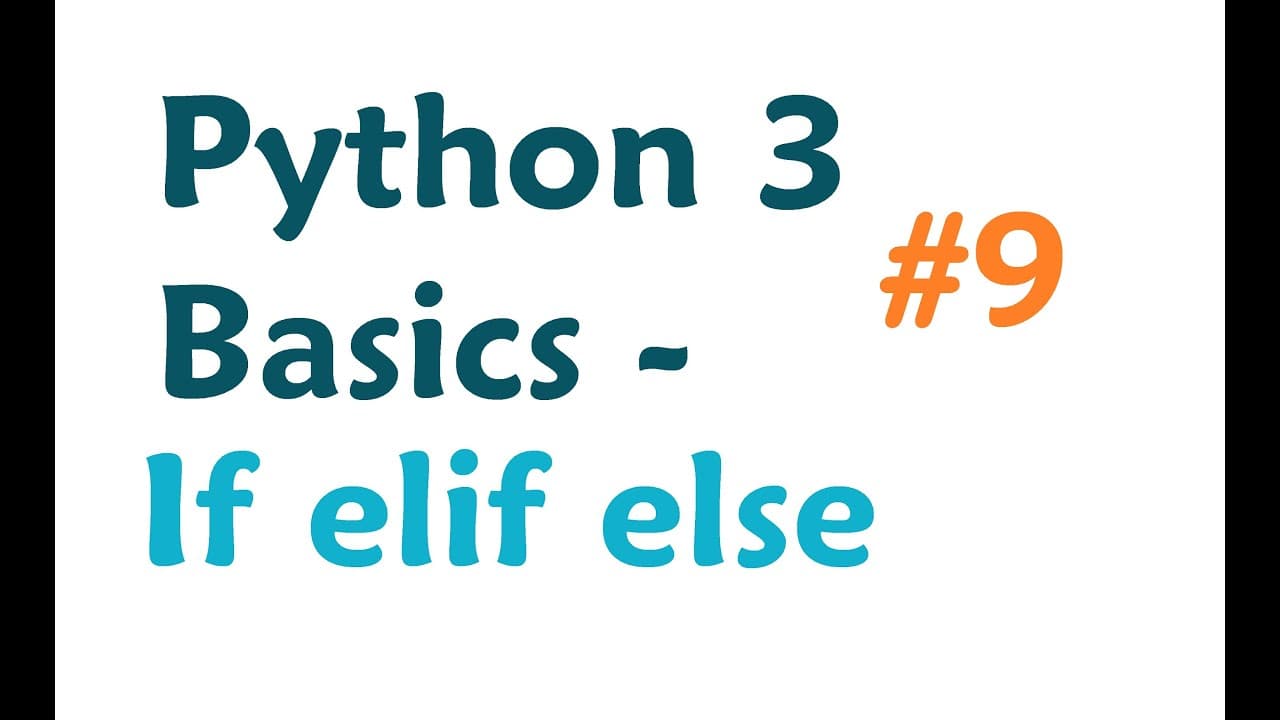
How to Use If, Elif, and Else Statements in Python
TL;DR
The if, elif, and else statements in Python allow for adding complex conditional logic to your code. The elif statement enables you to check multiple conditions in sequence, improving code readability and efficiency. Using elif prevents unnecessary nested structures and ensures that only the first true condition's block executes.
Transcript
what's going on everybody and welcome to my if L if else tutorial video for Python 3 the idea of this is to add yet another layer of logic to our pre-existing if and now else statement see with our typical if else statement the if will be checked for sure uh and the else will only run if the if fails but what if you wanted to check multiple if stat... Read More
Key Insights
- 👻 The elif statement is an important addition to Python's conditional logic, allowing for multiple conditions to be checked sequentially and their associated blocks to be executed.
- 🪡 Writing multiple if statements separately can be a valid approach if each condition needs to be checked individually, without any logical grouping.
- 💨 The elif statement provides a cleaner and more efficient way to handle complex conditions and execute code accordingly.
- 👨💻 Using the elif statement can improve code readability and maintainability, as it reduces the need for nested if-else statements.
- 💄 Python's elif statement shares similarities with else if statements in other programming languages, making the language more familiar to developers.
- 👨💻 The elif statement enhances the flexibility and versatility of Python's conditional statements, enabling more sophisticated decision-making in code.
- 🥺 Proper usage of the elif statement can lead to more efficient and concise code, reducing the complexity and potential for errors.
Install to Summarize YouTube Videos and Get Transcripts
Explore YouTube Video Summarizer or Get YouTube Transcript Extractor
Questions & Answers
Q: What is the purpose of the L if statement in Python 3?
The elif statement provides a way to check multiple conditions sequentially. It is useful when you want to execute different blocks of code based on different conditions without writing separate if statements for each condition.
Q: Can multiple if statements be written separately instead of using the elif statement?
Yes, multiple if statements can be written separately. However, this approach is not recommended if you want all the if statements to be checked individually. In such cases, the elif statement should be used to maintain a logical grouping.
Q: How does the elif statement differ from the traditional if-else statement?
The elif statement allows for multiple conditions to be checked in sequence. It will execute the block of code associated with the first condition that evaluates to True and skip the rest. In contrast, the else block of the if-else statement only runs when the initial if condition fails.
Q: Can the elif statement be used with other comparison operators like "<=" or ">="?
Yes, the elif statement can be used with any comparison operator, such as "<=", ">=", or "!=". It allows for more complex conditional expressions to be evaluated and executed based on the outcome.
Summary & Key Takeaways
-
This tutorial introduces the concept of if, else, and elif statements in Python 3 to add more complex logic to code.
-
The traditional if-else statement only runs the else block if the if condition fails, but multiple if statements can be written separately if each statement needs to be checked individually.
-
The elif statement, short for "else if", allows for multiple conditions to be checked and executed in sequence.
Read in Other Languages (beta)
Share This Summary 📚
Summarize YouTube Videos and Get Video Transcripts with 1-Click
Try YouTube Summary with ChatGPT & Claude or YouTube Transcript Generator
Explore More Summaries from sentdex 📚


Summarize YouTube Videos and Get Video Transcripts with 1-Click
Try YouTube Summary with ChatGPT & Claude or YouTube Transcript Generator