Why Were Ancient Pyramids Built Worldwide?
TL;DR
Pyramids may have served purposes beyond royal burial, including celestial alignment, energy generation, and religious connection to the gods, according to theories presented in the episode. Their worldwide distribution, stable geometry, precise construction, and recurring links to Orion support the program’s controversial proposal that ancient cultures shared advanced knowledge, possibly received from common or extraterrestrial teachers.
Transcript
[tense music] NARRATOR: Mysterious structures located all over the world-- GIORGIO TSOUKALOS: It's as if all these ancient builders went to the same school. NARRATOR: --magnificent monuments emitting powerful energy. WILLIAM HENRY: When you go inside it, you have the feeling like you are in the hands of an extraordinary intelligence. NARRATOR: Did ... Read More
Key Insights
- Pyramids are a worldwide architectural phenomenon, with examples identified across five continents in places including Egypt, Sudan, India, China, Indonesia, Cambodia, Central America, Peru, and Bolivia. Their shapes vary, but recurring geometric features prompt questions about independent invention, cultural exchange, or shared instruction.
- A pyramid is an inherently stable structure because its broad base and narrowing sides support substantial height. Physicist Michael Dennin presents this practical engineering advantage as a straightforward reason that unrelated civilizations might independently choose pyramidal forms when constructing tall monuments.
- The Great Pyramid is an exceptionally large engineering project, standing about 480 feet high, covering 13 acres, and incorporating roughly 2.5 million stone blocks. Some stones weigh 70 tons, while granite used in the structure was quarried about 500 miles away.
- The Great Pyramid’s identification as a royal tomb remains disputed within the episode because no body was found inside it. Contributors also cite sealed pyramids discovered during the 1950s whose intact sarcophagi reportedly contained no corpse or coffin, challenging explanations based solely on grave robbery.
- The Great Pyramid has a subtly concave, eight-sided form that becomes visible from above through shadows at dawn and sunset during the spring and autumn equinoxes. The episode interprets this effect as evidence that its builders understood solar cycles, mathematics, and precise architectural design.
- The Great Pyramid is described as nearly aligned with magnetic north, while internal shafts are associated with Orion and Sirius. One shaft is said to point toward Orion’s Belt, which contributors connect to the Egyptian belief that a deceased king would become a star in Orion.
- The Giza and Teotihuacan complexes are presented as celestial maps designed according to similar principles. The episode claims that three major structures at each site correspond to Orion’s Belt, while Teotihuacan’s broader arrangement is also interpreted as representing the solar system.
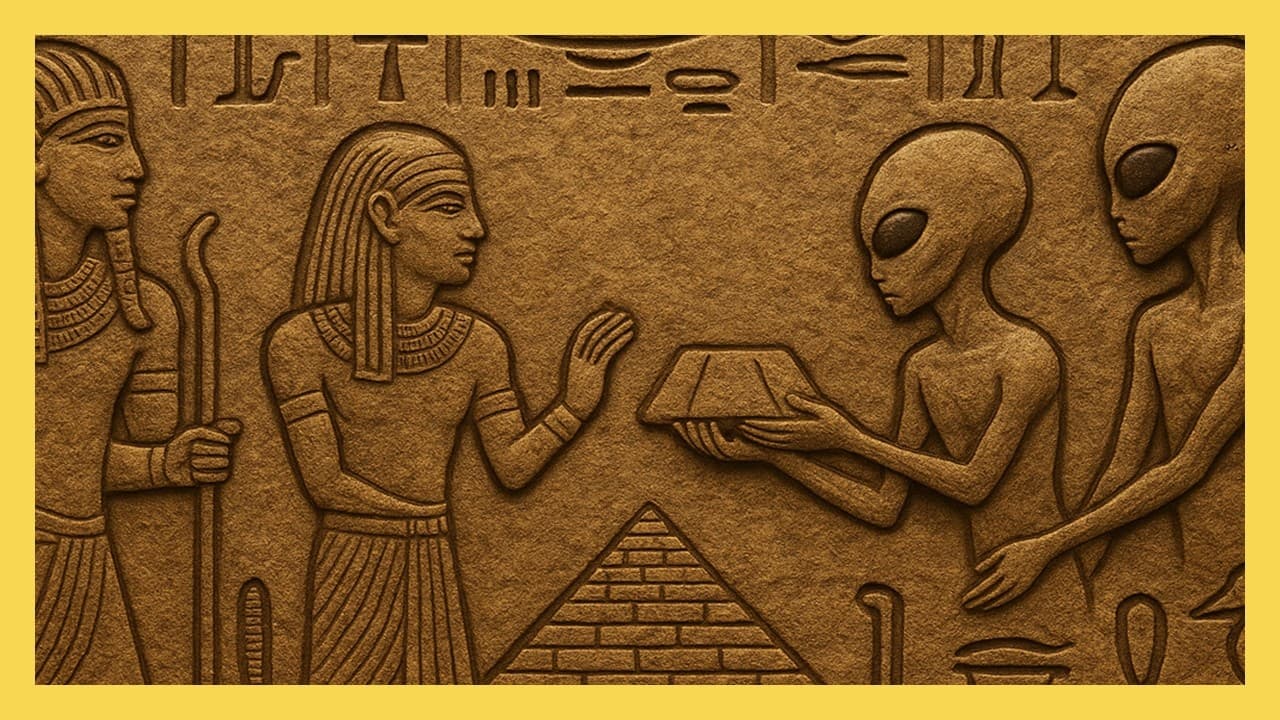
- The extraterrestrial blueprint theory is presented as a speculative explanation for similarities among ancient pyramids. Supporters argue that legends about gods providing architectural knowledge, including traditions involving Thoth and Imhotep, could describe advanced teachers who influenced multiple civilizations.
Install to Summarize YouTube Videos and Get Transcripts
Explore YouTube Video Summarizer or Get YouTube Transcript Extractor
Questions & Answers
Q: Why did ancient civilizations build pyramids worldwide?
The episode presents several possible explanations for the worldwide construction of pyramids. Their geometry provides a stable way to build tall structures, so different cultures may have developed the form independently. Contributors also propose cultural travel, inheritance from an earlier civilization, shared measurement systems, instruction from common teachers, or knowledge delivered by beings remembered as gods. The extraterrestrial explanation is presented as a controversial theory, not an established conclusion.
Q: Was the Great Pyramid of Giza built as a tomb?
Mainstream archaeologists are described as dating the Great Pyramid to around 2,500 BC and interpreting it as the burial tomb of Pharaoh Khufu. The episode challenges an exclusively funerary purpose because no body was found inside the pyramid. It also cites sealed pyramids discovered in the 1950s with intact sarcophagi but no corpse or coffin, leading contributors to consider whether pyramids provided a broader benefit to their builders.
Q: How large is the Great Pyramid of Khufu?
The Great Pyramid is described as approximately 480 feet high and covering 13 acres. Its construction involved about 2.5 million stone blocks and a total mass of roughly six million tons. The heaviest stones reportedly weigh 70 tons, and thousands of tons of granite were transported from quarries about 500 miles away. Contributors use this scale and resource investment to question whether the monument served only as a tomb.
Q: Why does the Great Pyramid appear to have eight sides?
The Great Pyramid’s four main faces are described as slightly concave, creating an eight-sided form. This feature is visible most clearly from above at dawn and sunset during the spring and autumn equinoxes, when sunlight casts revealing shadows across the faces. The episode argues that this carefully timed effect indicates knowledge of the solar cycle, sophisticated mathematics, and an architectural feature designed to produce a specific visual phenomenon.
Q: How is the Great Pyramid aligned with stars?
The Great Pyramid is described as almost perfectly aligned with magnetic north and containing four narrow shafts arranged along a north-south axis. The episode says that particular shafts align with Orion and Sirius, including one directed toward the passage of Orion’s Belt. Some contributors interpret these features as celestial or spiritual connections, especially because Egyptian pyramid builders reportedly believed that the king would become a star in Orion.
Q: What similarities connect the Giza and Teotihuacan pyramids?
The episode claims that both the Giza Plateau and Teotihuacan were designed according to celestial layouts. At Giza, the three pyramids are interpreted as corresponding to the three stars of Orion’s Belt. At Teotihuacan, the Temple of the Sun, Temple of the Moon, and Temple of Quetzalcoatl are said to follow the same pattern. Contributors also interpret Teotihuacan’s larger design as a representation of the solar system.
Q: Did ancient cultures share knowledge about pyramid building?
Contributors argue that recurring pyramid shapes, geometry, measurement systems, and celestial alignments may indicate shared knowledge. They compare structures in Italy with Giza, an Indonesian temple with Chichen Itza, and a Cambodian Hindu temple with a Maya temple at Tikal. Proposed explanations include travel between ancient cultures, influence from an earlier civilization, or teaching by a common group. The episode does not establish which explanation is correct.
Q: What evidence does the episode offer for an alien pyramid blueprint?
The episode combines architectural similarities, precise astronomical alignments, global distribution, and traditions about gods teaching construction. It says Egyptian and Mayan legends describe gods providing instructions for pyramids, identifies Thoth as an architect of the universe, and reports that Imhotep accessed information from another reality. Ancient astronaut theorists interpret such accounts as possible memories of extraterrestrial teachers, but the program presents this as a speculative conclusion rather than demonstrated proof.
Summary & Key Takeaways
-
Pyramids appear across Egypt, Central America, Peru, Bolivia, India, China, Indonesia, Cambodia, Sudan, and various islands. Although their forms differ, many share comparable geometry and measurement systems. The episode considers practical structural stability, cultural contact, inheritance from an earlier civilization, and instruction by common teachers as possible explanations for these similarities.
-
The Great Pyramid of Khufu is presented as a structure whose immense scale raises questions about its purpose. It stands about 480 feet high, covers 13 acres, and contains approximately 2.5 million stone blocks. Because no body was found inside, contributors dispute the conventional identification of the monument exclusively as Pharaoh Khufu’s tomb.
-
The episode connects pyramid architecture with astronomy, energy, religion, and speculative extraterrestrial intervention. It highlights the Great Pyramid’s equinox shadows, alignment with magnetic north, and shafts directed toward Orion and Sirius. Comparisons with Teotihuacan support the proposed celestial pattern, while later chapters consider pyramid energy, Mayan gods, interdimensional portals, and an extraterrestrial blueprint.
Read in Other Languages (beta)
Share This Summary 📚
Summarize YouTube Videos and Get Video Transcripts with 1-Click
Try YouTube Summary with ChatGPT & Claude or YouTube Transcript Generator
Explore More Summaries from HISTORY 📚






Summarize YouTube Videos and Get Video Transcripts with 1-Click
Try YouTube Summary with ChatGPT & Claude or YouTube Transcript Generator