A Deep Dive Into The Bizarre Future of Telescopes
TL;DR
The future of space exploration lies in the development of powerful telescopes, such as the Extremely Large Telescope and the Square Kilometer Array, both of which aim to answer fundamental questions about the universe. New designs, like liquid mirror telescopes and the possibility of harnessing the Sun's gravitational lensing, also offer exciting prospects.
Transcript
People have always wondered what’s out there. What’s on the other side of an ocean, or what’s on the other side of the universe. And when it comes to space, we’ve done a lot more than wonder. Our curiosity began with people staring up at the night sky with just their eyeballs and making mental notes of how things changed as the weeks rolled by. Tod... Read More
Key Insights
- ✋ Telescopes like the Extremely Large Telescope and the Giant Magellan Telescope are pushing the boundaries of size and precision to capture high-quality images of cosmic objects.
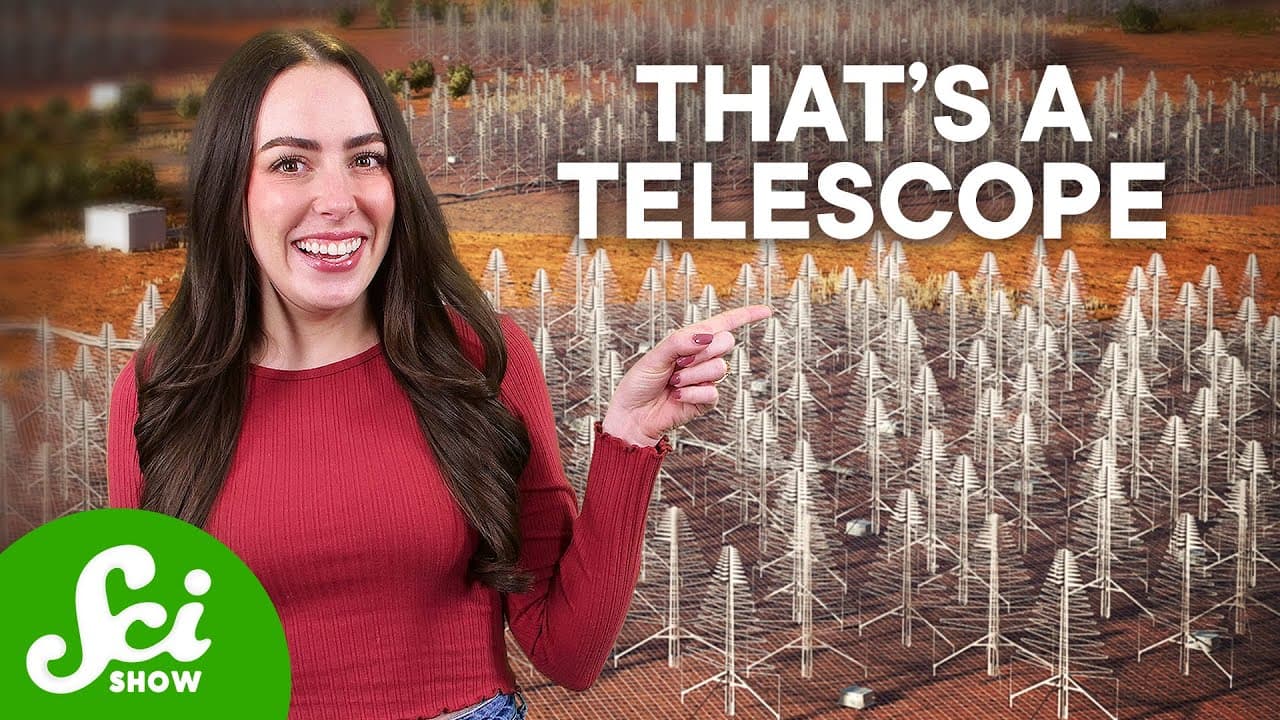
- 🤩 The Square Kilometer Array Observatory (SKAO) aims to study the first billion years of the universe by detecting radio waves and exploring phenomena like star formation and galactic evolution.
- 🙂 Space telescopes, such as Origins, LUVOIR, HabEx, and Athena, are being developed to observe different wavelengths of light and focus on a range of scientific objectives, from studying exoplanets to capturing detailed images of distant objects.
- 🔭 Future telescope concepts include miniaturized telescopes like SPIDER, lunar-based telescopes using crater dishes, liquid mirror telescopes, and even harnessing the Sun's gravitational lensing effect for observations.
Install to Summarize YouTube Videos and Get Transcripts
Explore YouTube Video Summarizer or Get YouTube Transcript Extractor
Questions & Answers
Q: What are the Extremely Large Telescope and the Giant Magellan Telescope designed to do?
Both telescopes are ground-based and designed to capture visible, ultraviolet, and infrared wavelengths of light from distant objects in the universe. They aim to tackle various scientific questions and study everything from our own solar system to the birth of galaxies.
Q: How will the Extremely Large Telescope overcome the challenges of combining 798 individual mirrors?
The Extremely Large Telescope will utilize 798 individual mirrors to create a structure 39 meters wide. To keep the mirrors moving in perfect sync, the telescope will employ about 9,000 highly accurate sensors. This precision ensures that the entire structure remains stable and the mirrors do not warp, allowing for crisp and high-quality images.
Q: What is the primary goal of the Square Kilometer Array (SKAO) Observatory?
The SKAO aims to detect radio waves from the first billion years of the universe. It will focus on studying the birth and death of stars, as well as the origins of galaxies. By observing radio waves, the SKAO hopes to shed light on cosmic phenomena that cannot be observed with other types of telescopes.
Q: What is the purpose of the Origins space telescope?
Origins is a future space telescope focused on observing infrared light. Its primary goal is to study exoplanets and determine their habitability by analyzing the composition of their atmospheres. Origins will look for compounds like methane, carbon dioxide, ozone, and water vapor to assess the potential for supporting life as we know it.
Summary & Key Takeaways
-
Ground-based telescopes like the Extremely Large Telescope and the Giant Magellan Telescope in Chile's Atacama Desert are being designed to capture visible light, ultraviolet light, and infrared wavelengths from distant objects in the universe, with the aim of unraveling the mysteries of the cosmos.
-
The Square Kilometer Array (SKAO) in South Africa and western Australia will focus on detecting radio waves to study the first billion years of the universe, including the origins of stars and galaxies.
-
Space telescopes like Origins, LUVOIR, HabEx, and Athena are being developed to observe various wavelengths of light, including infrared, visible, ultraviolet, and X-rays. They aim to study exoplanets, investigate the habitability of other worlds, and capture clearer images of cosmic objects.
-
Future telescope concepts include SPIDER, a miniaturized space telescope; the Lunar Crater Radio Telescope, which proposes using a lunar crater as a radio telescope dish; liquid mirror telescopes that utilize spinning liquid to create a curved mirror; and the ambitious idea of utilizing the Sun's gravitational lensing to observe distant objects in unprecedented detail.
Read in Other Languages (beta)
Share This Summary 📚
Summarize YouTube Videos and Get Video Transcripts with 1-Click
Try YouTube Summary with ChatGPT & Claude or YouTube Transcript Generator
Explore More Summaries from SciShow 📚

Summarize YouTube Videos and Get Video Transcripts with 1-Click
Try YouTube Summary with ChatGPT & Claude or YouTube Transcript Generator