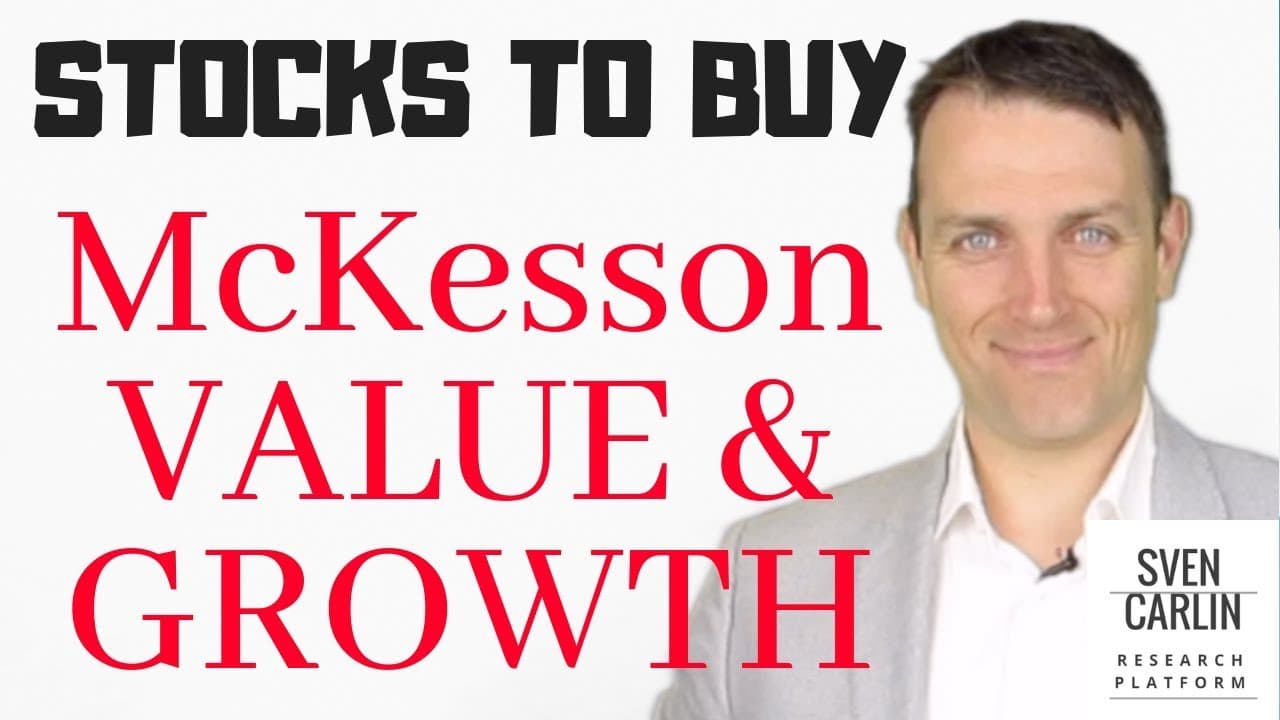
Is McKesson (MCK) One of 3 Stocks to Buy in December 2018?, Part 1
TL;DR
McKesson is presented as a potential value investment because it generates substantial cash flow, requires relatively little capital, and holds one-third of North America’s prescription-medicine distribution market. In 2018, it had $208 billion in revenue, while its share price had fallen from $242 to around $120 despite relatively stable fundamentals. Read on for the bull case, expected returns, and key risks.
Transcript
good day fellow investors it's the end of the month and it's customs for a YouTube channel investing channel to make the free stocks to buy in the next month last month I made free contrarian plays with a gold mine or copper miner this month I want to focus on great businesses I'll separate this series in three parts so that we can really dedicate ... Read More
Key Insights
- 💪 McKesson is a defensive investment in the pharmaceutical distribution industry, with a strong market position and steady revenue growth.
- 😘 The company has a high return on invested capital of 12% and a low valuation, making it an attractive investment opportunity.
- ✳️ Risks include the threat of Amazon entering the market and potential fines related to the opioid epidemic.
Install to Summarize YouTube Videos and Get Transcripts
Explore YouTube Video Summarizer or Get YouTube Transcript Extractor
Questions & Answers
Q: Why was McKesson (MCK) considered a stock to buy in December 2018?
McKesson was presented as a value opportunity because its share price had fallen from a high of $242 to around $120 while its business fundamentals had not changed substantially. The company also produced significant free cash flow, required relatively little capital spending, and operated in a defensive pharmaceutical-distribution market.
Q: What does McKesson’s business do?
McKesson distributes pharmaceuticals in the United States, Canada, and to a lesser extent Europe. It delivered one-third of all prescription medicine in North America, giving it a significant market position.
Q: How large was McKesson’s business in 2018?
McKesson generated $208 billion in revenue in 2018. Although pharmaceutical distribution operates on thin margins, the company produced $3.8 billion in cash flow.
Q: Why was McKesson viewed as a defensive or recession-proof business?
The investment case was that people continue to need pharmaceuticals regardless of economic conditions. Its exposure to an aging population also placed McKesson in a sector with continuing demand.
Q: How had McKesson’s fundamentals changed over the previous 10 years?
Revenue had grown steadily and doubled over the previous 10 years, while gross margins and operating income remained relatively stable. The dividend payout tripled during the same period.
Q: How had McKesson returned capital to shareholders?
McKesson increased dividends and repurchased shares, reducing shares outstanding from 270 million to 204 million over 10 years. It also had approximately $4.2 billion in remaining buyback authorization and a reported return on capital of 12%.
Q: What was the cash-flow valuation case for McKesson?
McKesson’s market capitalization was about $24.5 billion, and annual free cash flow was expected to be roughly $2.5 billion to $3 billion. Assuming no growth, the argument was that the company could generate an amount equal to its market capitalization in free cash flow within about eight or nine years.
Q: What were the main risks to investing in McKesson?
A major competitive concern was whether Amazon or similar entrants could disrupt pharmaceutical distribution and weaken McKesson’s moat. Other identified risks included possible fines and regulation connected to the opioid epidemic.
Summary & Key Takeaways
-
McKesson is a pharmaceutical distributor with $208 billion in revenues in 2018 and one-third market share in prescription medicine in North America.
-
The company has steady revenue growth, stable gross margins, and tripled its dividend payout over the past 10 years.
-
With a strong moat in the market, McKesson has a low valuation, high free cash flows, and a return on capital of 12%, making it an attractive investment option.
Read in Other Languages (beta)
Share This Summary 📚
Summarize YouTube Videos and Get Video Transcripts with 1-Click
Try YouTube Summary with ChatGPT & Claude or YouTube Transcript Generator
Explore More Summaries from Value Investing with Sven Carlin, Ph.D. 📚
Summarize YouTube Videos and Get Video Transcripts with 1-Click
Try YouTube Summary with ChatGPT & Claude or YouTube Transcript Generator