How to Go Viral With Just 3 Posts Per Week
TL;DR
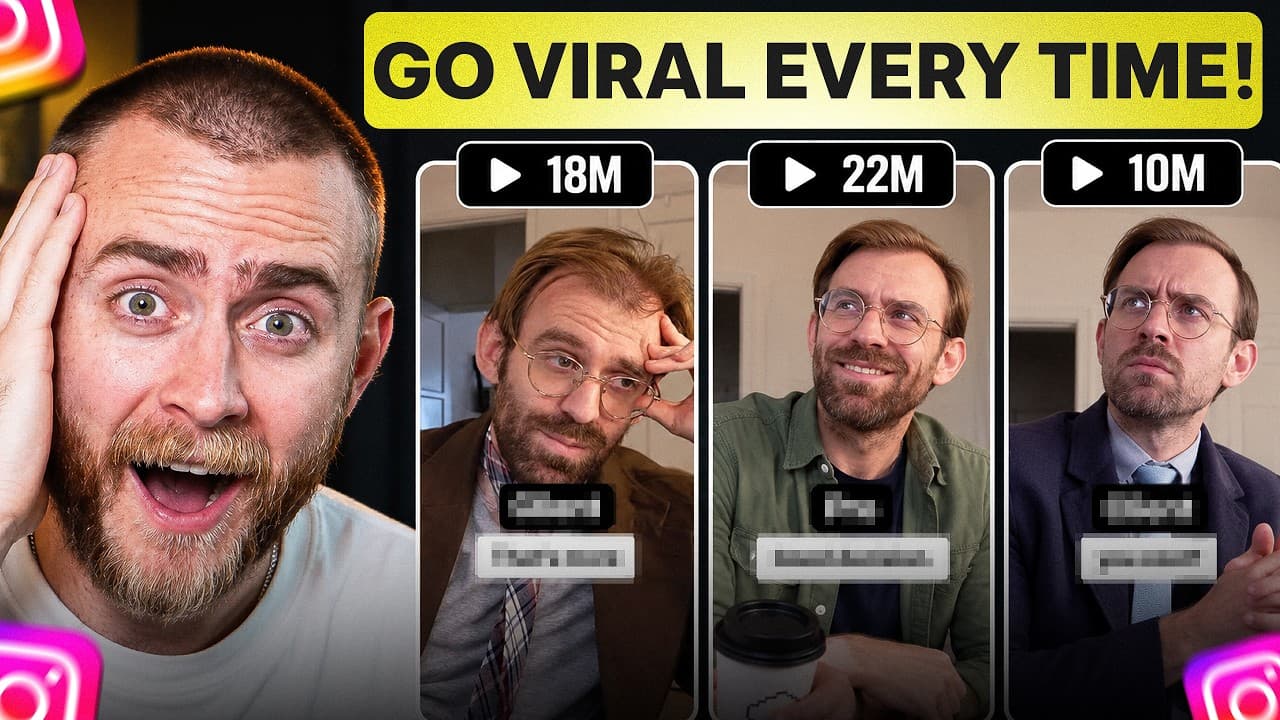
Posting fewer but higher quality posts can outperform high-volume strategies. In the last 90 days, Jamie Brindle shifted from 12 reels a day to three per week and saw nearly 30k new Instagram followers and 50k new Facebook followers, with views up 139 percent to 41.9 million and reach up 467 percent.
Transcript
Imagine only posting three reels per week and yet getting almost 50 million views per month. In today's episode, I'm going to be interviewing someone who was on the podcast just a few months ago, but he's now using a polar opposite strategy. Earlier this year, today's guest Jamie Brindle joined the show to tell us about his strategy of posting 12 r... Read More
Key Insights
- 12 posts a day served as a data collection method, and the cadence was later reduced to three posts per week to focus on quality and intent.
- The pivot prioritized one well crafted post over many lower effort ones and asked what would make someone share the content.
- A 90 day window of the new approach produced substantial growth in followers, views, reach, and engagement across platforms.
- Views surged by 139 percent to 41.9 million, signaling a strong lift from the shift in strategy.
- Reach increased by 467 percent, and interactions rose by 366 percent, showing deeper audience engagement and content resonance.
- Follower growth was substantial, with about 30,000 new Instagram followers and 50,000 on Facebook in the recent period.
- The one-post-at-a-time method relies on starting with why someone would share, then building the post around that reason.
- Trial Reels and data-backed testing underpin the evolution from volume to precision in Jamie Brindle’s content process.
Install to Summarize YouTube Videos and Get Transcripts
Explore YouTube Video Summarizer or Get YouTube Transcript Extractor
Questions & Answers
Q: What prompted Jamie Brindle to move from 12 posts a day to three per week
Jamie Brindle realized that posting nonstop was a weak approach that did not force him to take responsibility for quality. He shifted from using quantity as a growth lever to focusing his energy on a single post that speaks the language of the internet, provides value, and has a clear shareability factor. This change meant rethinking every post around why someone would share it, rather than how many posts could be produced.
Q: How did the 90 day window influence the strategy
The 90 day window provided a clear data set to compare the results of the drastic change. It showed that a lower posting frequency could lead to higher engagement, more followers, and better overall performance. The data collected during that period allowed Jamie to optimize which elements of a post drive retention and sharing, then apply those insights to subsequent posts.
Q: What metrics improved after the switch
After the switch, followers increased by nearly 30,000 on Instagram and 50,000 on Facebook. Views rose by 139 percent to 41.9 million, reach jumped by 467 percent, interactions climbed 366 percent, link clicks doubled, and profile visits and follows also showed strong gains, indicating broader audience discovery and engagement.
Q: Why start posts with why someone will share
Starting with why someone will share makes the post inherently more valuable and more likely to spread. If the content has a clear purpose that resonates with the audience, people feel compelled to pass it along. This shift anchors the post in social dynamics, aligning content with what triggers sharing behavior.
Q: What is the difference between manual labor and creative labor in this context
The older high-volume approach felt like manual labor, producing many posts without deep consideration for quality. The new approach is creative labor, where thinking, testing, and refinement are used to craft one strong post at a time. This reduces wasted effort and increases the impact of each piece of content.
Q: How important was data testing in Jamie’s strategy
Data testing was central to the shift. Trial Reels were used to test retention and early performance, enabling Jamie to identify what elements contribute to virality before a post goes wide. This data-informed process ensures that only posts with a high likelihood of success are pushed further.
Q: What role did audience insights play in the switch
Audience insights guided content decisions by revealing what resonates and what prompts engagement. The six month data period exposed viewers’ preferences, needs, and behaviors, allowing Jamie to tailor posts to address those insights directly and improve long term growth rather than chasing short term spikes.
Q: What is the core takeaway from this strategy
The core takeaway is that a lower posting frequency can outperform constant posting if each post is intentional, tested, and aligned with audience interests. Quality, clarity, and shareability trump volume when the content is backed by data and aimed at meaningful engagement.
Summary & Key Takeaways
-
Jamie Brindle shifted from a high-volume posting approach to a low-volume, high-quality strategy. He focuses on crafting posts that people will share and adds testing to refine what works. The change coincides with significant gains in followers, views, and engagement.
-
The switch from quantity to quality involved using trial Reels for data collection, then scaling up only the best performers. This approach leverages insights from extensive testing to maximize impact per post and improve long-term growth metrics.
-
Overall results show that intentional, well-tested content can outperform sheer quantity. The strategy emphasizes understanding audience values, platform dynamics, and the role of sharing to drive sustainable growth across multiple networks.
Read in Other Languages (beta)
Share This Summary 📚
Summarize YouTube Videos and Get Video Transcripts with 1-Click
Try YouTube Summary with ChatGPT & Claude or YouTube Transcript Generator
Explore More Summaries from Build Your Tribe 📚



Summarize YouTube Videos and Get Video Transcripts with 1-Click
Try YouTube Summary with ChatGPT & Claude or YouTube Transcript Generator