How does food travel through the human body?
TL;DR
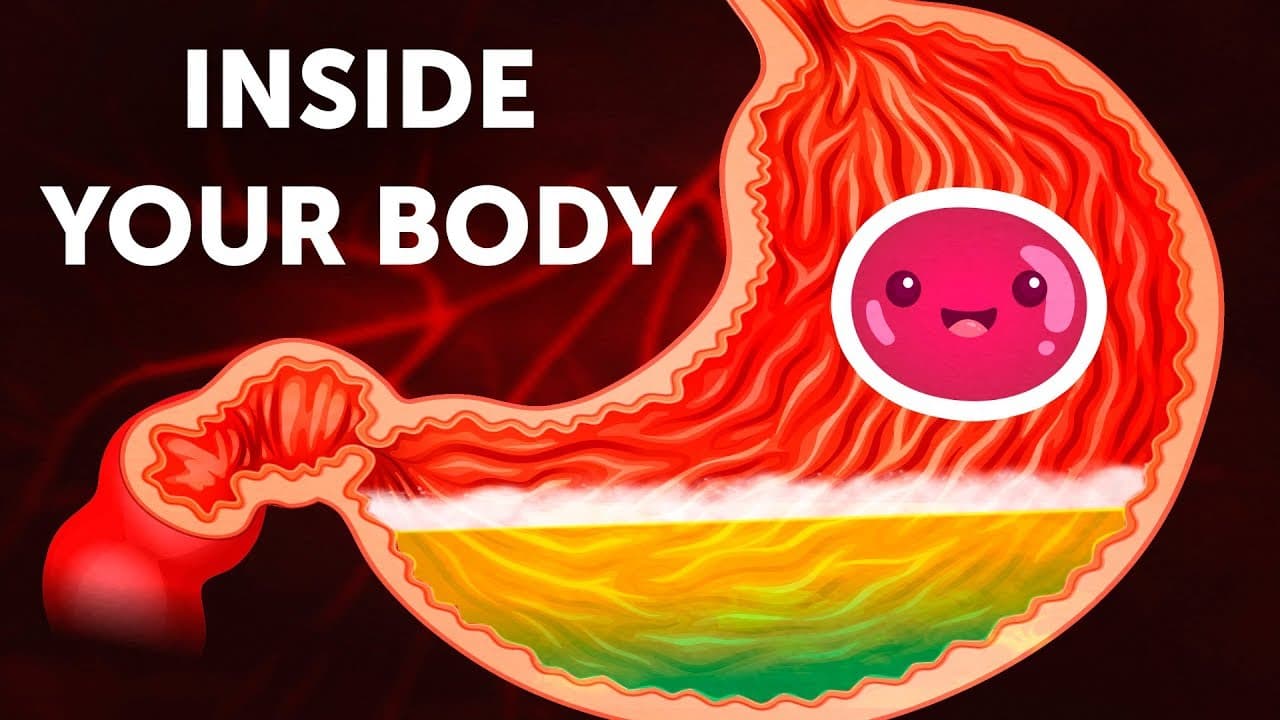
Food is broken down from mouth to rectum through chewing, saliva, peristalsis, stomach acid, and intestinal absorption. The video follows Gilbert the Grape as he tours the digestive system, explaining key roles of teeth, esophagus, stomach, small and large intestines, pancreas, liver bile, appendix, and gut bacteria.
Transcript
Hey dude. My name’s Gilbert. Gilbert The Grape. Yeah the name was my dad’s idea… Anyway, today I’m going on an epic journey…through the human body! So, wanna watch? The trip starts as the human heads to the office lunch room, opens his lunchbox, and finds me in there. What else has he got here? A turkey sandwich, some yogurt, hmm! I see he’s taken ... Read More
Key Insights
- The mouth is the gateway to the digestive system.
- Chewing and saliva break food into smaller pieces to aid digestion.
- Peristalsis moves food through the esophagus toward the stomach.
- The stomach uses strong muscles and acid to grind and mix food into mush.
- The small intestine is over 20 feet long when stretched.
- Bile and pancreatic enzymes help digest fats, with the gallbladder storing bile.
- The large intestine absorbs water and forms stool.
- The appendix houses bacteria and supports the immune system, while the large intestine hosts trillions of gut bacteria.
Install to Summarize YouTube Videos and Get Transcripts
Explore YouTube Video Summarizer or Get YouTube Transcript Extractor
Questions & Answers
Q: How does peristalsis move food through the digestive tract?
Peristalsis is the process by which muscles in the walls of the esophagus contract behind the food and relax in front of it, creating a wave that pushes the food downward toward the stomach. This coordinated contraction and relaxation sequence ensures a smooth, one way progression of the bolus through the digestive system, preventing backflow and aiding efficient transport.
Q: What role does saliva play in digestion?
Saliva mixes with food in the mouth to begin breaking it down before it reaches the stomach. It softens and moistens food, making it easier to chew and swallow, and starts chemical digestion by dissolving some components of food, which helps the body prepare nutrients for absorption later in the digestive tract.
Q: Why is the stomach so important in digestion?
The stomach is a muscular sac that holds and mixes food, using strong muscle contractions to grind it into mush. It also secretes acid and enzymes that begin the chemical breakdown of proteins and fats, creating a semi liquid substance called chyme that is ready for further digestion in the small intestine.
Q: How long is the small intestine and why is its length significant?
The small intestine is described as a long, coiled tube that would measure over 20 feet in length if stretched. Its length provides a large surface area for nutrient absorption, which is essential for breaking down food into usable vitamins and energy while passing wastes along to the large intestine.
Q: What is the function of the liver, bile, and pancreas in digestion?
The liver produces bile, which helps digest fats. Bile is stored in the gallbladder until the right moment. The pancreas contributes enzymes that aid digestion in the small intestine, enhancing the breakdown of carbohydrates, proteins, and fats to support nutrient absorption and energy production.
Q: What happens in the large intestine?
In the large intestine, water is removed from indigestible food matter, and the remaining material is formed into stool. This section houses a large community of bacteria that play roles in digestion and immunity, turning some leftovers into nutrients while helping to maintain gut health.
Q: What is the role of the appendix in digestion?
The appendix is a small pouch connected to the large intestine that houses bacteria. It does not have a major digestive function for most people, and individuals can live without it. However, it can be inflamed and surgically removed if needed, and it may contribute immune-related tissue.
Q: How do the rectum and anal sphincters control waste excretion?
The rectum holds stool until a signal from sensors prompts the brain that it is time to eliminate. When the moment is appropriate, the external anal sphincter relaxes to allow passage of stool, while other sphincters and signals manage retention when it is not convenient, ensuring control over when waste exits the body.
Summary & Key Takeaways
-
The journey begins in the mouth where food enters the digestive system, and the process starts with chewing, saliva, and swallowing. It explains how the mouth serves as the gateway and how the body prepares food for digestion and nutrient extraction.
-
The video highlights the esophagus and peristalsis, the muscular contractions that push food toward the stomach, and describes a valve mechanism that prevents backflow, ensuring a one-way ride through the digestive tract.
-
The tour ends in the large intestine where water is absorbed and stool is formed, with notes on gut bacteria and the appendix as a reservoir of microbes and a nonessential organ, respectively.
Read in Other Languages (beta)
Share This Summary 📚
Summarize YouTube Videos and Get Video Transcripts with 1-Click
Try YouTube Summary with ChatGPT & Claude or YouTube Transcript Generator
Explore More Summaries from BRIGHT SIDE 📚
Summarize YouTube Videos and Get Video Transcripts with 1-Click
Try YouTube Summary with ChatGPT & Claude or YouTube Transcript Generator