Can Print on Demand Still Make Money in 2026?
TL;DR
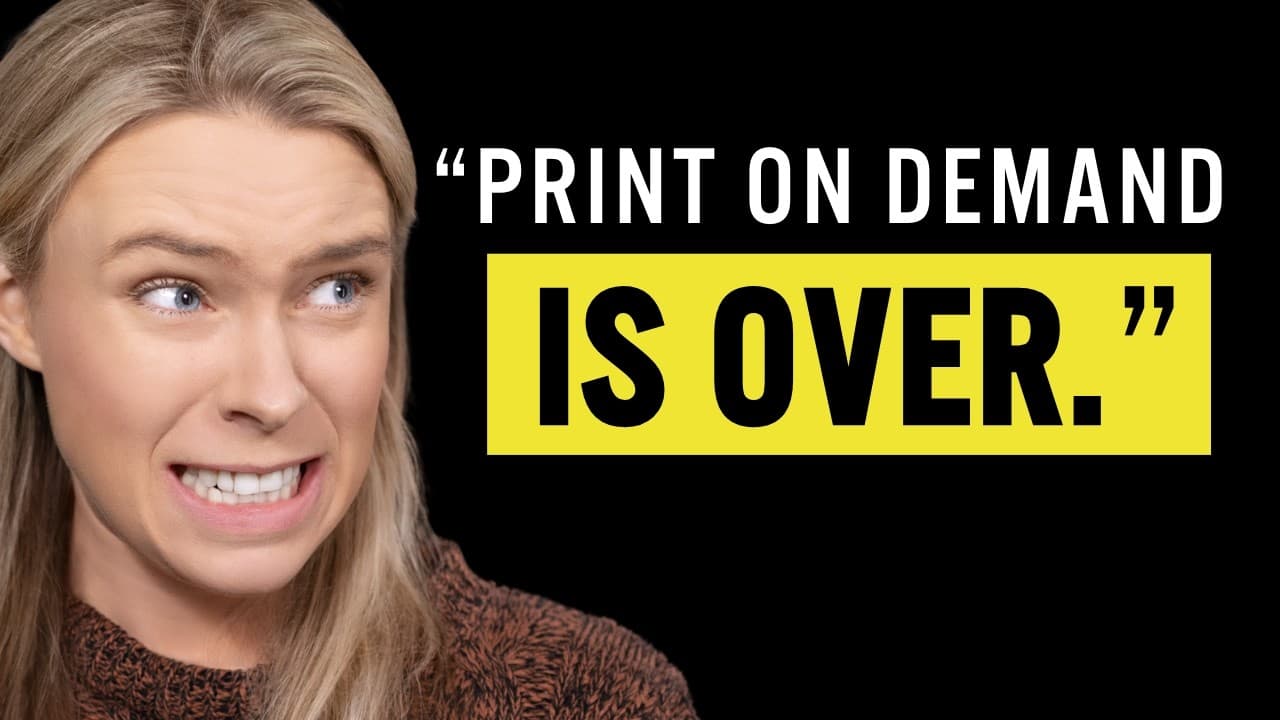
Print on demand can still be worthwhile when sellers target specific, underserved niches instead of copying generic popular products. AI can accelerate idea generation and design testing, while organic content and SEO can reduce dependence on paid advertising. Although digital products offer higher percentage margins, physical products can generate more profit per sale because customers perceive them as more valuable.
Transcript
So, a lot of people ask me, Sarah, do you honestly think that print on demand is still worth it? And I'm always like, well, let me tell you, I've got a lot of opinions on this subject and I've got to warn you because some of my opinions are a bit controversial. But, well, if you don't mind a bit of controversy, then buckle up because we're just... Read More
Key Insights
- Generic print-on-demand categories are highly saturated for new sellers because numerous stores now offer similar products. A generic custom dog mug on Etsy is presented as an example where copying an established product is unlikely to provide a realistic competitive advantage.
- The exceptional selling conditions of 2020 were created by a rapid lockdown-driven increase in marketplace traffic. Etsy and Amazon received more customers while relatively few stores were available, but many additional sellers subsequently entered, closing that unusually easy window of opportunity.
- AI is a tool for finding and developing underserved product opportunities. ChatGPT can help adapt popular formats, such as double-entendre shirts, to narrower audiences, while AI art can produce custom visual elements that were previously limited by available Canva clip art.
- Fast testing is a central advantage of AI-assisted design. Sellers can generate a niche slogan, create the corresponding artwork, publish the product, and measure customer interest more quickly than when every clever phrase and visual element had to be developed without AI assistance.
- Print-on-demand shirts can retain meaningful margins despite production and marketplace costs. A Bella Canvas 3001 from Monster Digital is cited at about $9.13 with a Printify premium account, while typical selling prices range from roughly $15 to $23, depending on positioning.
- Digital products can produce percentage margins of 70 to 90% because they require no physical item, printing staff, packaging, or shipping. Their perceived value may be lower, however, as illustrated by a $149 pack containing 55 shirt designs compared with one physical shirt selling for $22.40.
- Physical products can earn more money per transaction even when their percentage margins are lower. Print-on-demand products command higher prices because buyers receive a tangible item, and sellers do not need to choose exclusively between physical and digital products because they can offer both.
- Paid advertising is not required as the only source of traffic. Print-on-demand stores can use Instagram Reels, TikTok image carousels, Facebook memes, and SEO to gain low-cost or free exposure, including viral reach measured in millions of views.
Install to Summarize YouTube Videos and Get Transcripts
Explore YouTube Video Summarizer or Get YouTube Transcript Extractor
Questions & Answers
Q: Is print on demand still worth starting in 2026?
Print on demand can still be worth starting when the business targets underserved niches and creates products suited to a specific audience. The older approach of copying generic, highly popular listings is described as saturated and ineffective. AI now makes it faster to generate slogans, create custom artwork, publish designs, and test demand, while organic content and SEO can provide traffic without requiring paid advertisements.
Q: Why are generic print-on-demand products difficult to sell?
Generic print-on-demand products are difficult for a new store because many competing sellers already offer similar listings. A custom dog mug on Etsy is used as an example of a popular product with too much competition. The easy conditions of 2020, when lockdowns produced a large influx of customers across Etsy, Amazon, and other marketplaces, ended after many new sellers entered those markets.
Q: How can AI help find print-on-demand niches?
AI can help sellers translate an observed product trend into ideas for narrower audiences. The example begins with popular double-entendre shirts on Etsy, then uses ChatGPT to generate a related concept for the gardening niche. The idea can be turned into a shirt design with Canva, while AI art can create custom clip art that is not already available in Canva's existing library.
Q: What profit margins can print-on-demand shirts generate?
The transcript calculates a 27 to 49% margin on Etsy using a Bella Canvas 3001 shirt that costs about $9.13 from Monster Digital with a Printify premium account. Shirt selling prices are described as approximately $15 at the low end, $18 to $20 around the midpoint, and up to about $23 at the higher end. After additional costs, a 15 to 30% margin may remain.
Q: Are digital products more profitable than print on demand?
Digital products have higher percentage margins, cited at 70 to 90%, because sellers do not need to purchase, print, package, or ship a physical item. Print-on-demand products have lower percentage margins but may generate more profit per transaction because customers perceive physical goods as more valuable and accept higher prices. Sellers can also offer both digital and physical products instead of selecting only one model.
Q: Should shipping be included in print-on-demand profit calculations?
Shipping may be excluded from the product-level calculation when it is charged separately and paid by the customer. The speaker follows this approach and therefore does not usually include shipping in profit calculations. Even after allowing for other fees and expenses, the transcript suggests that sellers may retain a margin of at least 15 to 30%, although actual results depend on costs and selling prices.
Q: Do print-on-demand stores need paid advertising?
Paid advertising is not presented as a requirement for generating sales. It offers fast, immediate traffic and may suit sellers who prefer that strategy, but low-cost and free alternatives are available. Sellers willing to understand content creation and platform algorithms can use Instagram Reels, TikTok image carousels, Facebook memes, and search engine optimization to attract potential customers organically.
Q: How can social media generate free traffic for print on demand?
Social media can generate traffic by presenting niche products through entertaining content designed for a specific audience. Examples include Instagram videos showing funny car stickers being placed on vehicles, TikTok carousels that use a joke setup followed by a product as the punchline, and Facebook memes aimed at accountants. These approaches produced millions of views, while the accounting page also gained hundreds of thousands of followers.
Summary & Key Takeaways
-
Generic print-on-demand products have become difficult for new stores because popular categories now contain many competing listings. The unusually easy opportunities created by the 2020 lockdown traffic surge have closed. The stronger current strategy is to identify underserved niches, develop original products for specific audiences, and test ideas quickly rather than copying successful listings.
-
AI makes niche product development faster by helping sellers generate slogans, adapt proven concepts for different audiences, and create custom artwork beyond the clip art available in Canva. The gardening double-entendre example illustrates how a recognizable design format can be translated into another niche, produced quickly, and evaluated through actual customer interest.
-
Print on demand combines respectable physical-product margins with several low-cost marketing options. Sellers can charge shipping separately and attract traffic through Instagram Reels, TikTok image carousels, Facebook memes, or SEO. Digital products offer higher percentage margins, but physical products can command higher prices, and a store may sell both formats rather than choosing only one.
Read in Other Languages (beta)
Share This Summary 📚
Summarize YouTube Videos and Get Video Transcripts with 1-Click
Try YouTube Summary with ChatGPT & Claude or YouTube Transcript Generator
Explore More Summaries from Wholesale Ted 📚

Summarize YouTube Videos and Get Video Transcripts with 1-Click
Try YouTube Summary with ChatGPT & Claude or YouTube Transcript Generator