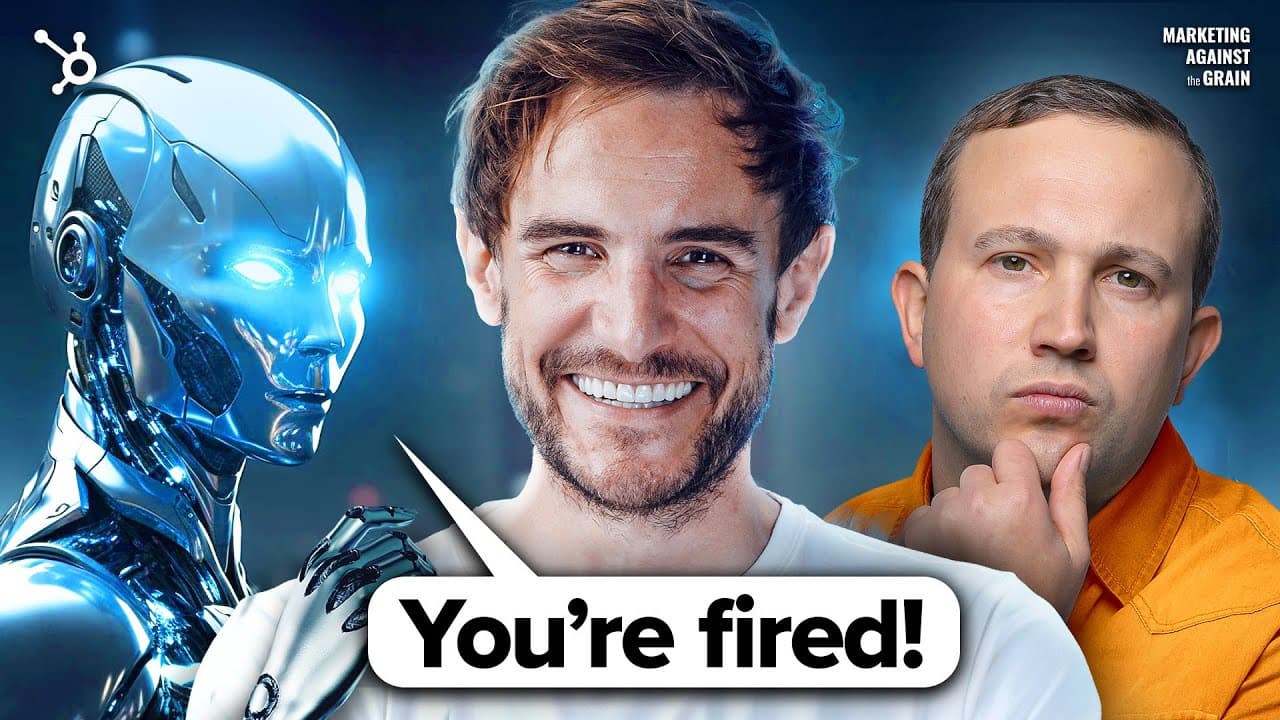
How Does AI Expose Lazy Employees? AI Founder Gabriel Hubert Explains
TL;DR
AI can expose performance gaps by helping knowledge workers complete tasks faster and more efficiently, leaving people who do not adopt the tools at a disadvantage. Gabriel Hubert, co-founder of Dust, explains how generative models restructure unstructured information, personalize customer interactions, and support specialized tasks. Read on to understand the capabilities, tradeoffs, and workplace changes he expects from AI.
Transcript
on today's show we're pulling back the curtain and revealing some secrets from an AI Insider he's going to talk to us about new AI use cases we didn't even know existed some really mind-blowing ways about how we could be working with machines in the future that I hadn't even considered and stick around because we're going to tell a funny story abou... Read More
Key Insights
- Gabriel Hubert, co-founder of Dust, discusses the transformative potential of AI in restructuring work processes and enhancing productivity.
- AI's ability to convert unstructured data into structured formats is a key advantage, offering new efficiencies in various business functions.
- The future of AI might involve using multiple models tailored for specific tasks rather than relying on a few dominant models.
- AI's potential to personalize interactions at scale is being realized in areas like customer support and sales, enhancing user experiences.
- The adoption of AI in business processes requires balancing control with efficiency, as AI tools can significantly alter traditional workflows.
- Knowledge workers need to adapt to AI tools to remain competitive, as these tools can drastically improve speed and efficiency.
- AI is currently excellent at classification and prediction tasks, with generative models providing creative and unexpected solutions.
- The paradigm shift introduced by AI involves moving from deterministic systems to probabilistic models, requiring new approaches to problem-solving.
Install to Summarize YouTube Videos and Get Transcripts
Explore YouTube Video Summarizer or Get YouTube Transcript Extractor
Questions & Answers
Q: How does AI expose lazy employees?
AI tools can make knowledge workers faster and more efficient, so differences in speed and output become more apparent. Workers who adapt can improve their productivity, while those who do not may find themselves at a disadvantage.
Q: Why did Gabriel Hubert leave a comfortable position to start Dust?
Hubert believed generative models had made previously impossible work possible, particularly repackaging unstructured information with the detail people need. He also trusted his co-founder, a longtime friend who had spent the previous four years at OpenAI.
Q: What breakthrough convinced Gabriel Hubert that AI had reached an inflection point?
He saw that generative models could take information in an unstructured form and repackage it on the fly at the required level of detail. That capability made previously unsolvable or inefficiently solved problems worth examining again.
Q: What are AI's current strengths according to Gabriel Hubert?
AI is particularly useful for classification and prediction tasks. Generative models can also produce plausible yet surprising results, creating new ways to approach problems and content.
Q: How can AI restructure workplace processes?
AI can convert unstructured information into structured, actionable output and reduce the effort required for routine work. This can change workflows, improve internal efficiency, and support more informed decisions.
Q: How are businesses using AI for personalization?
Businesses can use AI to tailor customer support, sales messages, emails, and other communications to individual context. This allows more personalized interactions to be delivered at scale.
Q: Will businesses rely on one AI model or multiple specialized models?
Hubert considers it mechanically probable that businesses will use an array of models because particular models perform some tasks better than others. A single dominant model becomes more plausible only in the scenario where one provider achieves artificial general intelligence.
Q: What would artificial general intelligence change about work?
Hubert describes AGI as machines becoming more capable than people at approaching and solving nearly any problem given to them. If machines could perform work better, faster, more accurately, and more dependably, existing economic models based on paying people for that work could fundamentally change.
Summary & Key Takeaways
-
Gabriel Hubert, co-founder of Dust, shares insights on AI's transformative role in the workplace, emphasizing its potential to enhance efficiency by restructuring workflows and converting unstructured data into structured formats.
-
AI's ability to personalize interactions at scale is revolutionizing customer support and sales, providing more contextual and efficient user experiences. The future of AI may involve using multiple specialized models for different tasks.
-
The adoption of AI tools in business requires a balance between control and efficiency, as AI can significantly change traditional workflows. Knowledge workers must adapt to these tools to remain competitive in an evolving landscape.
Read in Other Languages (beta)
Share This Summary 📚
Summarize YouTube Videos and Get Video Transcripts with 1-Click
Try YouTube Summary with ChatGPT & Claude or YouTube Transcript Generator
Explore More Summaries from Marketing Against the Grain 📚



Summarize YouTube Videos and Get Video Transcripts with 1-Click
Try YouTube Summary with ChatGPT & Claude or YouTube Transcript Generator