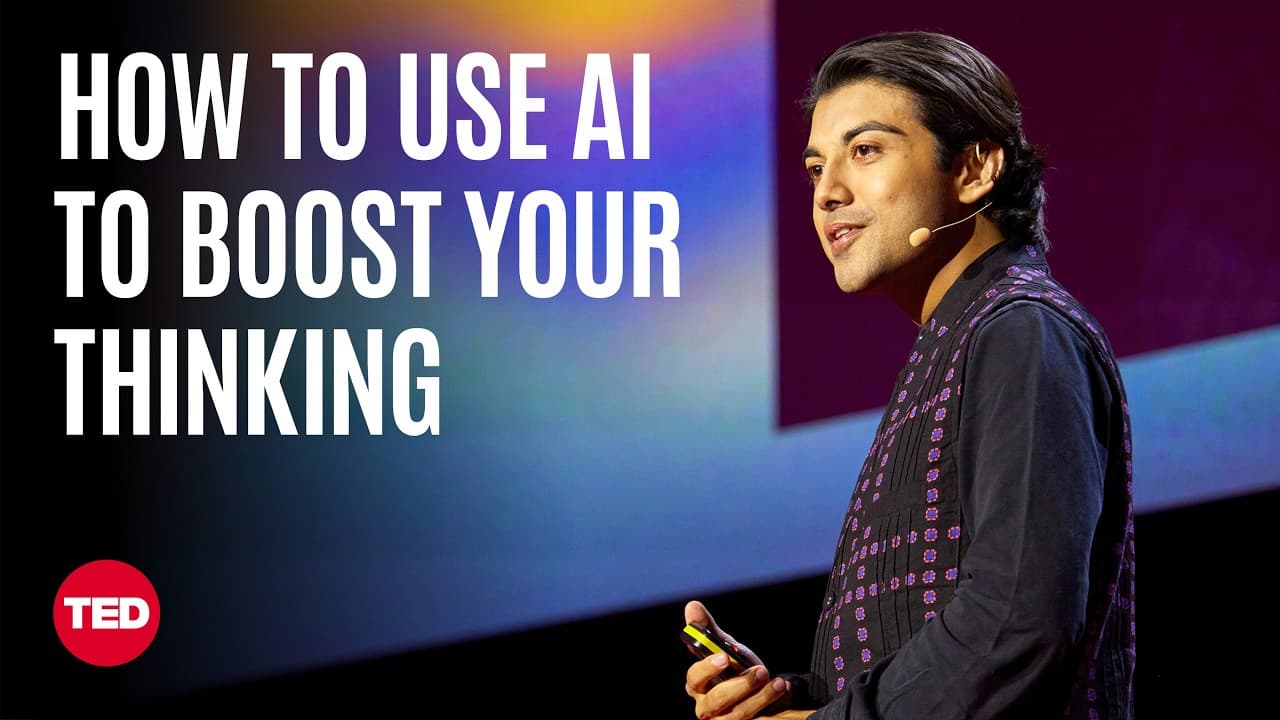
How to Stop AI from Killing Your Critical Thinking | Advait Sarkar | TED
TL;DR
To stop AI from weakening critical thinking, use it as a tool that challenges your reasoning rather than an assistant that simply completes tasks. Advait Sarkar explains that AI-assisted knowledge workers report less critical-thinking effort, generate a smaller range of ideas collectively, and remember less AI-mediated material. Read on to discover how productive resistance, material engagement, and metacognition can make AI support better thinking.
Transcript
I'm here today to talk about thinking for yourself. And I must admit, I did use AI to help me think about it. (Laughter) The irony is not lost on me. But the way I did so is not by using AI as an assistant to help me prepare this talk faster. Rather, I use AI as a tool for thought. And by the end of this talk, I will have explained what I mean by t... Read More
Key Insights
- AI as an assistant can reduce critical thinking, creativity, and memory by intermediating our engagement with tasks.
- Knowledge workers using AI assistants tend to produce a narrower range of ideas compared to manual work.
- Relying on AI for writing or summaries leads to poorer memory retention of the material.
- Metacognition is crucial when working with AI, as it involves reasoning about task goals and evaluating AI outputs.
- AI should challenge users and stimulate thought, rather than just providing answers or automating tasks.
- Tools for Thought are designed to preserve material engagement and offer productive resistance to enhance thinking.
- AI provocations can stimulate critical thinking by raising alternatives and identifying fallacies.
- The ability to think well is essential for human agency, empowerment, and flourishing in the age of AI.
Install to Summarize YouTube Videos and Get Transcripts
Explore YouTube Video Summarizer or Get YouTube Transcript Extractor
Questions & Answers
Q: How can you stop AI from weakening your critical-thinking skills?
Use AI as a tool for thought that challenges your reasoning instead of merely obeying instructions or completing tasks. It should help you examine alternatives, ask the right questions, evaluate outputs, and explore the unknown while you remain engaged with the material.
Q: How does AI affect critical thinking and creativity?
Knowledge workers surveyed about AI use reported putting less effort into critical thinking than when working manually. Studies also found that groups using AI assistants produced a smaller range of ideas, even if individual users felt that rapid access to ideas improved creativity.
Q: Why can confidence in AI reduce critical-thinking effort?
The reported decline in critical-thinking effort was greater when workers had more confidence in AI and less confidence in themselves. This can shift their role from developing ideas directly to validating the AI's opinions.
Q: How can relying on AI affect memory?
People remember less of what they wrote when they rely on AI to write for them. They also remember less after reading AI-generated summaries than after reading the original document.
Q: What role does metacognition play when working with AI?
Metacognition is the ability to think about your own thinking process. Working effectively with AI requires reasoning about task goals, breaking down the task, deciding whether generative AI applies, and evaluating its output.
Q: What is the difference between an AI assistant and a tool for thought?
An AI assistant focuses on completing work faster by drafting, summarizing, analyzing, or automating known processes. A tool for thought instead helps users understand the task, improve the work, ask better questions, and explore unknown possibilities.
Q: Why does direct engagement with work materials matter?
Direct engagement naturally exercises creativity, critical thinking, memory, and metacognitive reasoning. When AI intermediates that engagement, workers may merely visit ideas rather than inhabit them, becoming what Advait Sarkar calls “intellectual tourists” in their own work.
Q: What example does Advait Sarkar give of AI designed to enhance thought?
He introduces a live research prototype developed with colleagues on the Tools for Thought team at Microsoft Research in Cambridge. It is not a product, but one of several explorations studying how different ways of working with AI can enhance human thought.
Summary & Key Takeaways
-
AI tools, when used as mere assistants, can diminish our critical thinking, creativity, and memory by intermediating our engagement with tasks. Instead, AI should be used as a tool for thought, challenging us and enhancing our cognitive abilities. This approach can preserve and even improve human agency and empowerment.
-
The speaker highlights that AI assistants tend to produce a narrower range of ideas and reduce critical thinking and memory retention. Instead, AI should be used to challenge and stimulate thought, helping users to ask the right questions and explore the unknown.
-
The development of AI tools should focus on enhancing human thought, not just efficiency. By preserving material engagement and offering productive resistance, AI can protect and enhance critical thinking, creativity, and memory, leading to better human agency and empowerment.
Read in Other Languages (beta)
Share This Summary 📚
Summarize YouTube Videos and Get Video Transcripts with 1-Click
Try YouTube Summary with ChatGPT & Claude or YouTube Transcript Generator
Explore More Summaries from TED 📚





Summarize YouTube Videos and Get Video Transcripts with 1-Click
Try YouTube Summary with ChatGPT & Claude or YouTube Transcript Generator