How Much Is Your Body Worth?
TL;DR
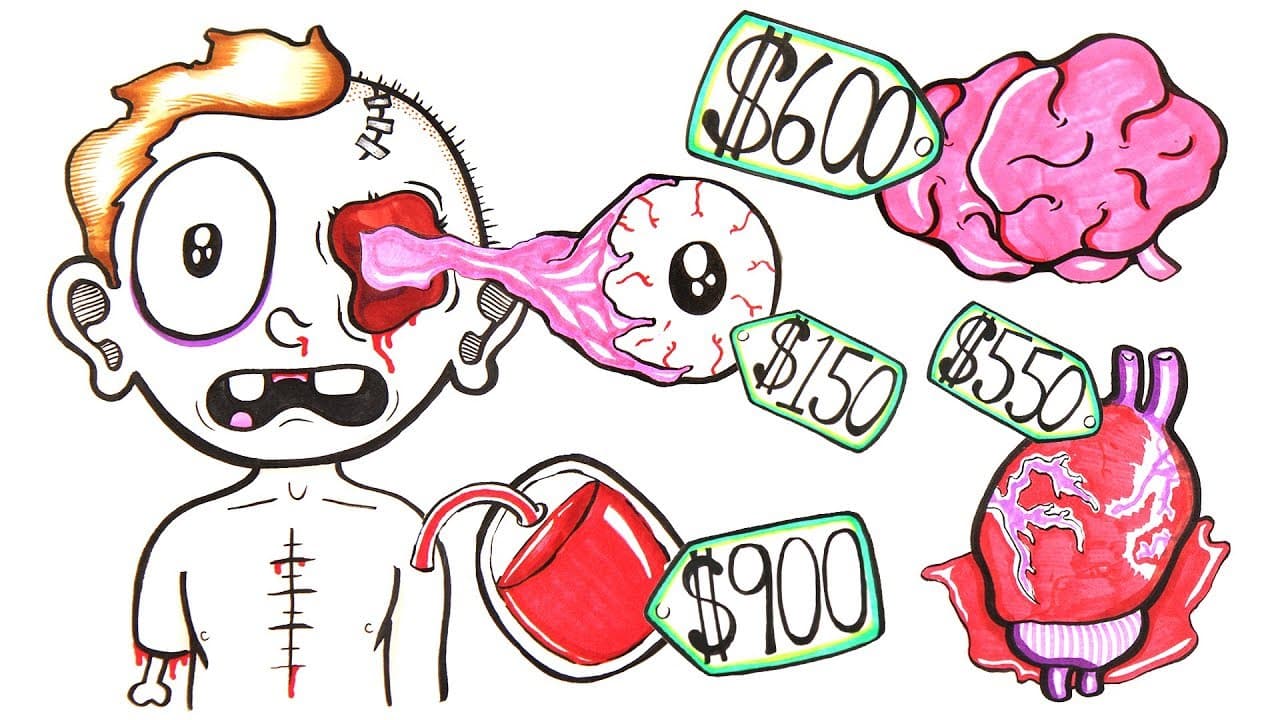
Your body has no single price: the episode values donations, transplant procedures, hair, physical functions, information storage, and constituent elements in very different ways. Eggs are presented as more valuable than sperm or plasma, while heart and kidney figures refer to transplant costs rather than legal earnings. It also compares insured celebrity legs, including those of Rihanna and Cristiano Ronaldo, and estimates the value of brain storage. Read on for the category-by-category breakdown.
Transcript
This episode is supported by Hims Your body is cool and all, but have you ever wondered how much is it all worth? Let's start with selling your body one piece at a time. Sperm? You can make $35 to $135 a shot, with some banks paying donors $1500 for a one-year commitment, the criteria being you are healthy, tall, young, and educated. The price for ... Read More
Key Insights
- 🪺 Donating sperm or eggs can be a lucrative source of income, with eggs being more valuable due to the invasive procedure involved.
- 📈 Buying young blood infusions is a trend among some wealthy individuals, despite limited scientific evidence supporting its effectiveness.
- 🖤 Organ transplants are costly surgeries, but the black market prices for organs vary significantly around the world.
- 😘 While some body parts, like hair and legs, hold significant monetary value, the worth of bodily functions and elements is relatively low.
Install to Summarize YouTube Videos and Get Transcripts
Explore YouTube Video Summarizer or Get YouTube Transcript Extractor
Questions & Answers
Q: How much is your body worth?
The episode does not assign the entire human body one definitive price. Instead, it separately values donations, transplant procedures, hair, insured celebrity body parts, bodily functions, brain storage capacity, and trace elements.
Q: How much can you earn from donating sperm or eggs?
Sperm donors can make $35 to $135 per donation, and some banks pay $1500 for a one-year commitment. An egg is priced at $10 000, which the episode attributes to the more invasive retrieval procedure and its risks.
Q: How much is plasma worth?
The protein-rich part of blood, called plasma, can be worth $50. The episode also says some wealthy, aging people pay $8 000 per session for young-blood infusions, although evidence for the hypothesis remains in its early stages.
Q: Do kidney and heart transplant prices represent what an organ seller earns?
No. The episode says a kidney transplant costs over $400 000 and a heart transplant costs $1.4M, but those amounts cover transplant surgery rather than payment to an organ seller.
Q: Is selling human organs legal?
The episode says selling organs is illegal in the US and most other nations. It nevertheless describes an organ black market and reports that kidney prices differ among India, China, and Israel.
Q: How much can human hair be worth?
The episode suggests selling hair as an option for someone unwilling to part with an organ. It says a real wig can cost $800 to $3 000.
Q: How much are Rihanna's and Cristiano Ronaldo's legs insured for?
Sources cited by the episode put Rihanna's insured legs at $1 000 000. Cristiano Ronaldo's legs are valued much higher, at $144 million.
Q: What is the estimated value of the human brain's storage capacity?
The episode says the human brain can store 100 tb of information. It compares that capacity with a hard drive of the same size, whose retail value is upwards to $2 500.
Summary & Key Takeaways
-
Selling sperm can earn you $35 to $135 per donation, while selling eggs can fetch $10,000.
-
Donating plasma can be worth $50, and some individuals pay $8,000 for infusions of young blood.
-
Organ transplants can cost over $400,000 for a kidney and $1.4M for a heart, but selling organs on the black market is illegal.
-
Selling hair can earn $800 to $3,000, and Rihanna's legs are insured for $1,000,000.
-
Bodily functions, such as breathing, sneezing, coughing, and farting, have surprising capacities, but their value is minimal.
-
Your brain can store 100 terabytes of information, with a retail value of a hard drive that size being around $2,500.
Read in Other Languages (beta)
Share This Summary 📚
Summarize YouTube Videos and Get Video Transcripts with 1-Click
Try YouTube Summary with ChatGPT & Claude or YouTube Transcript Generator
Explore More Summaries from AsapSCIENCE 📚




Summarize YouTube Videos and Get Video Transcripts with 1-Click
Try YouTube Summary with ChatGPT & Claude or YouTube Transcript Generator