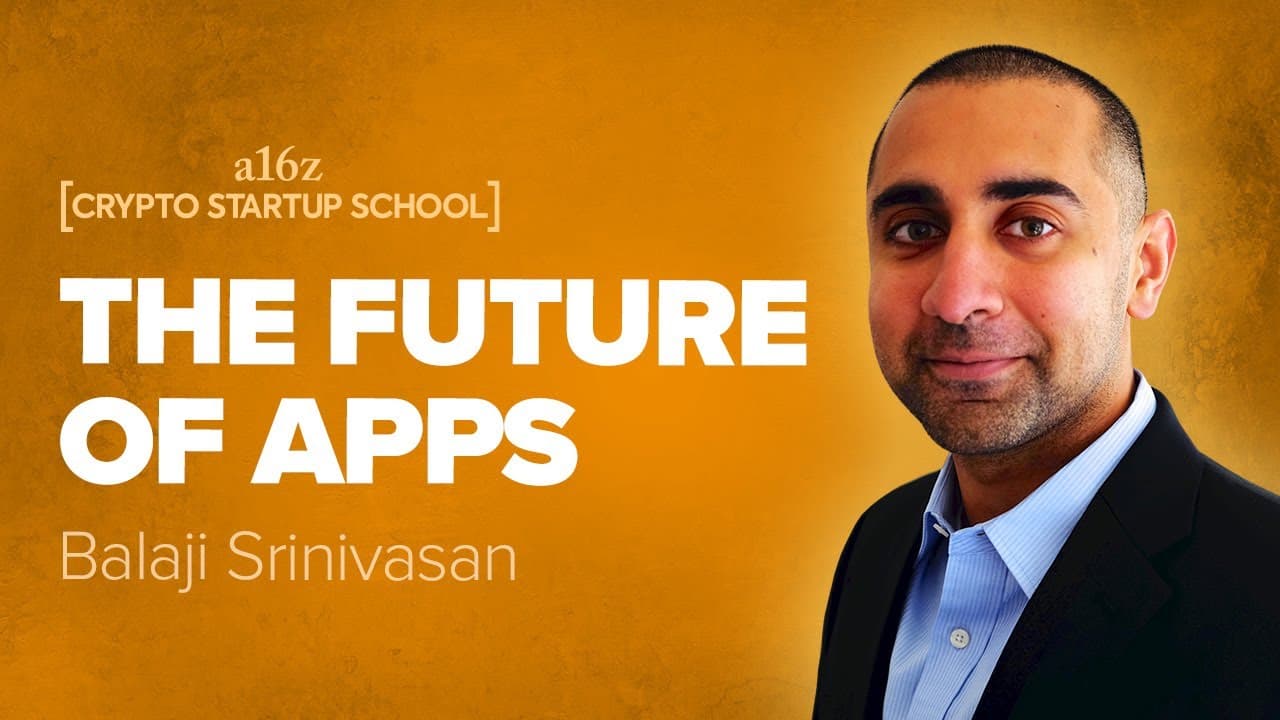
What Crypto Applications Does Balaji Srinivasan See Today and in 2025?
TL;DR
Balaji Srinivasan explains that blockchains enable applications built around tamper-resistant records of value without a central trusted party. Bitcoin addresses digital cash’s double-spending problem through competing miners, while Ethereum makes blockchain programming more accessible through Solidity. The broader possibilities include digital assets, identity, decentralized finance, stablecoins, social networks, microtasks, and decentralized organizations. Read on to understand the foundations behind them.
Transcript
this week we're gonna hear about applications and first speaker is going to be apologies for New Boston he's joining us remotely from zoom and he's gonna talk to us about applications today and some that we we think are exciting on the near term horizon okay so with that I'm gonna get straight into the presentation so we can turn it over to bajji h... Read More
Key Insights
- 👶 Blockchain technology eliminates the need for trusted intermediaries in financial transactions, introducing new possibilities for value transfer and programmable transactions.
- 🈸 Cryptocurrencies and blockchain applications have the potential to disrupt various industries, from finance and gaming to social networks and identity management.
- 💦 Tasking and microtasks enabled by cryptocurrencies can revolutionize the future of work, providing opportunities for individuals to earn rewards for specific actions.
- 🔒 Pseudonymous identities can enhance privacy and security online, enabling individuals to separate their real names from their online activities.
Install to Summarize YouTube Videos and Get Transcripts
Explore YouTube Video Summarizer or Get YouTube Transcript Extractor
Questions & Answers
Q: How did Bitcoin solve the double-spending problem?
Bitcoin replaced the central institution normally responsible for debiting one party and crediting another with a decentralized network of miners. These miners compete to approve transactions and receive Bitcoin rewards, so stopping a payment would require a critical mass of them to collude.
Q: Why does digital cash have a double-spending problem?
A physical dollar bill can occupy only one place at a time, so handing it to someone means the original owner no longer possesses it. Digital information can be copied, allowing the same identifying data to be sent to several people unless a system prevents it.
Q: How is Bitcoin different from bank-based digital payments?
A conventional digital payment relies on a trusted bank or financial institution to debit one account and credit another. Bitcoin distributes that approval process among competing miners, removing the privileged central node.
Q: What role do Bitcoin miners play in transactions?
Miners compete to carry out transaction approvals, including debiting one party and crediting another. A miner who declines a transaction can be bypassed by others, and miners are rewarded in Bitcoin for processing transactions.
Q: What is a blockchain according to Balaji Srinivasan?
Srinivasan describes a blockchain as a decentralized data structure and a tamper-resistant database for storing things of value. Bitcoin uses it to record and transfer Bitcoin without depending on a central bank.
Q: What applications can blockchain support beyond Bitcoin payments?
The page identifies digital assets, identity, decentralized finance, stablecoins, decentralized social networks, microtasks, personal tokenization, and decentralized organizations as possible applications. These uses build on blockchains’ ability to store value and support programmable transactions.
Q: How did Ethereum expand blockchain applications?
Ethereum introduced a blockchain that was more programmable than Bitcoin. Srinivasan contrasts Bitcoin’s assembly-language-like programming with Ethereum’s Solidity, which looks more like JavaScript and makes writing blockchain programs more accessible.
Q: How could crypto affect work and online identity?
Crypto can support tasking and microtasks that reward people for completing specific actions. It can also enable pseudonymous identities, allowing people to separate their real names from their online activities and potentially participate in new economic models.
Summary & Key Takeaways
-
Balaji Sreenivasan discusses the history and underlying concepts of cryptocurrencies and blockchain technology.
-
He explains how Bitcoin solved the double-spending problem by eliminating the need for a centralized trusted party.
-
Sreenivasan highlights the main applications of blockchain technology, such as digital assets, identity, decentralized finance (DeFi), stable coins, and decentralized social networks.
-
He also touches upon the potential for microtasks, personal tokenization, decentralized organizations (DAOs), and the future of work in the crypto space.
Read in Other Languages (beta)
Share This Summary 📚
Summarize YouTube Videos and Get Video Transcripts with 1-Click
Try YouTube Summary with ChatGPT & Claude or YouTube Transcript Generator
Explore More Summaries from TechCrunch 📚





Summarize YouTube Videos and Get Video Transcripts with 1-Click
Try YouTube Summary with ChatGPT & Claude or YouTube Transcript Generator