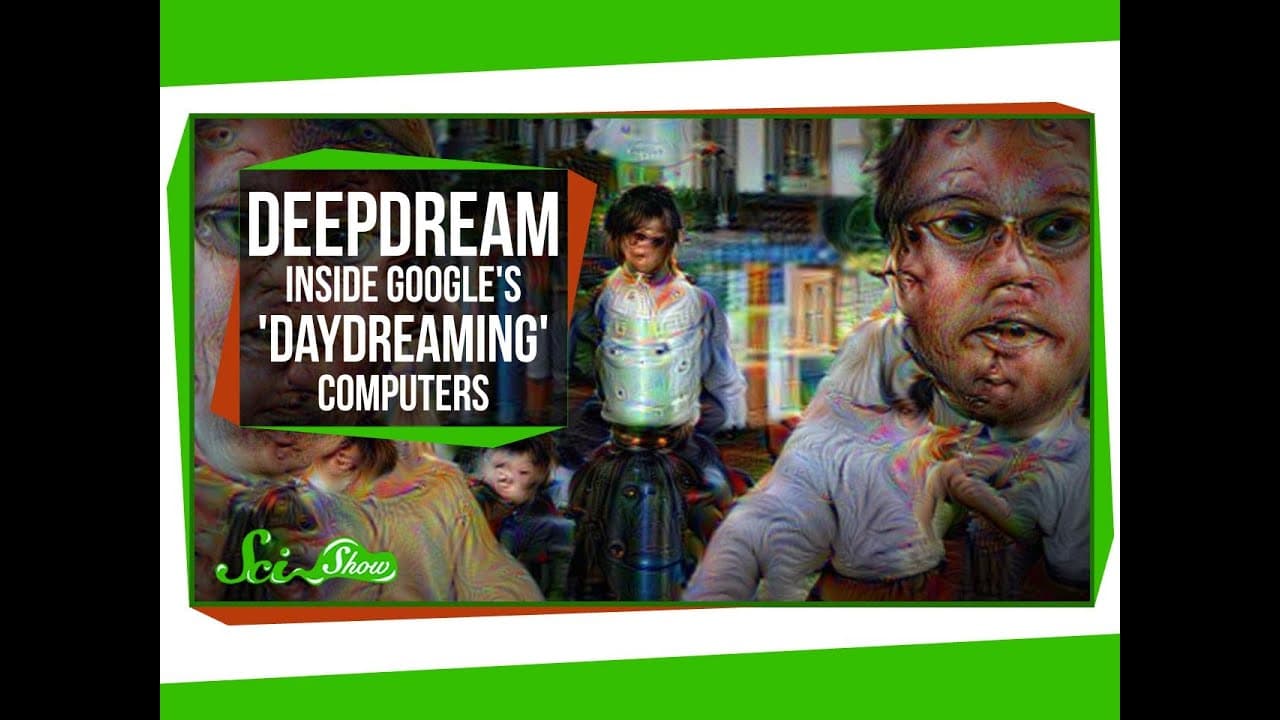
DeepDream: Inside Google's 'Daydreaming' Computers
TL;DR
Google's Deep Dream project uses neural networks to train computers to recognize objects in images and generate dream-like visuals.
Transcript
you may have been seeing some cool but mildly disturbing pictures on the internet recently I mean pictures that are more disturbing than usual and in a different way from like that fish with people teeth the images are part of a project that Google's calling deep dream as in Inception style digital Daydreams which is actually not too far from what ... Read More
Key Insights
- 💦 Deep Dream is a step toward solving the problem of computer image recognition that researchers have been working on since the 1960s.
- 👍 Neural networks, with interconnected layers of nodes, have proven powerful for image recognition due to their ability to be trained.
- 🪜 Deep Dream modifies original images, highlighting patterns and adding details to fit category definitions.
- 👨🔬 The project provides valuable research insights, such as understanding how the network defines categories and the need for balanced training data.
- 👤 Users can explore Deep Dream on their own by installing a simulated version of the network on their computers.
- 🙂 Deep Dream images can be both visually stunning and slightly unsettling.
- 🤨 AI and image recognition have the potential for significant advancements through projects like Deep Dream.
Install to Summarize YouTube Videos and Get Transcripts
Explore YouTube Video Summarizer or Get YouTube Transcript Extractor
Questions & Answers
Q: What is Deep Dream and how does it work?
Deep Dream is a project by Google that uses neural networks to teach computers how to recognize objects in images. It modifies images by enhancing patterns and shapes based on its understanding of each category.
Q: How did researchers train the network?
Researchers trained the network by feeding it a database of 1.2 million categorized images and asking it to classify them. If the network misclassified an image, they adjusted the parameters until it correctly identified the image.
Q: What insights did researchers gain from Deep Dream?
Deep Dream revealed that the network's first layer looks for basic hints of a category, while subsequent layers fill in more details. It also showed the network's tendency to include human hands when generating images of dumbbells, prompting researchers to adjust training data.
Q: How can users generate their own Deep Dream pictures?
Google has released the code and instructions to install a simulated version of the network on users' computers, allowing them to generate their own Deep Dream images.
Summary & Key Takeaways
-
Google's Deep Dream project utilizes neural networks to teach computers how to recognize objects in images.
-
Researchers trained the network with 1.2 million categorized images to classify new images accurately.
-
Deep Dream modifies original images, highlighting patterns to fit categories and providing insights into how the network thinks.
Read in Other Languages (beta)
Share This Summary 📚
Summarize YouTube Videos and Get Video Transcripts with 1-Click
Try YouTube Summary with ChatGPT & Claude or YouTube Transcript Generator
Explore More Summaries from SciShow 📚


Summarize YouTube Videos and Get Video Transcripts with 1-Click
Try YouTube Summary with ChatGPT & Claude or YouTube Transcript Generator