What Factors Affect Maximum Torque in Induction Motors?
TL;DR
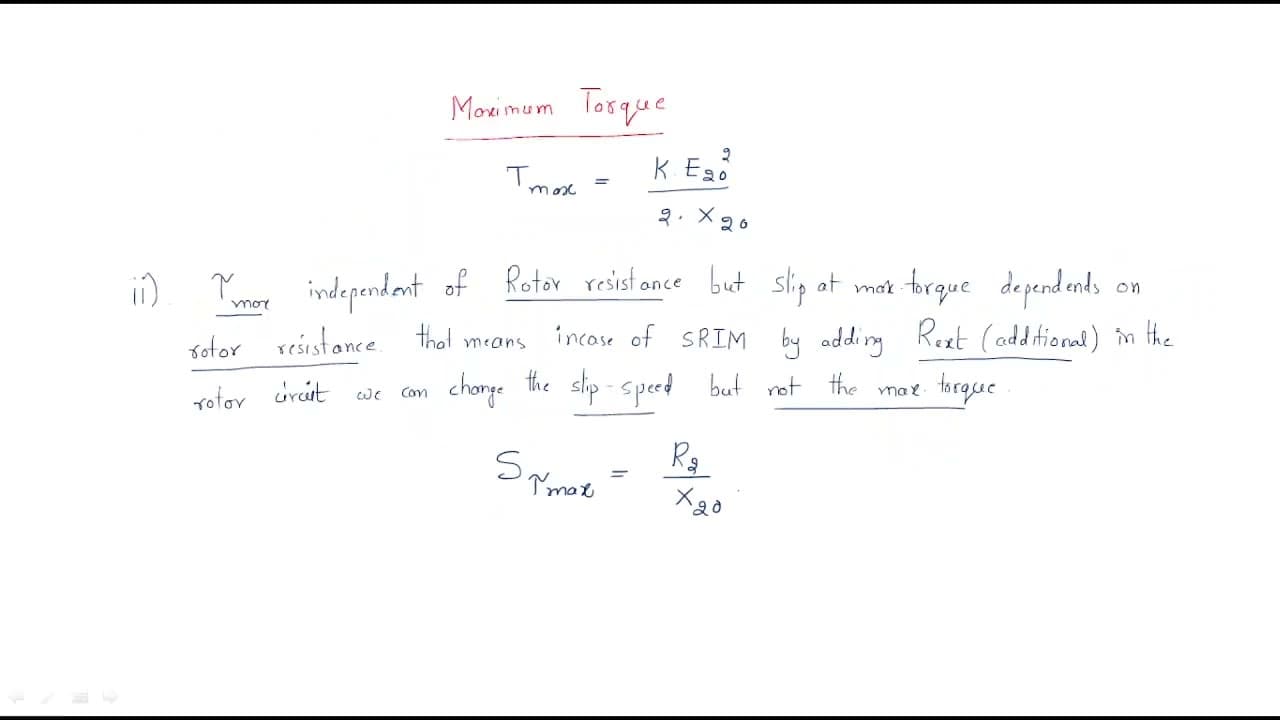
Maximum torque in induction motors is determined by rotor design, with squirrel cage motors achieving higher torque due to smaller air gaps compared to slipping motors. While slip at maximum torque can be adjusted through rotor resistance, the maximum torque itself remains unchanged. Additionally, voltage and frequency significantly impact maximum torque, with a direct proportionality to voltage squared and an inverse relationship to frequency squared.
Transcript
hello everyone in this session we will discuss the continuation of the maximum term first what is the maximum target we already find the maximum torque equation is tau max equal k e 2 naught square by 2 into x 2 naught so the maximum path will be depends on the k k is nothing but 180 by 2 pi n s and and e to not equal e to not equal the rota induce... Read More
Key Insights
- 🧑🦼 Maximum torque is fundamentally influenced by design elements like rotor configuration and air gap size, which differ between squirrel cage and slipping induction motors.
- 💋 Slip at maximum torque can be modulated through adjustments in rotor resistance, but the absolute maximum torque remains constant across variations in resistance.
- 🧑🦼 The shorter the air gap in an induction motor, the higher the potential maximum torque, making design decisions critical for optimizing performance.
- 🦥 Different slot configurations for rotor windings affect the performance of motors, as open slots reduce leakage reactance compared to more closed designs.
- 🧑🏭 Electrical factors such as voltage and frequency have a profound impact on maximum torque, emphasizing the need for careful monitoring and adjustment in practical applications.
- 🎚️ The formula related to maximum torque provides insight into how changing one variable can necessitate compensatory adjustments in others to maintain performance levels.
- 🦾 Understanding the interplay between mechanical and electrical factors is essential for engineers designing efficient induction motors.
Install to Summarize YouTube Videos and Get Transcripts
Explore YouTube Video Summarizer or Get YouTube Transcript Extractor
Questions & Answers
Q: What factors determine the maximum torque of induction motors?
The maximum torque of induction motors is influenced by several factors, including rotor resistance, air gap length, rotor design (squirrel cage vs. slipping), as well as electrical factors such as voltage and frequency. The torque calculation emphasizes these parameters, showcasing their roles in determining performance.
Q: How does rotor resistance affect slip at maximum torque?
While maximum torque remains unaffected by rotor resistance, slip at maximum torque is influenced by this resistance. Specifically, in slipping induction motors, increasing rotor resistance can alter the slip speed, thereby impacting the slip at which maximum torque occurs, but it won't change the actual torque value itself.
Q: Why do squirrel cage induction motors have higher maximum torque than slipping induction motors?
Squirrel cage induction motors typically have a smaller air gap between rotor and stator, which results in reduced leakage reactance and higher electromagnetic interaction, leading to greater maximum torque. In contrast, slipping induction motors feature a wider air gap, which diminishes their torque capabilities.
Q: How does the design of rotor slots impact maximum torque?
The design type of rotor slots significantly affects maximum torque. Generally, open slots have lower leakage reactance and can produce higher maximum torque compared to semi-open and closed slots, which exhibit higher leakage reactance, resulting in lower torque performance.
Q: What is the relationship between voltage and frequency regarding maximum torque?
The maximum torque is proportional to the square of voltage and inversely proportional to the square of frequency. This relationship indicates that if voltage increases, maximum torque will increase, whereas if the frequency increases, maximum torque will decrease, assuming other factors are constant.
Q: How do electrical factors affect the air gap in induction motors?
Electrical factors indirectly influence the air gap by dictating operational parameters like voltage and frequency. Changes in these electrical conditions can lead to variations in the induced electromagnetic force, which in turn affects the air gap's impact on maximum torque in different induction motor designs.
Summary & Key Takeaways
-
The discussion centers on the maximum torque of induction motors, noting that it is independent of rotor resistance. While the slip at maximum torque is affected by rotor resistance, the maximum torque itself remains constant regardless of resistance levels.
-
The maximum torque varies based on rotor design, with squirrel cage induction motors exhibiting higher torque due to smaller air gaps compared to slipping induction motors. Differences in winding types and construction also impact torque performance.
-
Electrical factors, including voltage and frequency, significantly affect maximum torque. The maximum torque formula indicates a direct relationship with voltage squared and an inverse relationship with frequency squared, emphasizing the importance of voltage to frequency ratios.
Read in Other Languages (beta)
Share This Summary 📚
Summarize YouTube Videos and Get Video Transcripts with 1-Click
Try YouTube Summary with ChatGPT & Claude or YouTube Transcript Generator