How to Find Out Why T. rex Arms Were… Like That | SciShow News
TL;DR
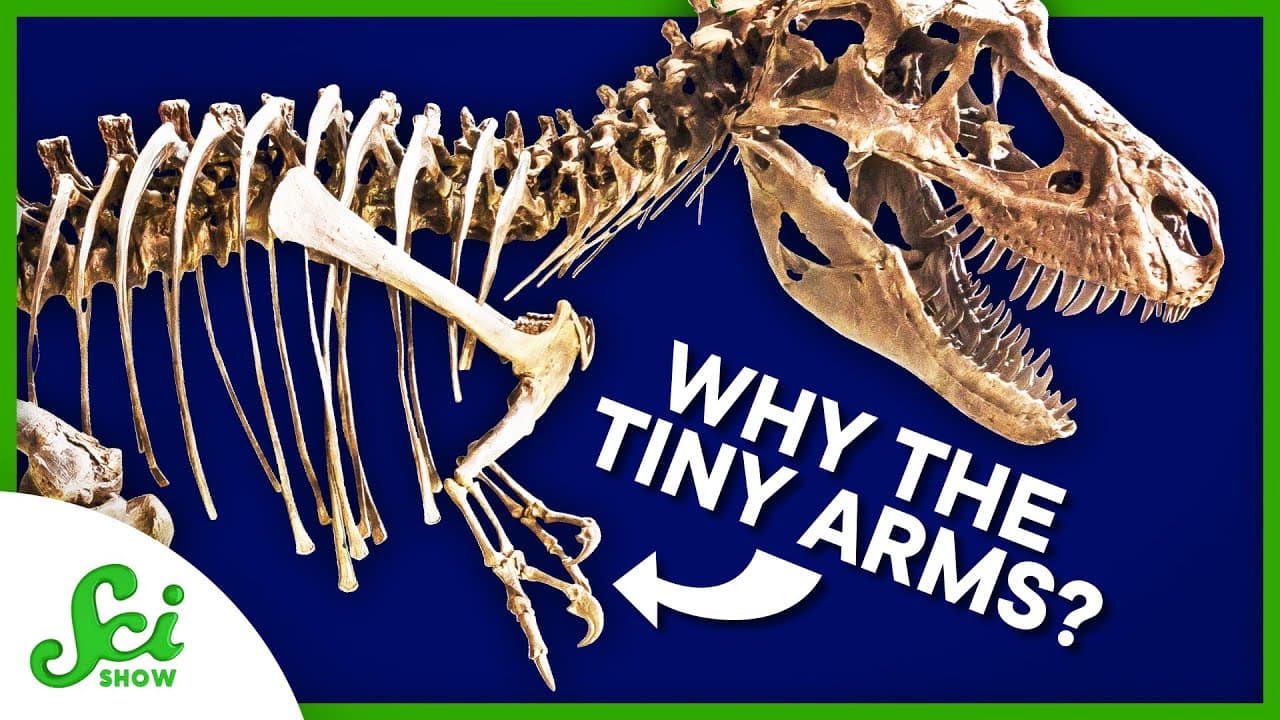
T-Rex arms may have evolved to avoid injury while feeding, allowing them to live longer and pass on their genes.
Transcript
t-rex arms are kind of ridiculous they're absolutely tiny compared to the rest of their body they can't touch each other and they sort of throw off the whole deadly predator vibe a little bit i'm not just pointing this out to be mean though i mean a little bit but not just that this week we bring you news of a new hypothesis as to why their arms ev... Read More
Key Insights
- 🦖 Previous theories about T-Rex arms focused on their functions, such as prey capture or mate attraction.
- 🦖 The new hypothesis suggests that T-Rex arms evolved to avoid injury during feeding.
- 🦖 T-Rex arms may have been more advantageous for survival and breeding, leading to their persistence in the population.
- ☠️ The hypothesis can be tested by examining patterns of damage in fossilized bones.
- 🦖 T-Rex arms are smaller compared to other theropods, but their unique size has attracted much attention and speculation.
- 🤞 Researchers hope for a global academic effort to gather more evidence for the hypothesis.
- 🦖 The study of T-Rex arms is challenging due to limited fossil remains, but new findings in the future may provide more insights.
Install to Summarize YouTube Videos and Get Transcripts
Explore YouTube Video Summarizer or Get YouTube Transcript Extractor
Questions & Answers
Q: Why are T-Rex arms so small?
T-Rex arms may have evolved to avoid getting injured while feeding on carcasses in groups. Smaller arms would be less likely to be bitten off and infected, leading to a longer lifespan.
Q: How did researchers test the hypothesis about T-Rex arms?
Researchers examined existing fossilized bones for patterns of damage related to arm size and position. This evidence can support the hypothesis that larger arms resulted in more injuries.
Q: Were there any previous theories about the purpose of T-Rex arms?
Yes, previous theories suggested that T-Rex arms were useful for grabbing prey, helping them get up, or attracting mates. However, these theories were not testable.
Q: How do T-Rex arms compare to other theropods?
T-Rex arms are disproportionately small compared to their body size. Other theropods may have had similar small arms, but T-Rex arms are particularly famous for their size.
Summary & Key Takeaways
-
T-Rex arms are small compared to the rest of their body and have been the subject of much speculation about their purpose.
-
Previous theories focused on the functions of T-Rex arms, such as grabbing prey or attracting mates, but a new hypothesis suggests they evolved to stay out of the way during feeding.
-
Researchers propose that T-Rex with smaller arms were less likely to get injured during feeding, leading to longer lifespans and increased chances of breeding.
Read in Other Languages (beta)
Share This Summary 📚
Summarize YouTube Videos and Get Video Transcripts with 1-Click
Try YouTube Summary with ChatGPT & Claude or YouTube Transcript Generator
Explore More Summaries from SciShow 📚


Summarize YouTube Videos and Get Video Transcripts with 1-Click
Try YouTube Summary with ChatGPT & Claude or YouTube Transcript Generator