What Makes the Perfect Business? 5 Things to Look For
TL;DR
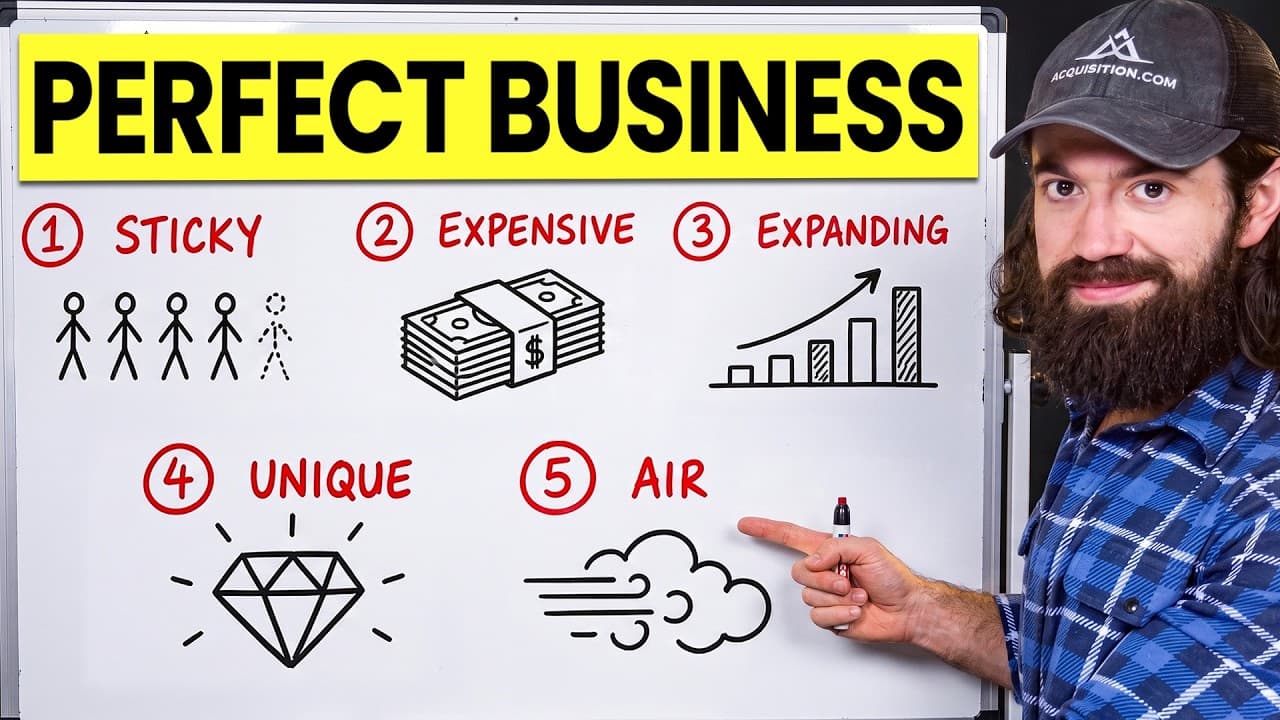
The perfect business combines five advantages: revenue retention, high gross margins, industry growth, operational scalability, and uniqueness. Revenue retention is the most important because customers who keep paying allow revenue to compound; in recurring businesses, churn drops to almost 2% per month after month six. High margins and low operational complexity further improve profitability and expansion. Read on to understand each advantage and the examples behind it.
Transcript
If I wanted to start the perfect business, these are the things that I would focus on. So, think of these like the five advantages that make any business easier to grow and way more profitable. And this is what's helped me build a portfolio of companies that generated over $250 million in revenue last year alone. And so, for each one, I'll describe... Read More
Key Insights
- Revenue retention is crucial for business growth, involving both logo and revenue retention to ensure sustainability.
- High gross margins allow for better reinvestment in growth and typically result in higher net margins.
- Choosing a growing industry helps businesses grow by default, reducing the need for excessive marketing efforts.
- Low operational complexity and low capital expenditure enable faster expansion and less reliance on external funding.
- A competitive moat, such as unique skills, patents, or brand, protects against market saturation and competition.
- Businesses with high gross margins, like media and software, typically enjoy better profitability than those with low margins, like grocery stores.
- Operational scale is easier in businesses with fewer variables, such as digital products, compared to complex operations like restaurant chains.
- Capital investment can create a competitive advantage by making it harder for others to enter the market, enhancing pricing power.
Install to Summarize YouTube Videos and Get Transcripts
Explore YouTube Video Summarizer or Get YouTube Transcript Extractor
Questions & Answers
Q: What five things make the perfect business?
The five advantages are revenue retention, high gross margins, industry growth, operational scalability, and uniqueness. Few businesses possess all five, but even one can make a business easier to grow and more profitable.
Q: Why is revenue retention the most important business advantage?
Revenue retention measures how much revenue from one year remains in the next year. When existing customers continue paying, growth can compound without requiring the business to replace all its customers through new sales.
Q: What is the difference between logo retention and revenue retention?
Logo retention tracks how many customers remain, while revenue retention tracks how much the same customer group continues to spend. Net revenue retention can exceed 100% when increased spending by remaining customers more than offsets revenue lost from departing customers.
Q: How can a recurring business improve customer retention?
Focus first on the customer’s first 30 days, when the transcript says churn across categories exceeded 20%, and then help customers pass months three and six. After month six, churn falls to almost 2% per month, so early customer experience and a clear path to continued value deserve the most attention.
Q: How can a business achieve more than 100% net revenue retention?
Give lower-paying customers a clear reason to spend more while continuing to deliver what they need. In the example, moving a customer from a $9 monthly membership to a $99 membership creates an 11x increase in that customer’s value, which can offset customers who leave.
Q: Why are high gross margins valuable?
High gross margins provide more cash to pay employees, reinvest in growth, and support higher net margins. The transcript contrasts a $100 million business with 10% margins and a $20 million business with 50% margins: both produce the same amount at the end, but the latter requires less revenue.
Q: Which businesses have high or low gross margins?
Media, information, education, community access, data, software, pharmaceuticals, supplements, and similar products are presented as high-gross-margin examples. Grocery stores, farming, and restaurants are cited as low-gross-margin businesses, with commodity-like products making it harder to raise margins.
Q: How do scalability and uniqueness strengthen a business?
Low operational complexity and low capital expenditure make expansion easier and reduce reliance on outside funding. A competitive moat based on unique skills, patents, proprietary technology, or brand differentiation makes the business harder to replicate and can protect its pricing power.
Summary & Key Takeaways
-
Building a profitable business involves focusing on five key advantages: revenue retention, high gross margins, industry growth, operational scalability, and uniqueness. Retaining customers and ensuring high margins are crucial for sustainable growth. Choose industries with growth potential and low operational complexity to maximize profitability and competitive edge.
-
Revenue retention is vital, involving both logo and revenue retention to ensure sustainability. High gross margins allow for better reinvestment in growth and typically result in higher net margins. Choosing a growing industry helps businesses grow by default, reducing the need for excessive marketing efforts.
-
Low operational complexity and low capital expenditure enable faster expansion and less reliance on external funding. A competitive moat, such as unique skills, patents, or brand, protects against market saturation and competition. Capital investment can create a competitive advantage by making it harder for others to enter the market, enhancing pricing power.
Read in Other Languages (beta)
Share This Summary 📚
Summarize YouTube Videos and Get Video Transcripts with 1-Click
Try YouTube Summary with ChatGPT & Claude or YouTube Transcript Generator
Explore More Summaries from Alex Hormozi 📚






Summarize YouTube Videos and Get Video Transcripts with 1-Click
Try YouTube Summary with ChatGPT & Claude or YouTube Transcript Generator