Can Artificial Intelligence Truly Understand?
TL;DR
A computer that produces convincing answers does not necessarily understand them as a human does. John Searle’s thought experiment separates rule-following from genuine cognition, while modern neural networks complicate the issue by learning patterns in ways that resemble aspects of human cognition. Because consciousness remains poorly defined and cannot yet be mapped fully onto brain activity, researchers lack a definitive test for conscious AI.
Transcript
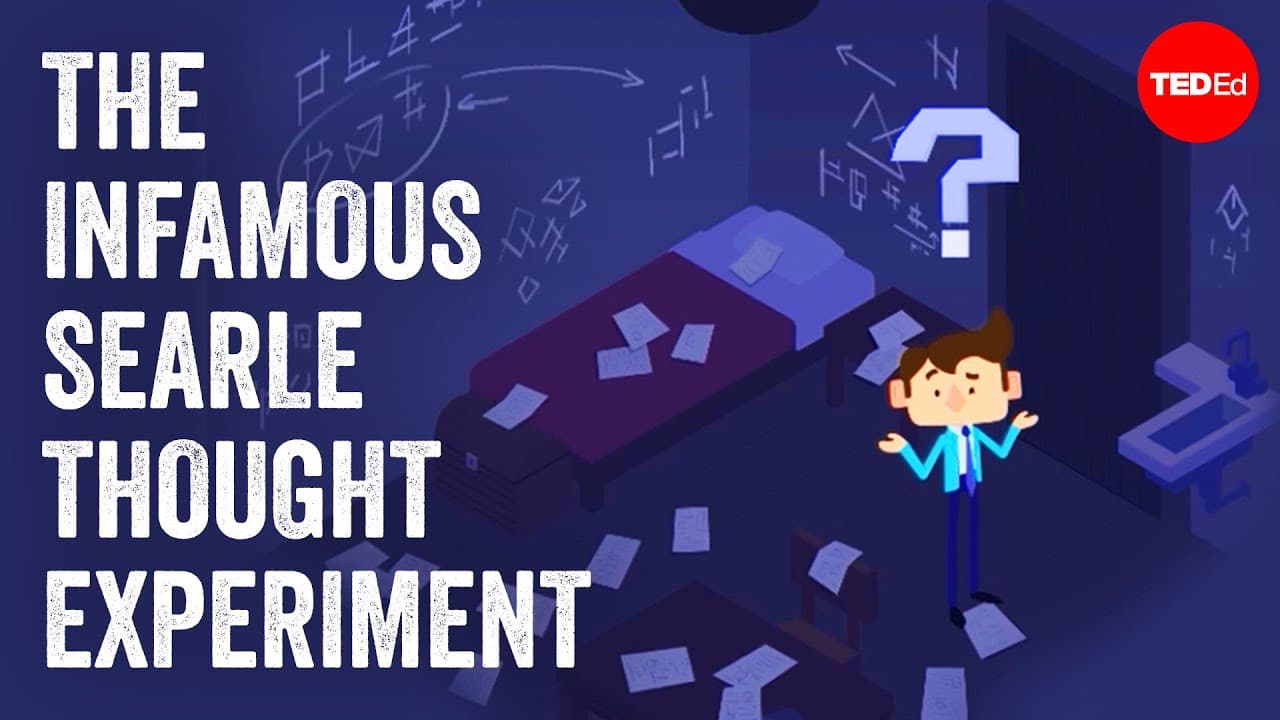
After waking up alone in a locked room, two documents are slipped under your door: a note in an alien language and a detailed instruction manual in your language. The manual explains that for each alien character in the note, you should write an indicated corresponding symbol. Following this chart, you write a response that you slip out the door. A... Read More
Key Insights
- Searle’s thought experiment distinguishes successful symbol manipulation from understanding by showing how someone can generate appropriate responses in an unknown language while remaining unaware of what any character means.
- The motivating question is whether an appropriately programmed computer literally possesses cognitive states, or whether behavior that appears intelligent merely creates the impression of human-like understanding.
- Understanding, sentience, and consciousness are different but related concepts, yet theorists do not know precisely how they connect. This uncertainty makes claims about a machine possessing any one of them difficult to evaluate.
- Consciousness is the subjective experience of being alive, including the combined sensations involved in smelling, sipping, evaluating, and experiencing a morning coffee routine, rather than only the objectively measurable physical processes.
- Researchers still do not know how firing neurons produce subjective experience, despite major advances in psychology, cognitive science, and neurology. This unresolved relationship limits attempts to identify consciousness in computers.
- The Turing Test treats indistinguishable conversation as possible evidence of internal cognition, but Searle’s scenario challenges that inference because convincing responses may arise without genuine comprehension.
- Modern neural networks and deep-learning systems mimic known elements of human cognition through pattern recognition, familiarity with information, and connections across data sets, bringing their processing arguably closer to Searle’s definition of understanding.
- An artificial consciousness test can seek knowledge unavailable in an AI’s data set, such as reports about dreaming or comprehension of body-swapping stories, to investigate whether the system draws on conscious experience.
Install to Summarize YouTube Videos and Get Transcripts
Explore YouTube Video Summarizer or Get YouTube Transcript Extractor
Questions & Answers
Q: What is John Searle’s thought experiment about AI?
John Searle’s 1980 thought experiment imagines a person locked in a room receiving notes written in an alien language. An instruction manual tells the person which symbols to write in response. Outside scientists think a conversation is occurring, but the person does not understand the characters. The scenario questions whether producing correct responses demonstrates genuine understanding or only rule-following behavior.
Q: Can a computer appear intelligent without understanding?
A computer can appear to understand if it produces responses that people interpret as meaningful, even when the process generating those responses may not involve human-like comprehension. Searle’s scenario illustrates this distinction through a prisoner who follows symbol-matching instructions successfully without knowing the language. The observable performance alone therefore does not settle whether genuine cognitive states exist inside the system.
Q: Why is it difficult to test whether AI is conscious?
Testing AI for consciousness is difficult because researchers do not have settled definitions of understanding, sentience, or consciousness, and they do not know exactly how these concepts relate. Scientists also cannot yet explain how neural activity produces subjective human experience. Without identifying what is uniquely human about these states or establishing reliable physical markers, comparable states in computers are hard to detect.
Q: What does the Turing Test suggest about computer cognition?
The Turing Test suggests that when a person cannot determine whether a conversational partner is a computer, the computer could be viewed as possessing some internal cognition. Searle’s thought experiment challenges this conclusion by showing that convincing communication may be generated through mechanical symbol manipulation. Passing such a behavioral assessment may therefore demonstrate an appearance of understanding without proving subjective comprehension.
Q: How do modern neural networks resemble human cognition?
Modern neural networks and deep-learning approaches are designed to mimic known elements of human cognition. Like humans, these models perform pattern recognition, become familiar with information, and form connections across data sets. This style of processing arguably approaches Searle’s definition of understanding, but similarity in learning methods does not establish that the systems possess consciousness or understand experiences as humans do.
Q: Why does human pattern recognition create bias in judging AI?
Humans learn through pattern recognition and also regard themselves as conscious. As a result, people may be predisposed to see another entity that learns through similar pattern-based processes as closer to consciousness. The resemblance between human learning and machine learning can influence judgments, even though shared processing features do not independently prove that an AI has subjective experience or a human-like mind.
Q: What is an artificial consciousness test?
An artificial consciousness test described in the lesson examines an AI that has no training data about consciousness and asks for information it could acquire only by being conscious. Questions might explore whether the AI understands dreaming, can report having dreams, or comprehends a story in which consciousnesses move between bodies. The goal is to test for connections extending beyond the system’s available data.
Q: Do researchers know how AI reaches its conclusions?
AI researchers know how they trained their systems, but they do not always know how those systems arrive at exact conclusions. This resembles the broader challenge faced by cognitive scientists, who can study brain activity but still cannot map it fully onto conscious experience. The uncertainty makes internal cognition difficult to assess, even when an AI produces coherent and apparently meaningful answers.
Summary & Key Takeaways
-
John Searle’s 1980 thought experiment imagines a prisoner using an instruction manual to answer messages written in an alien language. Outside observers believe the prisoner is communicating, although the prisoner understands none of the symbols. The scenario asks whether correct, convincing outputs are sufficient evidence that a programmed computer possesses genuine cognitive states.
-
The central difficulty is that understanding, sentience, and consciousness are considered distinct but related concepts whose connections remain uncertain. Researchers can objectively observe bodily processes and neural activity, yet they still cannot explain how firing neurons produce subjective experience. Without clear definitions or measurable markers, testing computers for these mental states remains deeply challenging.
-
Modern neural networks and deep-learning systems recognize patterns, form connections across data sets, and mimic known elements of human cognition. However, researchers understand how these systems were trained without always knowing how particular conclusions emerge. Proposed consciousness tests therefore ask whether an AI can report experiences or make connections unavailable in its training data.
Read in Other Languages (beta)
Share This Summary 📚
Summarize YouTube Videos and Get Video Transcripts with 1-Click
Try YouTube Summary with ChatGPT & Claude or YouTube Transcript Generator
Explore More Summaries from TED-Ed 📚


Summarize YouTube Videos and Get Video Transcripts with 1-Click
Try YouTube Summary with ChatGPT & Claude or YouTube Transcript Generator