Why Did the US Capture Maduro and How Does China Win?
TL;DR
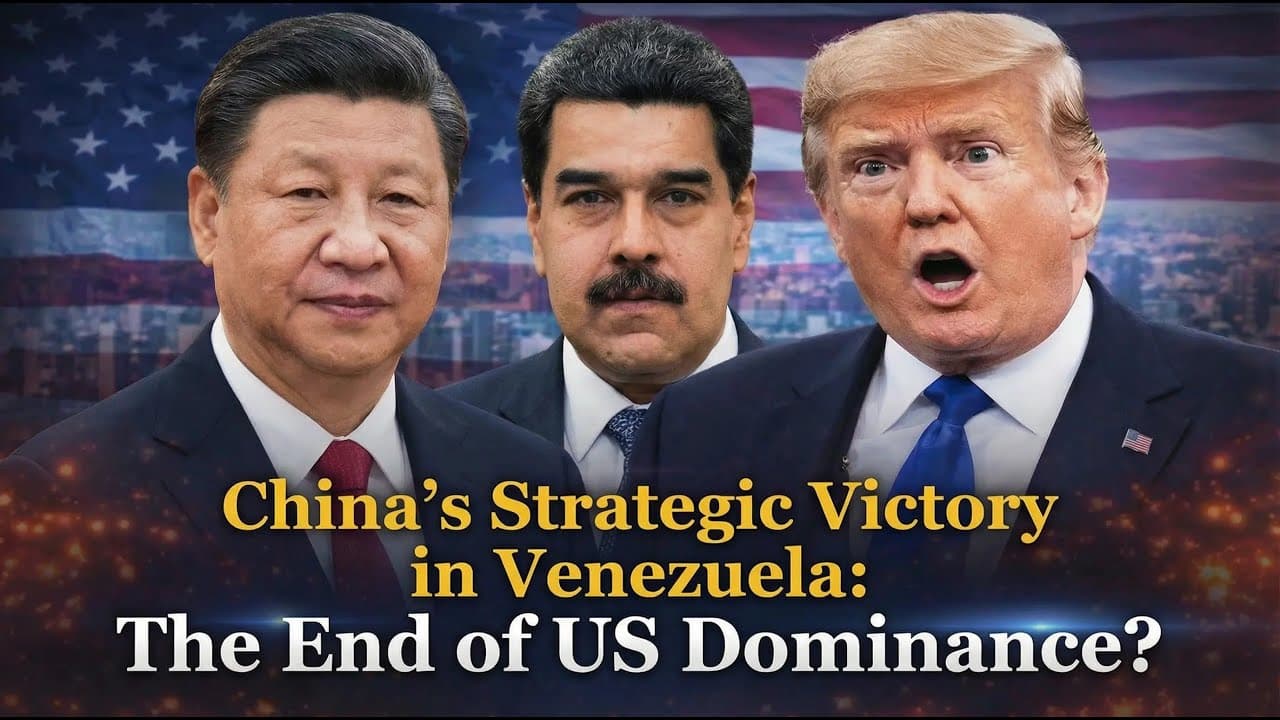
On January 3rd, 2026, more than 150 US aircraft struck Caracas and extracted President Nicolas Maduro to face narco-terrorism charges in New York. Yet China had positioned itself over 25 years through $60 billion in loans and control of 85% of Venezuela's oil exports, so it profits regardless of who governs Caracas.
Transcript
There is an ancient truth in the game of empires that Washington seems to have completely forgotten. You cannot seize a country's resources and call it liberation. You cannot kidnap a president and call it law enforcement. And you cannot bomb a sovereign nation and expect the rest of the world to applaud your virtue. What the United States just did... Read More
Key Insights
- Venezuela holds approximately 303 billion barrels of proven oil reserves, roughly 18% of Earth's oil, making it the largest petroleum repository on the planet, larger than Saudi Arabia's 267 billion barrels according to OPEC's 2025 annual statistical bulletin.
- Venezuelan oil is heavy, sour crude packed with sulfur, requiring specialized refineries. The US Gulf Coast refineries were built 50 years ago specifically to process this thick crude, so American 'energy independence' from light shale oil omits this dependency.
- On January 3rd, 2026, over 150 US aircraft struck Caracas, disabled critical infrastructure, and a ground team extracted Maduro and his wife within 30 minutes, placing him on the USS Iwo Jima to face narco-terrorism charges in New York.
- China cultivated Venezuela deliberately over two decades, with Venezuela becoming the first Hispanic nation to sign a strategic development partnership with China in 2001, evolving into an 'all-weather strategic partnership.'
- China extended nearly $60 billion in state loans to Venezuela since 2005, nearly double what it loaned any other Latin American nation, structured as oil-for-financing deals that guaranteed China oil shipments and a foothold in America's backyard.
- Approximately 85% of Venezuela's total crude production is now destined for Chinese refineries, which China built specifically to process the heavy sulfurous oil other nations could not handle efficiently, making Beijing indispensable.
- China's strategy is to control infrastructure, shipping lanes, refining capacity, and financial relationships rather than the government itself, so regime change does not erase its joint ventures, debt obligations, or commercial ties.
- The US now manages a nation of 30 million people whose economy contracted 75% over the past decade, with 6 million citizens having fled abroad, while Maduro's government structure, including Vice President Delcy Rodriguez, remains intact.
Install to Summarize YouTube Videos and Get Transcripts
Explore YouTube Video Summarizer or Get YouTube Transcript Extractor
Questions & Answers
Q: How much oil does Venezuela have?
Venezuela holds approximately 303 billion barrels of proven oil reserves according to OPEC's 2025 annual statistical bulletin, making it the largest petroleum repository on the planet, larger than Saudi Arabia's 267 billion barrels and larger than Iran, Canada, and Iraq combined. Nearly 18% of all oil on Earth lies beneath Venezuelan soil, concentrated in the Orinoco Belt, a formation stretching 600 kilometers across the country's central interior, which the US Geological Survey estimates could contain up to 1.4 trillion barrels in total deposits.
Q: What happened in Venezuela on January 3rd, 2026?
At approximately 2:00 a.m. local time, more than 150 American military aircraft crossed Venezuelan airspace, explosions rocked Caracas, and US forces disabled the city's critical infrastructure. Within 30 minutes, a ground team extracted President Nicolas Maduro and his wife from their fortified compound inside Fuerte Tiuna, the nation's largest military complex. By dawn, Maduro was aboard the USS Iwo Jima heading to New York to face narco-terrorism charges. Trump announced the United States would run the country until further notice.
Q: Why is Venezuelan oil so important to the United States?
Venezuela produces heavy, sour crude that is thick, viscous, and packed with sulfur, requiring specialized refineries to process. The massive refineries along the American Gulf Coast were built 50 years ago specifically to process this type of heavy crude. Although the US produces large amounts of light, sweet shale oil, its industrial machine that makes diesel, jet fuel, and lubricants was designed to run on Venezuela's thick crude. For decades Venezuela pumped, America refined, and everyone profited, until Chavez, nationalizations, sanctions, and China changed the relationship.
Q: How much has China invested in Venezuela?
According to data compiled by the Council on Foreign Relations, China has extended nearly $60 billion in state loans to Venezuela since 2005, nearly double the amount it has loaned any other Latin American nation. Most loans were structured as oil-for-financing agreements, giving Venezuela desperately needed capital and China guaranteed oil shipments. The China Development Bank and Export Import Bank of China became Venezuela's primary lenders when Western institutions withdrew, funding railways, telecommunications networks, and other infrastructure that replaced the role American capital once played.
Q: Why does China benefit regardless of who governs Venezuela?
China understands you do not need to control the government to control the resources; you need to control the infrastructure, shipping lanes, refining capacity, and financial relationships. Beijing built specialized refineries, trained personnel, and created joint ventures like Petrosinovensa, formed in 2008 to develop the Orinoco's extra heavy crude. Approximately 85% of Venezuela's crude now goes to Chinese refineries. Its billions in infrastructure, debt obligations, and commercial ties do not disappear with regime change, so China can maintain oil exports and relationships with whoever ends up governing.
Q: What was the significance of the timing of the US raid?
Just hours before the raid, Maduro was meeting China's special envoy for Latin American affairs, reaffirming their strategic partnership, discussing oil exports, and building what Maduro called a multipolar world of development and peace. The video argues this timing was not coincidental but a message sent to Washington. By capturing Maduro hours after he met Chinese diplomats, the US walked into a country where China had established deep commercial roots and created a crisis that, regardless of how it resolves, serves Beijing's strategic interests.
Q: How did China officially respond to the operation?
China's Foreign Ministry described the operation as deeply shocking and a blatant use of force against a sovereign state. Spokesman Lin Jian called it a violation of international law, the UN Charter, and basic norms governing relations between nations, and China demanded the immediate release of Maduro and his wife. However, Beijing did not threaten military retaliation, announce sanctions, withdraw its ambassador, or sever ties. Instead it emphasized maintaining positive communication and cooperation with whoever governs Venezuela and keeping oil exports unchanged, which the video calls strategic patience.
Q: What challenges does the US now face in Venezuela?
The United States is stuck managing a country of 30 million people with no clear exit strategy. Although Maduro was removed, his government structure remains, with Vice President Delcy Rodriguez assuming the presidency and Defense Minister Vladimir Padrino Lopez still commanding the military. Washington now bears responsibility for an economy that has contracted 75% over the past decade, hyperinflation that destroyed the currency, and providing basic services to a population from which 6 million citizens have fled. The video argues occupying a country is far more expensive than invading one.
Summary & Key Takeaways
-
On January 3rd, 2026, more than 150 US military aircraft struck Caracas, disabled infrastructure, and extracted President Nicolas Maduro within 30 minutes. Trump declared the US would run Venezuela until further notice, calling it one of the most powerful displays of American military might in history.
-
Venezuela sits on roughly 303 billion barrels of proven oil, the world's largest reserves, concentrated in the Orinoco Belt. Its heavy sour crude requires specialized refineries, historically the US Gulf Coast, but sanctions and nationalizations under Chavez pushed Venezuela toward China instead.
-
China spent 25 years and nearly $60 billion in loans making itself indispensable, taking 85% of Venezuela's oil exports and building joint ventures like Petrosinovensa. By controlling infrastructure rather than the government, Beijing profits regardless of the outcome while Washington inherits a collapsed economy with no exit strategy.
Read in Other Languages (beta)
Share This Summary 📚
Summarize YouTube Videos and Get Video Transcripts with 1-Click
Try YouTube Summary with ChatGPT & Claude or YouTube Transcript Generator
Explore More Summaries from Untold Money Secrets 📚
Summarize YouTube Videos and Get Video Transcripts with 1-Click
Try YouTube Summary with ChatGPT & Claude or YouTube Transcript Generator