How Is Harvard Responding to the Supreme Court Ruling?
TL;DR
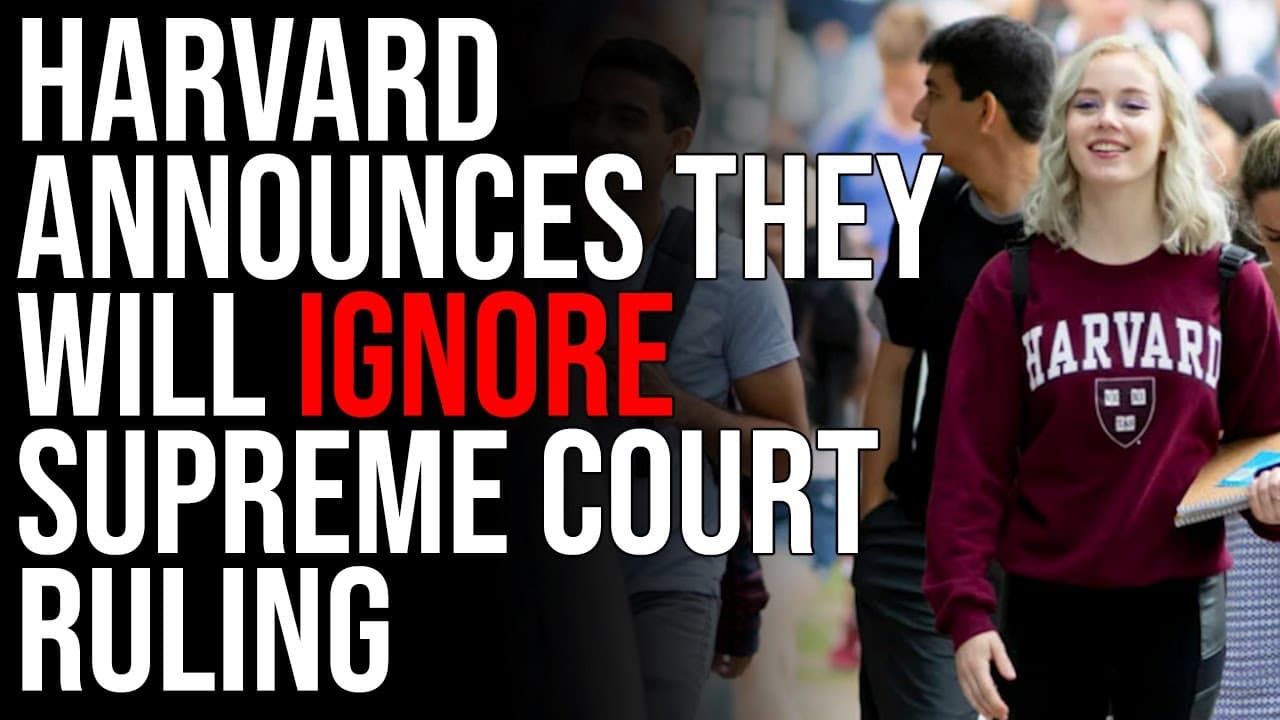
Harvard plans to bypass the Supreme Court's ruling on affirmative action by requiring students to write essays about their racial experiences. This strategy raises concerns about potential dishonesty among applicants and whether it truly supports diversity. Critics argue that such tactics continue to perpetuate racial bias in admissions.
Transcript
take a look at this tweet from uh Helena Johnson so let's see she is the editor-in-chief of the Free Beacon Harvard to turn to essays it says in email this is Harvard basically declaring they intend to ignore the Supreme Court ruling and use loopholes to keep being racist watch out the email says Dear members of the Harvard Community today the Supr... Read More
Key Insights
- 🎟️ Harvard's admission system has been found to be noncompliant with equal protection principles.
- 😌 Applicants may exploit the system by lying about their racial background to gain admission.
- 🎁 Affirmative action policies extend beyond universities and are present in hiring practices in public institutions.
- ❓ Suggesting that someone is a diversity hire or has benefited from affirmative action can be controversial.
- 🇨🇫 The public's perception and understanding of affirmative action are inconsistent and vary.
- 🛄 Affirmative action policies aim to provide equal opportunities, but their implementation can be flawed.
- 🤨 The recent Supreme Court ruling has raised concerns about the enforcement of fair admissions practices.
Install to Summarize YouTube Videos and Get Transcripts
Explore YouTube Video Summarizer or Get YouTube Transcript Extractor
Questions & Answers
Q: How does Harvard plan to continue racially biased admissions despite the Supreme Court ruling?
Harvard intends to have applicants write essays about their racial background and use that information to select students who align with their "woke ideology." However, this may be difficult to enforce, as some individuals may lie about their racial identity to gain admission.
Q: Are there instances where individuals have lied about their racial background to gain admission to Harvard?
Yes, there have been cases where individuals misrepresented their racial identity to secure admission. For example, an admissions consultant who was Indian claimed to be black to get into Harvard Medical School and now advocates against affirmative action.
Q: How does affirmative action extend beyond universities?
Affirmative action policies are present in various realms, including public institutions. They explicitly consider race as a hiring criterion, leading to diversity hires in government jobs, such as the Press Secretary and Vice President of the United States.
Q: Why is it controversial to suggest that someone is a diversity hire or has benefited from affirmative action?
While proponents argue that diversity hires and affirmative action create equal opportunities, insinuating someone is a diversity hire or has benefited from affirmative action is often perceived negatively. This discrepancy in perception highlights inconsistencies in the public's understanding of affirmative action.
Summary & Key Takeaways
-
Following the Supreme Court ruling in Students for Fair Admissions vs. President and Fellows of Harvard College, Harvard College's admission system has been found to be noncompliant with the principles of the equal protection clause.
-
The court ruled that colleges and universities can consider an applicant's discussion of how race affected their life in their admissions decisions.
-
People may exploit this system by lying about their racial background to gain admission, as exemplified by an admissions consultant who claimed to be black to get into Harvard Medical School.
Read in Other Languages (beta)
Share This Summary 📚
Summarize YouTube Videos and Get Video Transcripts with 1-Click
Try YouTube Summary with ChatGPT & Claude or YouTube Transcript Generator
Explore More Summaries from Timcast IRL 📚




Summarize YouTube Videos and Get Video Transcripts with 1-Click
Try YouTube Summary with ChatGPT & Claude or YouTube Transcript Generator