What Are the Levels of Consciousness and Ignorance?
TL;DR
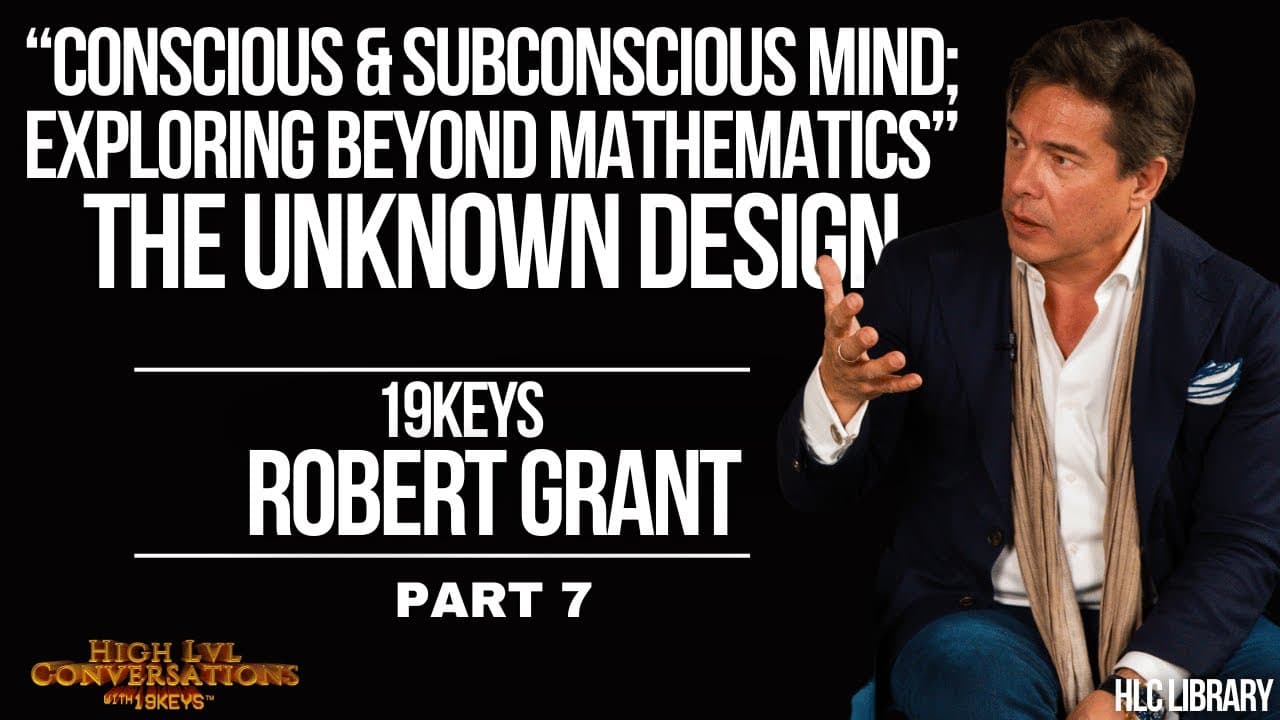
Consciousness can be divided into three levels: conscious knowledge, aware ignorance, and subconscious ignorance. The concept of entropy may represent the boundary between knowledge and ignorance, and scientists often avoid recognizing patterns that imply intelligent design to maintain a purely random framework in their work.
Transcript
I'm 19 keys and this is high Lev conversation we start out talking also about you know personality type and I tend to think of that which I know I know is what I call my conscious mind that which I know I don't know could be analogously my subconscious mind and then there's something Beyond The Border you know once you go past the I know what I kno... Read More
Key Insights
- ❓ Knowledge can be categorized into conscious knowledge, aware ignorance, and subconscious ignorance.
- ❓ The boundary between knowledge and ignorance might be represented by entropy.
- 🧑🔬 Scientists often avoid finding patterns as it challenges the notion of randomness and implies intelligent design.
- 💡 Science operates within a fixed framework and can disregard ideas that do not fit the current scientific consensus.
- ⁉️ The concept of entropy can be questioned when patterns are found within seemingly random systems.
- ✋ Scientists tend to find alternative explanations for the workings of the universe, avoiding the notion of a higher power or intelligence.
- 🔬 Science can be considered a religion of its own, often unwilling to admit its limitations and biases.
Install to Summarize YouTube Videos and Get Transcripts
Explore YouTube Video Summarizer or Get YouTube Transcript Extractor
Questions & Answers
Q: What is the speaker's interpretation of the three levels of knowledge?
According to the speaker, knowledge can be divided into conscious knowledge, aware ignorance, and subconscious ignorance. Conscious knowledge refers to what one knows, aware ignorance is an understanding of what one does not know, and subconscious ignorance is the realm of unknown unknowns.
Q: How does the speaker challenge the concept of entropy?
The speaker suggests that if even one pattern is found within a seemingly random system, it calls into question the idea that the entire system is truly random. This challenges the notion of entropy and opens up the possibility that everything is patterned.
Q: Why does the speaker believe science disregards things that do not fit the common scientific consensus?
The speaker argues that science often operates within a fixed framework and rejects ideas or findings that do not align with the current scientific consensus. This can hinder the exploration of patterns and intelligent design.
Q: What does the analogy of "scientists having daddy issues" mean?
The speaker uses the analogy to describe how scientists tend to find alternative explanations for the existence and workings of the universe, avoiding the idea of a greater intelligence or designer. It implies that scientists have a reluctance to acknowledge a higher power or intelligence.
Summary & Key Takeaways
-
The speaker discusses the concept of "knowing" and divides it into three categories: conscious knowledge, aware ignorance, and subconscious ignorance.
-
Entropy, defined as randomness, might actually be the boundary between knowledge and ignorance.
-
Science tends to avoid finding patterns as it implies the existence of a greater designer or intelligence.
Read in Other Languages (beta)
Share This Summary 📚
Summarize YouTube Videos and Get Video Transcripts with 1-Click
Try YouTube Summary with ChatGPT & Claude or YouTube Transcript Generator
Explore More Summaries from Earn Your Leisure 📚



Summarize YouTube Videos and Get Video Transcripts with 1-Click
Try YouTube Summary with ChatGPT & Claude or YouTube Transcript Generator