What Are Generative Adversarial Networks (GANs) and How Do They Work?
TL;DR
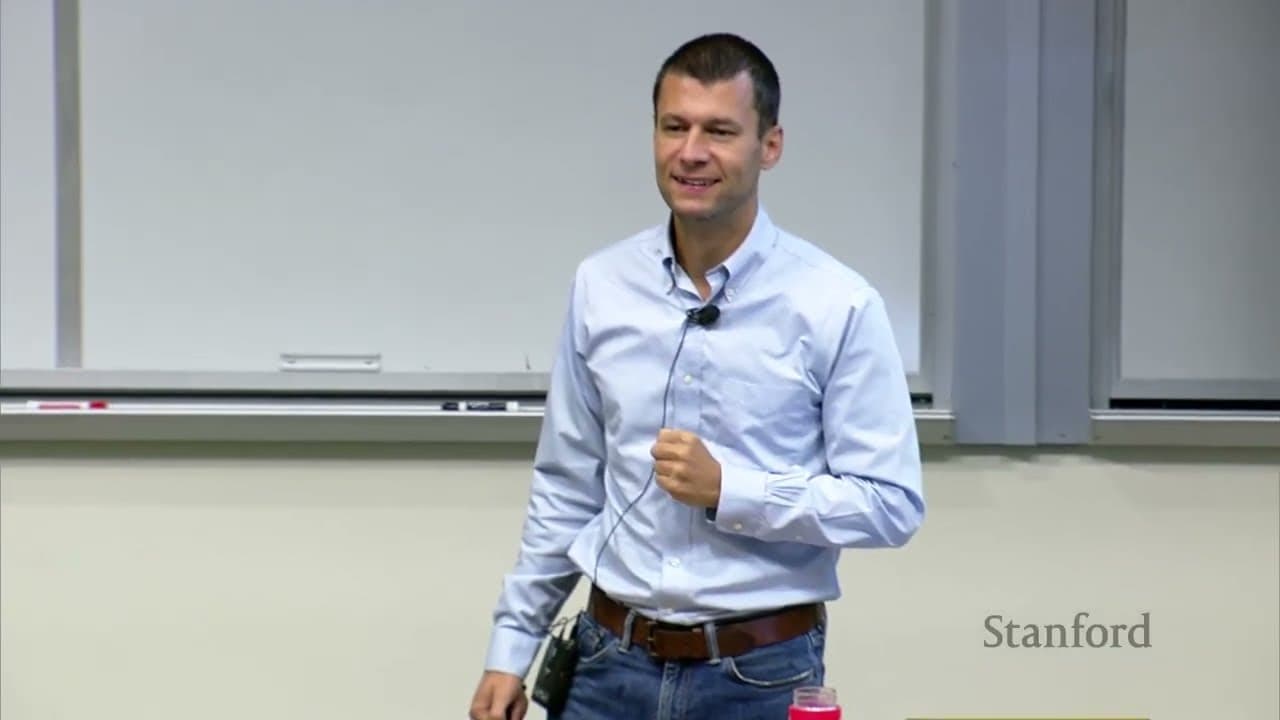
Generative Adversarial Networks (GANs) consist of a generator that creates samples and a discriminator that assesses their realism. Instead of relying on likelihood estimation, GANs create a minimax game where the generator aims to fool the discriminator, ultimately improving sample quality. Despite their promise, GANs face challenges like unstable training and mode collapse, highlighting the need for alternative models like diffusion for better stability.
Transcript
Read and summarize the transcript of this video on Glasp Reader (beta).
Key Insights
- Generative Adversarial Networks (GANs) offer an alternative approach to generative modeling by using a discriminator to differentiate between real and generated data samples.
- Traditional maximum likelihood estimation in generative models may not always lead to high-quality samples, motivating the need for alternative objectives like those used in GANs.
- The GAN framework involves a minimax game between a generator, which produces samples, and a discriminator, which tries to distinguish between real and fake samples.
- The optimal discriminator in a GAN is based on the density ratio between the data and model distributions, and the generator aims to minimize this distinction.
- Training GANs is challenging due to unstable optimization and issues like mode collapse, where the generator focuses on a limited set of outputs.
- Despite their challenges, GANs have been successfully used in various applications, including generating high-quality images and art.
- GANs do not require likelihood evaluation, allowing for flexible architecture choices for the generator, unlike other generative models.
- The lecture highlights the evolution of GANs and their current limitations, suggesting diffusion models as a more stable alternative for generative tasks.
Install to Summarize YouTube Videos and Get Transcripts
Explore YouTube Video Summarizer or Get YouTube Transcript Extractor
Questions & Answers
Q: What is the main objective of a Generative Adversarial Network (GAN)?
The main objective of a GAN is to train a generator to produce samples that are indistinguishable from real data samples. This is achieved through a minimax game between the generator and a discriminator, where the discriminator tries to distinguish between real and generated samples, and the generator aims to fool the discriminator by generating realistic samples.
Q: How does a GAN differ from traditional generative models that use maximum likelihood estimation?
Unlike traditional generative models that rely on maximum likelihood estimation, GANs do not require likelihood evaluation. Instead, they use a discriminator to measure the similarity between real and generated samples, allowing for more flexibility in model architecture. This approach can lead to high-quality sample generation but presents challenges in training stability.
Q: What are some challenges associated with training GANs?
Training GANs is challenging due to unstable optimization and issues like mode collapse, where the generator focuses on a limited set of outputs. The minimax optimization problem between the generator and discriminator can lead to oscillations and difficulty in convergence. Additionally, there is no robust stopping criterion, making it hard to determine when to stop training.
Q: What role does the discriminator play in a GAN?
The discriminator in a GAN acts as a binary classifier that distinguishes between real data samples and those generated by the generator. It is trained to maximize its ability to differentiate between the two, providing feedback to the generator. The discriminator's loss is used as a measure of how similar the generated samples are to real data, guiding the generator's training.
Q: How does the generator in a GAN learn to produce realistic samples?
The generator in a GAN learns to produce realistic samples by minimizing the discriminator's ability to distinguish between real and generated samples. It takes random noise as input and transforms it into samples through a neural network. The generator's objective is to confuse the discriminator, effectively learning to generate samples that are similar to real data.
Q: What is mode collapse in the context of GANs?
Mode collapse is a common issue in GANs where the generator produces a limited variety of outputs, focusing on a few modes of the data distribution while ignoring others. This results in a lack of diversity in the generated samples and occurs when the generator learns to exploit weaknesses in the discriminator, leading to suboptimal convergence.
Q: Why are GANs considered difficult to train compared to other generative models?
GANs are difficult to train due to the adversarial nature of the minimax optimization problem, which can lead to instability and oscillations. The lack of a clear stopping criterion and the potential for mode collapse further complicate training. These challenges require careful tuning and the use of various hacks and techniques to achieve stable and effective training.
Q: What advantages do GANs offer over other generative models?
GANs offer the advantage of not requiring likelihood evaluation, allowing for more flexible generator architectures. They can produce high-quality samples in a single pass, making them efficient for tasks like image generation. The adversarial framework also provides a novel way to measure sample quality, potentially leading to more perceptually realistic outputs compared to maximum likelihood-based models.
Summary & Key Takeaways
-
The lecture introduces Generative Adversarial Networks (GANs) as a class of generative models that use a discriminator to evaluate the similarity between real and generated data samples. This approach provides flexibility in model architecture and avoids the need for likelihood evaluation, unlike traditional models.
-
GANs involve a minimax optimization game between a generator and a discriminator, where the generator aims to produce samples indistinguishable from real data, and the discriminator attempts to differentiate between real and fake samples. This framework is based on the Jensen-Shannon divergence.
-
Despite their potential, GANs face challenges like unstable optimization and mode collapse, making them difficult to train effectively. The lecture discusses various tricks and techniques to improve GAN training and suggests diffusion models as a more stable alternative for generative tasks.
Read in Other Languages (beta)
Share This Summary 📚
Summarize YouTube Videos and Get Video Transcripts with 1-Click
Try YouTube Summary with ChatGPT & Claude or YouTube Transcript Generator
Explore More Summaries from Stanford Online 📚

Summarize YouTube Videos and Get Video Transcripts with 1-Click
Try YouTube Summary with ChatGPT & Claude or YouTube Transcript Generator