What Are Alkene Addition Reactions and Their Patterns?
TL;DR
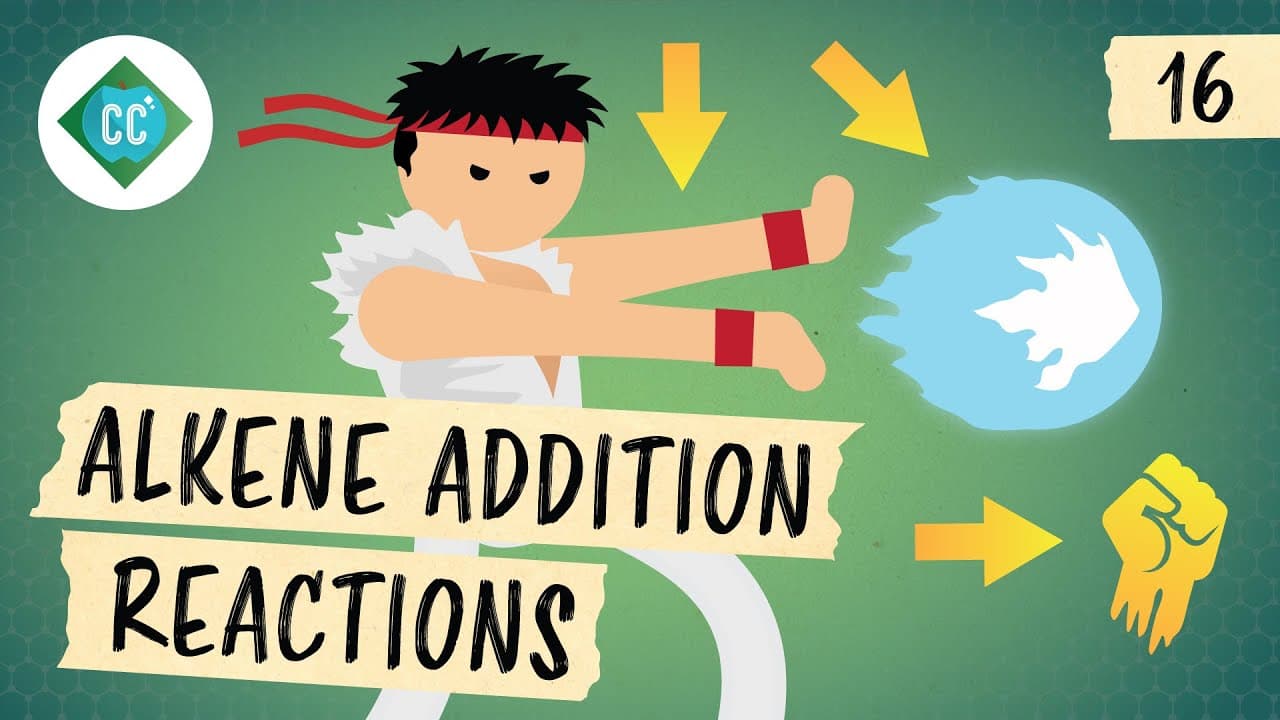
Alkene addition reactions involve adding two groups across a double bond, resulting from breaking the pi bond and forming sigma bonds. Key to predicting their outcomes are three questions: what is being added, the regioselectivity of the addition on asymmetrical molecules, and the stereochemistry of the added groups. Different types of addition reactions follow specific patterns and rules.
Transcript
You can review content from Crash Course Organic Chemistry with the Crash Course app, available now for Android and iOS devices. Hi! I’m Deboki Chakravarti and welcome to Crash Course Organic Chemistry! The Portuguese explorer Vasco da Gama sought a sea route to India in 1497 to bring black pepper and other spices back to Europe, which helped kick ... Read More
Key Insights
- 🖤 The pursuit of black pepper and the organic chemical piperine played a role in kickstarting the Age of Discovery due to their significance in trade.
- 🪜 Alkene addition reactions can be predicted by considering three key questions: what is being added across the double bond, where will the group add on an asymmetrical molecule, and what is the expected stereochemistry of the added groups.
- 💁 Different addition reactions, such as halogenation, halohydrin formation, acid-catalyzed hydration, and hydroboration, have specific patterns, regioselectivity, and stereochemistry associated with them.
- ❓ Acid-catalyzed hydration involves a 1,2 hydride shift and can result in carbocation rearrangements.
- 🚫 Oxymercuration blocks carbocation rearrangements and has Markovnikov regioselectivity.
- 🕍 Hydroboration has anti-Markovnikov regioselectivity, syn stereochemistry, and no carbocation rearrangements.
- 🆘 Recognizing these patterns and understanding the outcomes of alkene addition reactions can help in predicting their products and understanding their mechanisms.
Install to Summarize YouTube Videos and Get Transcripts
Explore YouTube Video Summarizer or Get YouTube Transcript Extractor
Questions & Answers
Q: What are the three key questions to consider when predicting the outcome of alkene addition reactions?
The three key questions are: 1) What is being added across the double bond? 2) Where will the group add on an asymmetrical molecule? 3) What is the expected stereochemistry of the added groups? These questions help determine the specific reaction and its outcome.
Q: How does halogenation differ from halohydrin formation in terms of regioselectivity?
Halogenation does not have regioselectivity since the same halogen group is added to both sides of the double bond. In halohydrin formation, water adds to the more substituted carbon of the double bond, exhibiting regioselectivity.
Q: What is the role of a catalyst in acid-catalyzed hydration?
The catalyst, typically an acid, helps add water across the double bond. It enables a 1,2 hydride shift to occur, resulting in the addition of a hydroxyl group to one of the carbons of the double bond.
Q: How does hydroboration differ from other alkene addition reactions?
Hydroboration exhibits anti-Markovnikov regioselectivity, meaning the smaller hydrogen adds to the more substituted carbon. It also has syn stereochemistry, with the boron and hydrogen adding to the same side of the double bond.
Summary & Key Takeaways
-
Alkene addition reactions follow a general pattern where the pi bond in the alkene is broken and two sigma bonds are formed, resulting in the addition of two groups across the double bond.
-
There are three key questions that help predict the outcome of alkene addition reactions: 1) What is being added across the double bond? 2) Where will the group add on an asymmetrical molecule? 3) What is the expected stereochemistry of the added groups?
-
Different addition reactions, such as halogenation, halohydrin formation, acid-catalyzed hydration, and hydroboration, have specific patterns, regioselectivity, and stereochemistry associated with them.
Read in Other Languages (beta)
Share This Summary 📚
Summarize YouTube Videos and Get Video Transcripts with 1-Click
Try YouTube Summary with ChatGPT & Claude or YouTube Transcript Generator
Explore More Summaries from CrashCourse 📚

Summarize YouTube Videos and Get Video Transcripts with 1-Click
Try YouTube Summary with ChatGPT & Claude or YouTube Transcript Generator