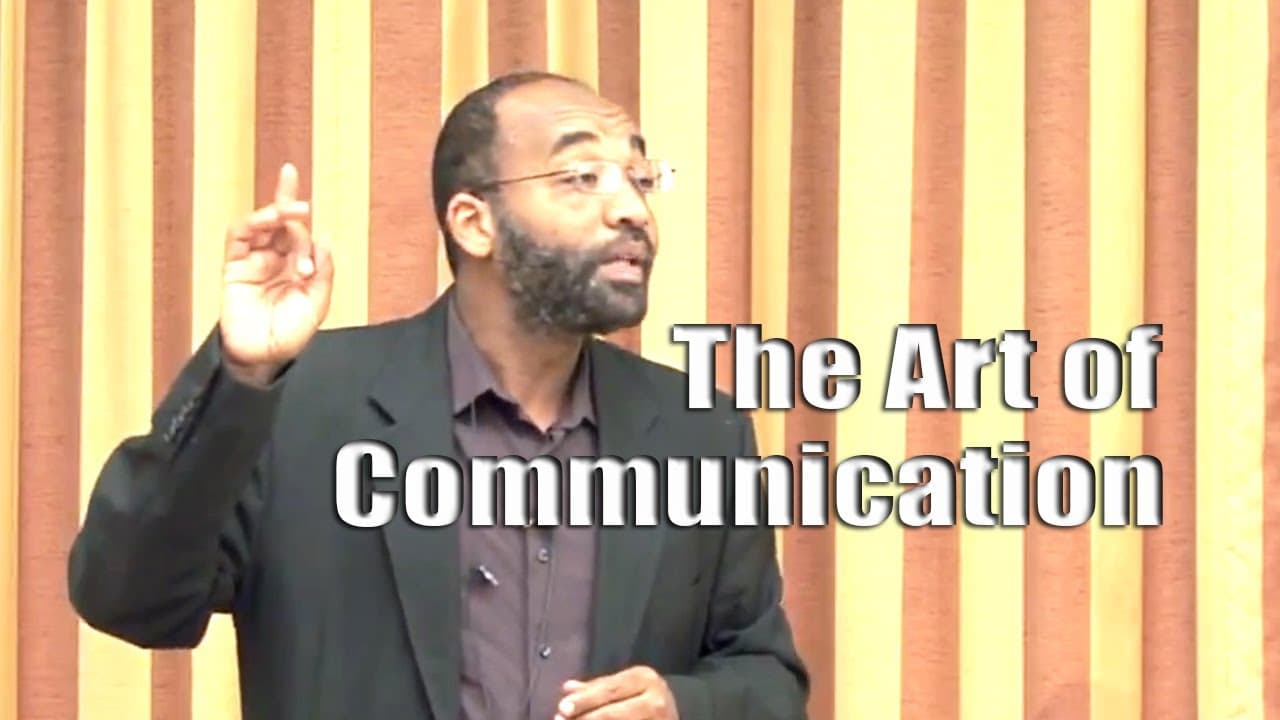
What Does Yassir Fazaga Teach About the Art of Communication?
TL;DR
Yassir Fazaga teaches that the art of communication requires both choosing the best words and listening carefully enough to recognize the best of what is said. Drawing on Quranic passages and a counseling story, he contrasts people’s fluency in anger with their difficulty expressing appreciation. Read on for his specific lessons about speech, listening, emotional vocabulary, and relationships.
Transcript
all Praises due to Allah and may his peace and blessings be upon our beloved Prophet Muhammad sallallahu alaihi wasallam I begin by greeting you all Allah says the most merciful taugh the Quran insan he created man and taught man the art of expressing himself or herself so when we say that this is really about the art of Comm communication I think ... Read More
Key Insights
- Expression is presented as a gift: Fazaga links the human ability to express ideas, thoughts, and feelings with Quranic teaching about creation and learning. This framing gives communication religious significance. It is not treated as an optional social technique, but as an ability that people have been taught and must use with care.
- Communication has two necessary sides: Speaking clearly is only one component of communication in Fazaga’s explanation. The message must also be received by another person, so listening belongs to the same process. The Quranic approach he describes changes emphasis according to the situation, but it does not reduce communication to either speech or listening alone.
- Best exceeds merely good: Fazaga stresses the Quranic instruction to say what is best rather than settling for what is simply good. He identifies the wording as a superlative or intensified form. The distinction raises the standard for a speaker, requiring selection among possible words instead of assuming that any acceptable statement is sufficient.
- Delivery matters with word choice: The problem is not limited to the content of a statement. Fazaga says people may be careless both with what they say and with how they say it. This makes communication a matter of wording and delivery together, since a speaker can fail to choose the best expression even when other choices are available.
- Good words have lasting strength: The Quranic parable cited by Fazaga compares a good word to a good tree that is firmly established, deeply rooted, and reaching upward through its branches. The image presents beautiful speech as something stable and elevated. It also reinforces why choosing words carefully matters within his account of communication.
- Anger can produce effortless fluency: Fazaga notes that a person who is upset may possess a seemingly endless dictionary of complaints. Angry speech can continue without hesitation and may expand into profanity or cursing. That abundance does not prove communication skill, because the speaker may still lack the vocabulary needed for constructive or affectionate expression.
- Positive feelings may remain unspoken: Happiness, joy, and appreciation can be harder to articulate than anger in Fazaga’s examples. His point is grounded in the imbalance between the many words available during conflict and the hesitation that appears when praise is requested. Emotional expression is therefore limited when a person develops only the language of displeasure.
- Problems are often easier to list: In the counseling account, the husband and wife could continue talking about their problems without stopping. The difficulty emerged only when the conversation shifted toward appreciation. This contrast reveals how repeated attention to grievances can make negative description immediate while leaving positive recognition slow, uncertain, and emotionally painful.
- A simple question changed the exchange: Fazaga did not initially answer the couple’s complaints or introduce another criticism. He asked the husband what he appreciated most about his wife. The question redirected attention from accumulated problems to valued qualities, exposing a gap that the couple’s fluent discussion of conflict had concealed.
- Delayed appreciation carries emotional weight: As the husband searched for an answer, his wife watched him and began to cry. His hesitation was therefore not merely a private vocabulary problem. It affected the person waiting to hear whether she was valued, showing why the ability to express appreciation matters inside a relationship.
- Listening enables meaningful selection: Fazaga cites believers who listen to what is said and then follow the best of it. Following the best requires attention first, because a person cannot distinguish among statements that were not actually heard. Listening is consequently presented as active reception that supports judgment, rather than passive exposure to sound.
- Failure to listen has consequences: In the Quranic account Fazaga recounts, people acknowledge that messengers and warnings reached them, but they rejected what was said. They later state that listening or using reason would have changed their outcome. The example makes receptive failure morally serious and places attentive listening beside thoughtful reasoning.
Install to Summarize YouTube Videos and Get Transcripts
Explore YouTube Video Summarizer or Get YouTube Transcript Extractor
Questions & Answers
Q: What does Yassir Fazaga teach about the art of communication?
Yassir Fazaga teaches that communication combines expressing an idea, thought, or feeling with receiving what another person says. He grounds speech in the Quranic instruction to say what is best, not merely what is good. He also presents believers as people who listen and follow the best of what they hear. Communication is therefore an art because both careful expression and attentive reception are difficult and necessary.
Q: What are the two components of communication in Fazaga’s explanation?
The two components are what is said and how it is received. Speaking carries an idea, thought, or feeling from one person to another. Listening allows the other person to attend to that message and identify the best of what was said. Fazaga explains that the Quranic approach values both components, with the needed emphasis depending on what is happening.
Q: Why should people say what is best rather than merely good?
Fazaga cites Quranic instructions telling people and Allah’s servants to say what is best. He emphasizes that the wording goes beyond asking for speech that is only good. This requires speakers to choose carefully among the words available to them. The Quranic parable of a good word as a firmly rooted tree reinforces the strength and elevation associated with beautiful speech.
Q: How does anger affect the way people express themselves?
Fazaga observes that many people become highly articulate when they are angry. They can continue speaking, use profanity or curses, and draw from a large vocabulary of hostile expressions. By contrast, they may have few words for happiness, joy, or appreciation. His comparison shows that verbal abundance during anger can coexist with a serious weakness in constructive communication.
Q: What happened when Fazaga asked a husband what he appreciated about his wife?
The husband and wife had been speaking continuously about their problems during a counseling session. Fazaga changed the topic and asked the husband what he appreciated most about his wife. The husband struggled for several minutes while his wife watched and began crying. He eventually answered that she cooked well and that she was beautiful, demonstrating his difficulty expressing appreciation.
Q: What does the counseling story show about positive communication?
The story shows that people may describe problems more easily than they express appreciation. The couple had no shortage of words while discussing what was wrong, but the husband hesitated when asked to name something valuable about his wife. His wife’s tears show that this inability affected her directly. Positive communication therefore requires a vocabulary and willingness that conflict-focused speech may not develop.
Q: Why is listening essential according to the Quranic examples Fazaga cites?
Fazaga recounts people in the Hellfire admitting that they had not listened or used their reason when warnings reached them. He contrasts them with believers who listen to what is said and follow the best of it. A person cannot identify and follow the best statement without first paying attention. Listening matters because reception, judgment, and response depend on actually hearing the message.
Q: Which is harder, speaking well or listening well?
Fazaga asks his audience whether speaking well or listening well is more challenging. His answer is that both are difficult. Speaking well requires careful selection of the best words and attention to how they are delivered. Listening well requires enough attention to understand what is said and recognize the best part of it.
Summary & Key Takeaways
-
Communication as a Quranic art: Yassir Fazaga begins by connecting communication with Allah teaching human beings how to express themselves. He presents expression as a bounty mentioned alongside creation, the name of Allah, and the learning and teaching of the Quran. Communication is not merely producing words. It involves conveying an idea, thought, or feeling to another person, which means both expression and reception must be considered.
-
Choosing the best speech: The Quranic approach addresses what people say and how they say it. Fazaga cites the covenant that includes worshipping Allah, being dutiful to parents, and treating orphans, needy people, and poor people well. He then emphasizes the instruction to speak to people with words that are best, not merely good. A good word is compared to a firmly rooted tree whose branches reach toward the heavens.
-
Anger exposes a vocabulary imbalance: Fazaga observes that people are often insufficiently careful about their words or delivery. Many can speak eloquently and at length when expressing anger, sometimes using profanity, curses, and an extensive hostile vocabulary. Yet the same people may struggle to describe happiness, joy, or appreciation. This contrast shows that effective expression is not demonstrated simply by verbal fluency, especially when that fluency appears mainly during conflict.
-
A counseling question reveals difficulty: During a counseling session with a struggling husband and wife, both spouses spoke continuously about their problems. Fazaga changed the subject by asking the husband what he appreciated most about his wife. The husband struggled for several minutes while his wife waited and began crying. He eventually said that she cooked well and was beautiful, illustrating how difficult positive expression can become even within an important relationship.
-
Listening completes the communication process: Fazaga then turns from speech to receiving what is said. He cites a Quranic account in which people entering the Hellfire admit that they did not listen or use their reason, despite receiving warnings from messengers. By contrast, believers are praised for listening to what is said and following its best part. Fazaga concludes this excerpt by asking whether speaking well or listening well is harder, then states that both are difficult.
Read in Other Languages (beta)
Share This Summary 📚
Summarize YouTube Videos and Get Video Transcripts with 1-Click
Try YouTube Summary with ChatGPT & Claude or YouTube Transcript Generator
Explore More Summaries from Yassir Fazaga 📚


Summarize YouTube Videos and Get Video Transcripts with 1-Click
Try YouTube Summary with ChatGPT & Claude or YouTube Transcript Generator