How Does the JMP Instruction Work in Beta Architecture?
TL;DR
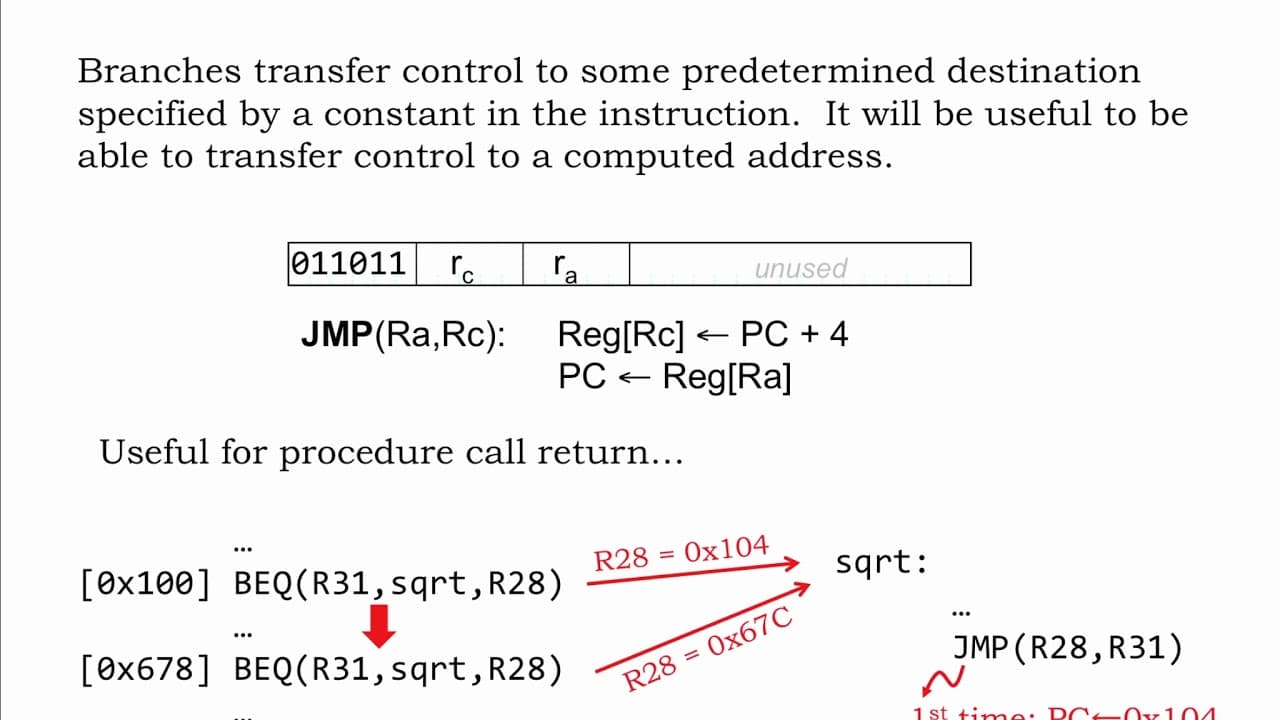
The JMP instruction in Beta architecture facilitates unconditional transfers of control by setting the program counter to the value from register 'ra'. This allows for the computation of target instruction addresses, crucial for implementing procedure calls. The Beta architecture supports 32 registers for operands and can access up to 4 gigabytes of memory using 32-bit addresses.
Transcript
Finally, our last instruction! Branches conditionally transfer control to a specific target instruction. But we'll also need the ability to compute the address of the target instruction - that ability is provided by the JMP instruction which simply sets the program counter to value from register "ra". Like branches, JMP will write the PC+4 value in... Read More
Key Insights
- 🎯 Branches and JMP instructions enable control transfer and computation of target instruction addresses in the Beta architecture.
- 🤙 Procedure calls in Beta are implemented using BEQ instructions and the JMP instruction.
- 🫡 The Beta architecture includes 32 registers for ALU operands and uses main memory for data storage.
- ♿ Memory access in Beta utilizes 32-bit addresses, allowing access to 4 gigabytes of memory.
- 😫 The Beta instruction set architecture consists of two instruction formats and three classes of instructions: ALU operations, memory access (LD and ST), and control flow operations (branches and JMPs).
- 😜 The JMP instruction sets the program counter based on the value in register "ra", facilitating address computation and control flow changes.
- 🤙 The implementation of procedure calls in Beta allows for calling and returning from procedures within the main program.
Install to Summarize YouTube Videos and Get Transcripts
Explore YouTube Video Summarizer or Get YouTube Transcript Extractor
Questions & Answers
Q: What is the purpose of the JMP instruction in the Beta architecture?
The JMP instruction sets the program counter to the value from register "ra", enabling the computation of the target instruction's address. It is useful for implementing procedures and changing the order of execution.
Q: How is the implementation of procedure calls demonstrated in the content?
The content showcases the implementation of procedure calls using BEQ (branch if equal) instructions and the JMP instruction. The programmer calls the procedure from different parts of the program, and the JMP instruction allows for returning to the main program.
Q: What is the role of registers in the Beta architecture?
The Beta architecture provides 32 registers that hold values as operands for the ALU (Arithmetic Logic Unit). These registers are used to perform computations and store intermediate results.
Q: What are the key features of the Beta instruction set architecture?
The Beta instruction set architecture includes 32 registers for ALU operands, memory access through main memory, 32-bit memory addresses allowing access to 4 gigabytes of memory, and instruction formats specifying opcodes, registers, and constants.
Summary & Key Takeaways
-
Branches and JMP instruction allow for conditional and unconditional transfers of control to specific target instructions, respectively.
-
The JMP instruction sets the program counter to the value from register "ra", allowing for the computation of the address of the target instruction.
-
The Beta architecture supports 32 registers for ALU operands, uses main memory for data storage, and can access up to 4 gigabytes of memory through 32-bit addresses.
Read in Other Languages (beta)
Share This Summary 📚
Summarize YouTube Videos and Get Video Transcripts with 1-Click
Try YouTube Summary with ChatGPT & Claude or YouTube Transcript Generator
Explore More Summaries from MIT OpenCourseWare 📚


Summarize YouTube Videos and Get Video Transcripts with 1-Click
Try YouTube Summary with ChatGPT & Claude or YouTube Transcript Generator