Why Quasars are so Awesome | Space Time
TL;DR
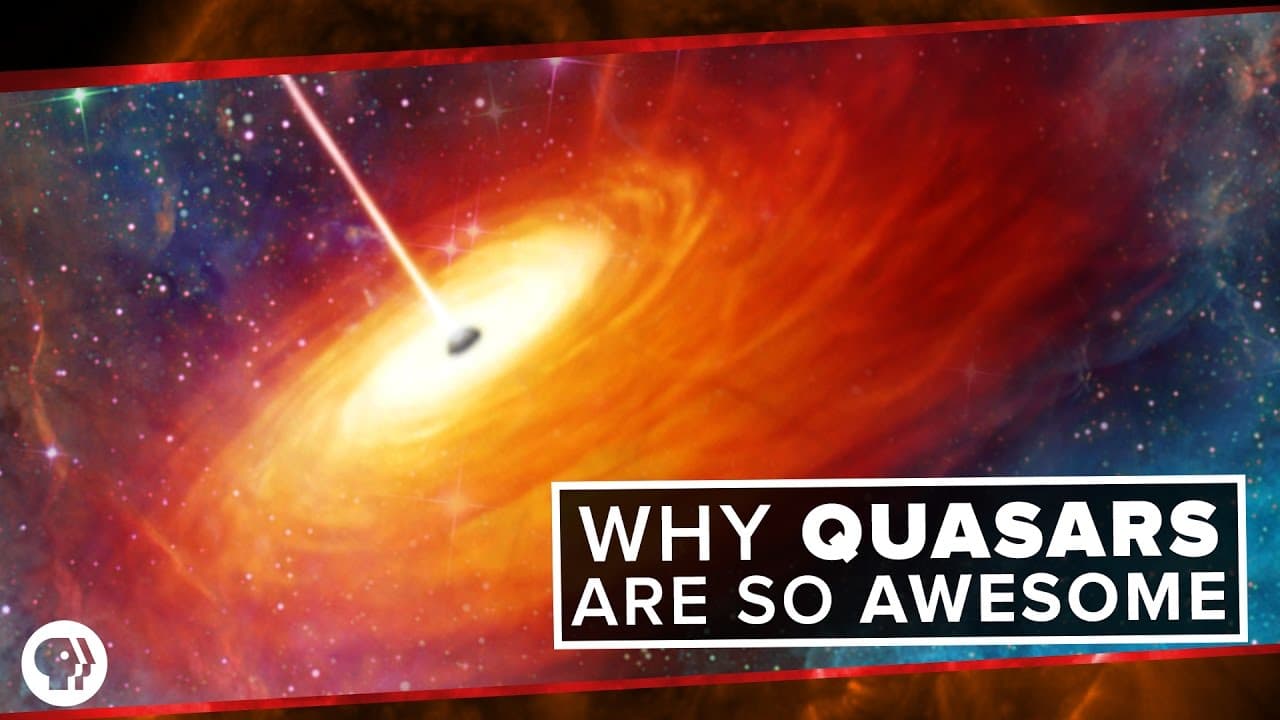
Quasars are powerful, supermassive black holes shaping the universe.
Transcript
[MUSIC PLAYING] This episode is supported by the Great Courses Plus. One of the most enigmatic of all astrophysical phenomena is the mighty quasar. They're also a subject of my own research, and so are close to my heart. Let's talk about what happens when the largest black holes in the universe start to feed. [MUSIC PLAYING] Space stuff is awesome.... Read More
Key Insights
- Quasars are extremely luminous and energetic phenomena powered by supermassive black holes at the center of galaxies, emitting more light than entire galaxies.
- The discovery of quasars began with early radio telescopes detecting mysterious radio blobs, leading to the identification of quasi-stellar radio sources.
- Quasars are characterized by their redshifted spectra, indicating they are located billions of light years away, emitting immense energy from a small region.
- The formation of quasars involves gas being driven into a galaxy's core, forming an accretion disk around a supermassive black hole, converting motion into heat and light.
- Quasars played a crucial role in the early universe, influencing star formation and the evolution of galaxies by heating and dispersing gas.
- The orientation and properties of quasars, such as the presence of jets, determine their appearance and classification, including radio galaxies and blazars.
- Although the peak of quasar activity has passed, active galactic nuclei still exist, with quasars like 3C273 serving as remnants of a more violent cosmic era.
- Future galactic mergers, such as that between the Milky Way and Andromeda, could trigger new quasar activity, illuminating the universe once more.
Install to Summarize YouTube Videos and Get Transcripts
Explore YouTube Video Summarizer or Get YouTube Transcript Extractor
Questions & Answers
Q: What are quasars and how are they powered?
Quasars are extremely luminous and energetic phenomena powered by supermassive black holes at the centers of galaxies. They emit more light than entire galaxies from a small region. This immense energy is generated by gas falling into the black hole's gravitational well, forming an accretion disk where motion is converted into heat and light.
Q: How were quasars first discovered?
Quasars were first discovered using early radio telescopes that detected mysterious radio blobs in the sky. These blobs were identified as quasi-stellar radio sources when optical telescopes pinpointed their location and analyzed their spectra. The redshifted spectra indicated they were billions of light years away, emitting immense energy.
Q: What role did quasars play in the early universe?
Quasars played a crucial role in shaping the early universe by influencing star formation and galaxy evolution. They heated and dispersed gas in galaxies, affecting the rate of star formation. This activity contributed to the transition from a universe dominated by starbursts to one where galaxies could stabilize and life could eventually emerge.
Q: How do the orientation and properties of quasars affect their appearance?
The orientation and properties of quasars, such as the presence of jets, significantly affect their appearance and classification. If viewed edge-on, the accretion disk is obscured by dust, while jets can create radio galaxies. When jets are pointed towards us, relativistic beaming magnifies their light, creating blazars. These variations define the family of active galactic nuclei.
Q: What is the significance of the quasar 3C273?
3C273 is one of the most luminous quasars known, serving as a relic of a more violent cosmic era. It was among the first quasars discovered, helping astronomers understand these phenomena. Its light comes from a time long after the quasar epoch, illustrating the enduring presence of active galactic nuclei in the universe.
Q: Could future galactic events trigger new quasar activity?
Yes, future galactic events, such as the merger between the Milky Way and Andromeda, could trigger new quasar activity. Such mergers drive gas into galactic cores, forming accretion disks around supermassive black holes. This process could reignite quasar activity, illuminating the universe with new bursts of energy.
Q: What are the key differences between quasars and other active galactic nuclei?
Quasars are the most luminous type of active galactic nuclei, characterized by their extreme brightness and energy output. Other types, such as Seyfert galaxies, are less luminous and more common in the modern universe. The key differences lie in the power of the accretion disk and the presence of features like jets, which define their classification.
Q: How did early radio telescopes contribute to the discovery of quasars?
Early radio telescopes contributed to the discovery of quasars by detecting mysterious radio blobs in the sky. These blobs were initially difficult to locate due to poor spatial resolution. However, events like the occultation of 3C273 by the moon allowed astronomers to pinpoint their locations, leading to the identification of quasars as powerful cosmic phenomena.
Summary & Key Takeaways
-
Quasars are among the most luminous and energetic phenomena in the universe, powered by supermassive black holes at the centers of galaxies. They emit more light than entire galaxies from a small region, making them visible across vast cosmic distances.
-
The discovery of quasars began with early radio telescopes detecting mysterious radio blobs, leading to the identification of quasi-stellar radio sources. Their redshifted spectra revealed they were located billions of light years away, emitting immense energy.
-
Quasars played a crucial role in shaping the early universe by influencing star formation and galaxy evolution. Although their peak activity has passed, active galactic nuclei still exist, with remnants like 3C273 serving as relics of a more violent cosmic era.
Read in Other Languages (beta)
Share This Summary 📚
Summarize YouTube Videos and Get Video Transcripts with 1-Click
Try YouTube Summary with ChatGPT & Claude or YouTube Transcript Generator
Explore More Summaries from PBS Space Time 📚


Summarize YouTube Videos and Get Video Transcripts with 1-Click
Try YouTube Summary with ChatGPT & Claude or YouTube Transcript Generator