What Is a Convolutional Neural Network and How Does It Work?
TL;DR
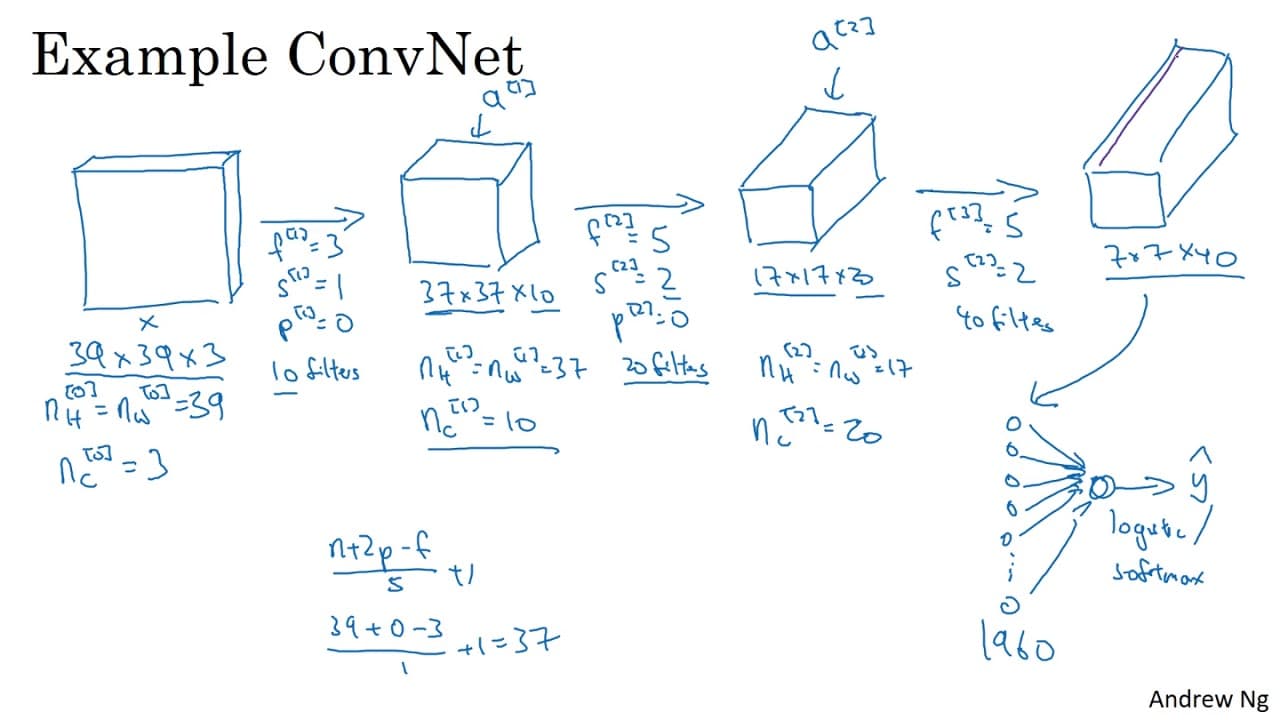
A convolutional neural network (CNN) processes images through multiple layers, utilizing filters to detect features. In a typical CNN example, an image transitions through layers with changing dimensions, beginning from an input size of 39x39x3 and reducing down to a final feature vector, allowing for classification tasks such as image recognition. Key components include convolutional, pooling, and fully connected layers.
Transcript
in the last video you saw the building boss of a single layer the single convolutional layer in a confident now let's go through a concrete example of a deep convolutional neural network and this will give you some practice with the notation that we introduced to at the end of the last video as well let's say you have an image and you want to do im... Read More
Key Insights
- ❓ Convolutional neural networks (CNNs) are commonly used for image classification and recognition tasks.
- 🧑🏭 The dimensions of the convolutional layers in a CNN are determined by factors such as the input image size, filter size, and stride.
- 🍁 Pooling layers help in reducing the dimensionality of feature maps and extracting important features.
- ⚾ Fully connected layers are used for classification and making predictions based on the extracted features.
Install to Summarize YouTube Videos and Get Transcripts
Explore YouTube Video Summarizer or Get YouTube Transcript Extractor
Questions & Answers
Q: How do you determine the dimensions of the convolutional layers in a CNN?
The dimensions of the convolutional layers in a CNN are determined by the input image size, filter size, stride, and number of filters used. The formula n + 2P - F / S + 1 is often used to calculate the output dimensions.
Q: What is the purpose of using pooling layers in a CNN?
Pooling layers are used to reduce the dimensions of the feature maps and extract the most important features. They help in reducing computational complexity and improving the efficiency of the network.
Q: How are fully connected layers used in a CNN architecture?
Fully connected layers, also known as FC layers, are used to process the flattened feature maps and make predictions based on the extracted features. They are typically used at the end of a CNN to classify the input image into different categories.
Q: What are some common hyperparameters that need to be chosen in a CNN?
Some common hyperparameters in a CNN include filter size, stride, padding, and the number of filters used in each convolutional layer. These hyperparameters play a crucial role in determining the network's performance and should be carefully chosen.
Summary & Key Takeaways
-
The video provides a concrete example of building a convolutional neural network (CNN) for image classification.
-
It explains the notation and steps involved in constructing the network, including the use of convolution and filters.
-
The video introduces the concepts of input layers, convolutional layers, and how the dimensions of the images and filters change throughout the network.
Read in Other Languages (beta)
Share This Summary 📚
Summarize YouTube Videos and Get Video Transcripts with 1-Click
Try YouTube Summary with ChatGPT & Claude or YouTube Transcript Generator
Explore More Summaries from DeepLearningAI 📚





![How Does the Logistic Regression Decision Boundary Work? — #33 Machine Learning Specialization [Course 1, Week 3, Lesson 1] thumbnail](/_next/image?url=https%3A%2F%2Fi.ytimg.com%2Fvi%2F0az8RjxLLPQ%2Fhqdefault.jpg&w=750&q=75)
Summarize YouTube Videos and Get Video Transcripts with 1-Click
Try YouTube Summary with ChatGPT & Claude or YouTube Transcript Generator