Did dark matter kill the dinosaurs? | Lisa Randall and Lex Fridman
TL;DR
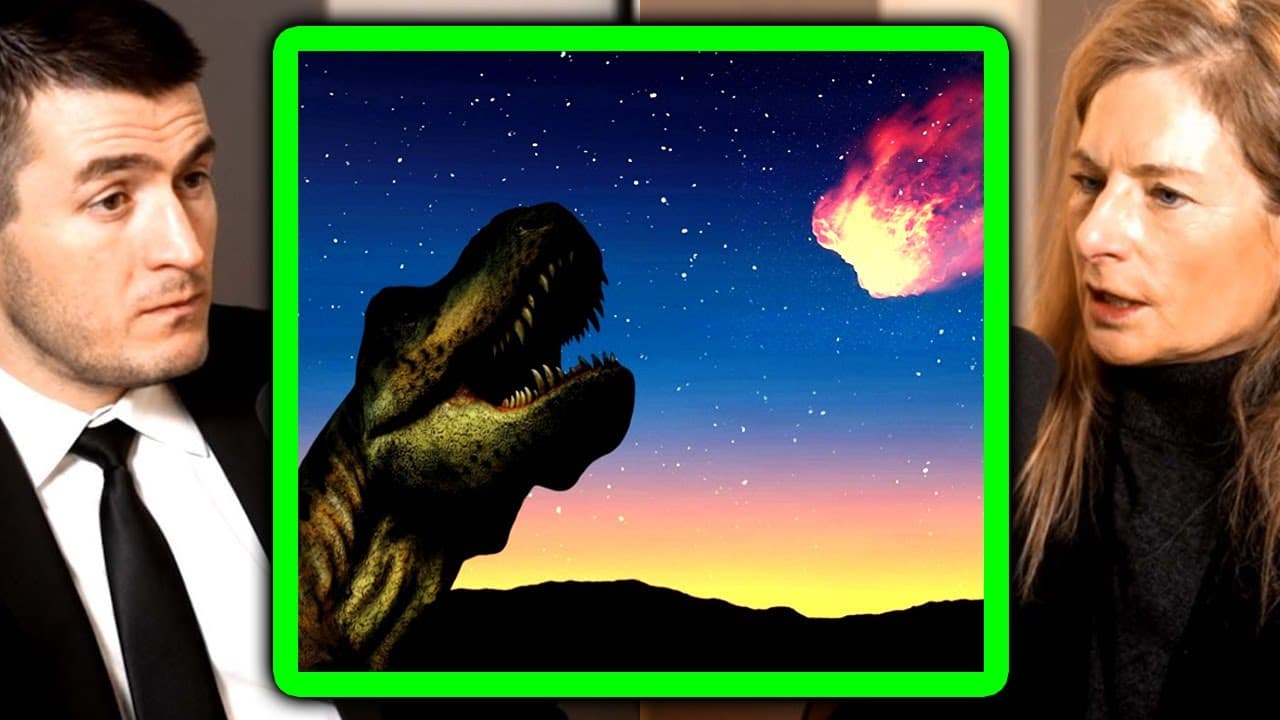
Dark matter might have indirectly contributed to the dinosaurs’ extinction by gravitationally dislodging an object from the cloud at the solar system’s edge, but Lisa Randall emphasizes that this theory is speculative and unconfirmed. The proposal involves a small fraction of dark matter collapsing into a thin disc, whose existence could be tested using stellar positions and velocities. Read on to understand the mechanism and the evidence scientists could seek.
Transcript
uh dark matter matter having to do something with the extinction events the extinction of the dinosaurs um which is kind of a fascinating presentation of how everything is connected so I guess the disturbances from the dark matter they create gravitational disturbances in the OR Cloud at the edge of our solar system and then that increases the rate... Read More
Key Insights
- 💩 Dark matter disturbances may play a role in the increased likelihood of asteroids hitting Earth.
- 🕶️ There could be a fraction of dark matter with its own interactions and structures.
- 🤩 Investigating the positions and velocities of stars can provide insights into the structure of the Milky Way and the potential existence of a dark matter disc.
- 🦕 The last extinction event, which wiped out dinosaurs, may have been caused by a cataclysmic event potentially triggered by dark matter disturbances.
- 🥺 Earth's history and the formation of humans are the result of numerous operations on different scales, including the impact event that led to the extinction of dinosaurs.
- 🫡 Understanding the intricate processes and history of Earth can help in preserving and respecting the planet.
- 👻 The scientific nature of the dark matter theory allows for experimental and observational testing.
Install to Summarize YouTube Videos and Get Transcripts
Explore YouTube Video Summarizer or Get YouTube Transcript Extractor
Questions & Answers
Q: Did dark matter kill the dinosaurs?
Lisa Randall describes that possibility as a speculative theory, not an established conclusion. The idea is that dark matter disturbances could have dislodged an object from the cloud at the solar system’s edge, increasing the probability of an Earth impact associated with an extinction event.
Q: How could dark matter increase the rate of asteroids hitting Earth?
The solar system moves around the galaxy while oscillating slightly up and down. The proposal suggests that certain passages could produce gravitational disturbances that dislodge objects from the cloud at the edge of the solar system, increasing the probability of impacts.
Q: What kind of dark matter structure does Lisa Randall propose?
Randall proposes that a small fraction of dark matter, not all of it, might have interactions of its own. If that fraction radiates what she calls “dark light,” it could collapse into a very thin, condensed disc, much as ordinary matter collapsed into the Milky Way disc.
Q: What is “dark light” in this proposal?
Randall uses “dark light” to describe radiation that dark matter could see but humans cannot. If some dark matter emits this radiation, it might lose energy and collapse into a disc.
Q: How could scientists test whether a dark matter disc exists?
Scientists can measure the positions and velocities of stars to infer the Milky Way’s structure. Those observations could reveal whether a thin dark matter disc exists and provide observational consequences against which the proposal can be tested.
Q: Is the dark matter extinction theory confirmed?
No. Randall explicitly calls it speculative and says researchers still do not know whether it is true, while emphasizing that it is scientific because its experimental and observational consequences can be investigated.
Q: Why is the dinosaur extinction story scientifically significant to Randall?
Randall says it brings together different fields of science and illustrates how a seemingly simple story about a large object striking Earth can have a rigorous scientific account. She also connects the impact and dinosaur extinction to the later development of mammals and, eventually, humans.
Q: What broader lesson does Randall draw from Earth’s history?
Randall argues that people should consider the many stages required to produce the present world, including the formation of structure, galaxies, the solar system, Earth, and humans. Because humanity is changing the planet too quickly, she says understanding that history should encourage greater care for Earth, even though the planet is resilient on a grand scale.
Summary & Key Takeaways
-
Speculative theory suggests that dark matter disturbances create gravitational disturbances in the OR Cloud, increasing the rate of asteroids hitting Earth.
-
Dark matter may have interesting structures and interactions, with a fraction of it potentially forming a thin disc.
-
Scientists are studying the positions and velocities of stars to investigate the existence of a dark matter disc and its potential effects on the solar system.
Read in Other Languages (beta)
Share This Summary 📚
Summarize YouTube Videos and Get Video Transcripts with 1-Click
Try YouTube Summary with ChatGPT & Claude or YouTube Transcript Generator
Explore More Summaries from Lex Clips 📚


Summarize YouTube Videos and Get Video Transcripts with 1-Click
Try YouTube Summary with ChatGPT & Claude or YouTube Transcript Generator