5.2.5 Sequential Circuit Timing
TL;DR
Single-clock synchronous systems in digital circuit design ensure stable and valid signals by using a shared clock across all registers.
Transcript
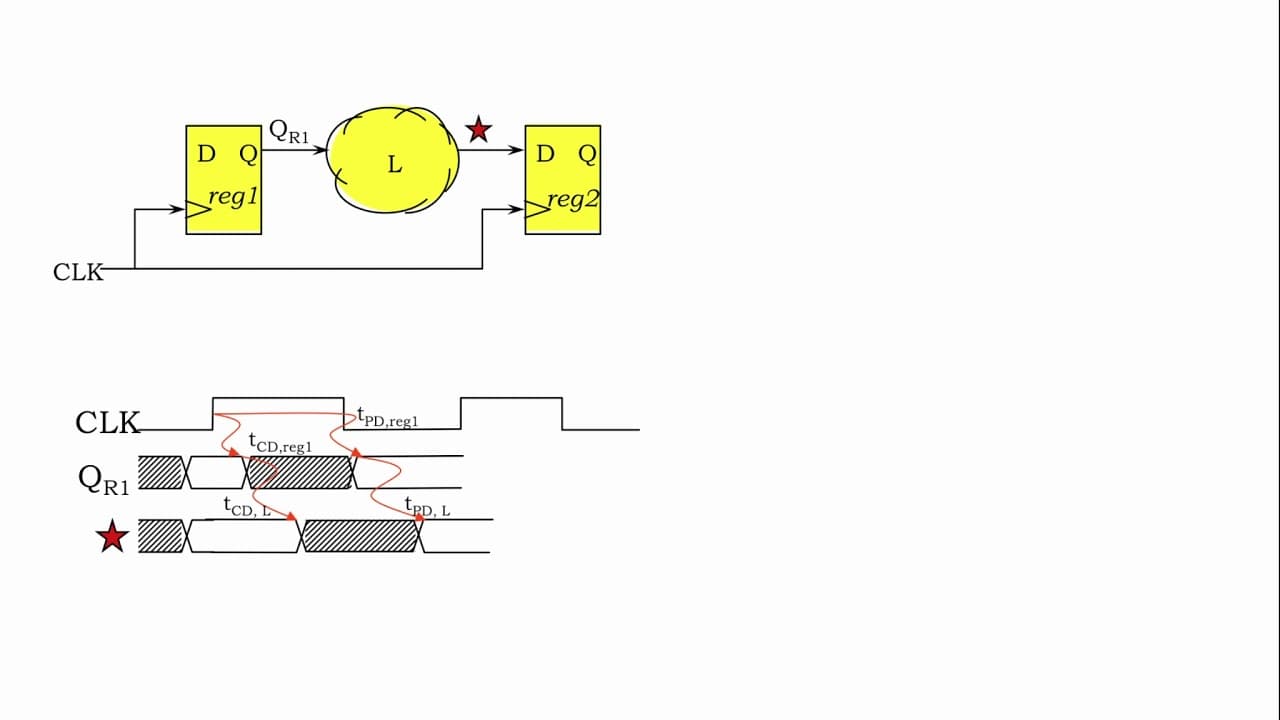
In 6.004, we have a specific plan on how we’ll use registers in our designs, which we call the single-clock synchronous discipline. Looking at the sketch of a circuit on the left, we see that it consists of registers — the rectangular icons with the edge-triggered symbol — and combinational logic circuits, shown here as little clouds with inputs an... Read More
Key Insights
- 😒 Single-clock synchronous discipline uses registers and combinational logic circuits to create a circuit without combinational cycles.
- ⏲️ Choosing a single clock signal simplifies timing analysis, although multiple clock signals are possible with more complexity.
- ⏲️ Timing analysis involves considering contamination and propagation delays, setup and hold times, and choosing an appropriate clock period.
- 🎨 Dummy logic may be required to create necessary contamination delay when designing circuits without combinational logic.
- ⏲️ Clock skew, where the clock signal arrives at different registers at different times, impacts timing analysis and circuit performance.
- ⏰ The clock period characterizes the performance of a digital system, and variations in manufacturing processes can lead to different clock frequencies in processor chips.
Install to Summarize YouTube Videos and Get Transcripts
Explore YouTube Video Summarizer or Get YouTube Transcript Extractor
Questions & Answers
Q: What is the purpose of the single-clock synchronous discipline in digital circuit design?
The single-clock synchronous discipline ensures stable and valid signals by organizing the circuit with registers and combinational logic circuits, eliminating combinational cycles.
Q: Can multiple clock signals be used in a digital circuit?
Yes, it is possible to use multiple clock signals, but analyzing the timing for signals crossing clock domains can be complex and challenging.
Q: How are timing analysis and stable signals related in digital circuit design?
Timing analysis involves choosing an appropriate clock period that is greater than the t_PD (contamination delay) of paths from register outputs to inputs, ensuring stable and valid signals for the registers' setup and hold times.
Q: How does clock skew affect digital circuits?
Clock skew, where the clock signal arrives at one register before another, can increase the apparent setup and hold times of the downstream register, impacting timing analysis and circuit performance.
Summary & Key Takeaways
-
Single-clock synchronous discipline in digital circuit design relies on registers and combinational logic circuits to create a circuit without combinational cycles.
-
Using a single periodic clock signal simplifies timing analysis, but multiple clock signals are possible with complex timing challenges.
-
Timing analysis involves ensuring stable and valid signals for register inputs, choosing an appropriate clock period, and considering setup and hold times.
Read in Other Languages (beta)
Share This Summary 📚
Summarize YouTube Videos and Get Video Transcripts with 1-Click
Try YouTube Summary with ChatGPT & Claude or YouTube Transcript Generator
Explore More Summaries from MIT OpenCourseWare 📚


Summarize YouTube Videos and Get Video Transcripts with 1-Click
Try YouTube Summary with ChatGPT & Claude or YouTube Transcript Generator