Stanford ENGR108: Introduction to Applied Linear Algebra | 2020 | Lecture 38 - VMLS classification
TL;DR
Explore the concept of classification in data analysis, where outcomes are categorical, and learn about error metrics to evaluate the accuracy of classifiers.
Transcript
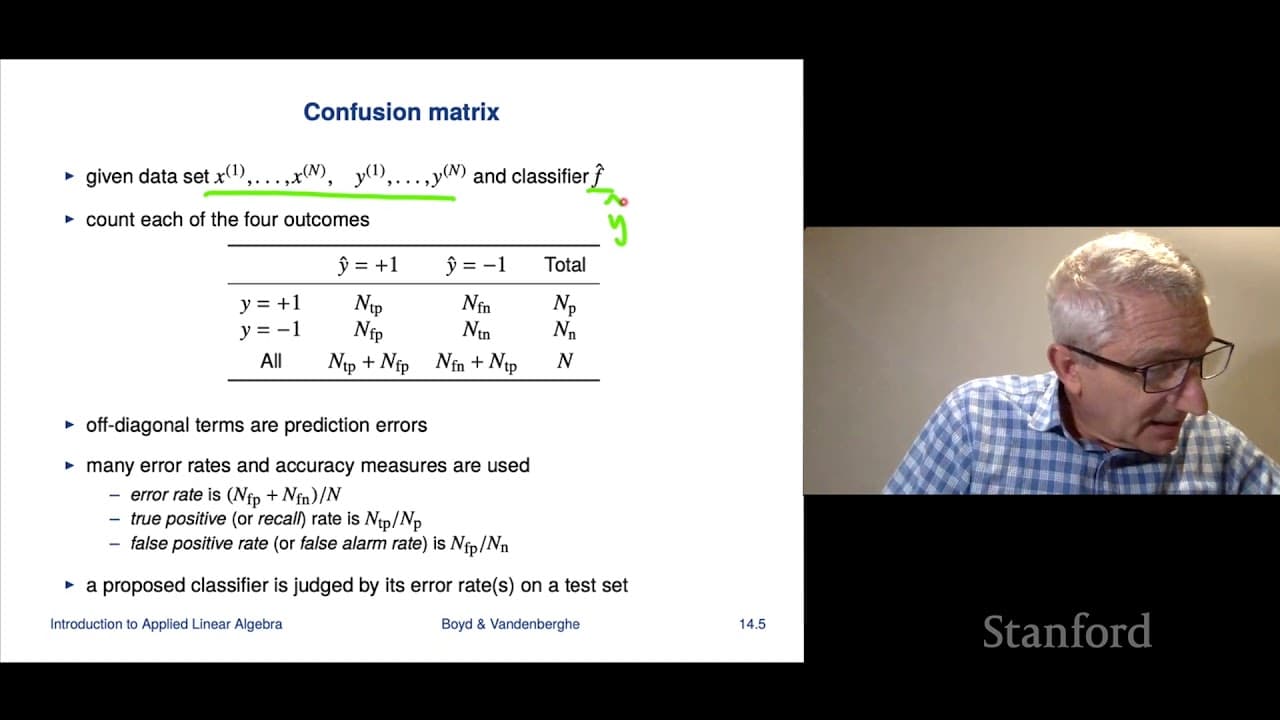
in the last chapter we looked at least squares regression or prediction what we're going to do now is look at a different form of prediction and that's going to be when the thing you're predicting takes on a finite number of values like you know true or false that's called classification and we'll see how that works in this lecture and we'll also s... Read More
Key Insights
- #️⃣ Classification predicts outcomes that have a finite number of possible values, such as true or false.
- 💁 Boolean classification is a common form of classification with two outcomes: +1 for true and -1 for false.
- 💌 Applications of classification include email spam detection, financial fraud detection, document classification, disease detection, and digital communications receiver.
- ☠️ Error metrics, such as error rate, true positive rate, and false positive rate, are used to assess the accuracy of classifiers.
- ❎ A confusion matrix is a useful tool for analyzing classification results, showing the number of true positives, true negatives, false positives, and false negatives.
- 📈 The choice of error metrics depends on the specific application and the importance of different types of errors.
- 😫 Evaluating classifiers on a test set is crucial to determine their performance on new, unseen data.
Install to Summarize YouTube Videos and Get Transcripts
Explore YouTube Video Summarizer or Get YouTube Transcript Extractor
Questions & Answers
Q: What is classification in data analysis?
Classification is a prediction method used when the outcome variables contain a finite number of values. It involves categorizing data into different classes based on given features.
Q: How does boolean classification work?
Boolean classification is the simplest and most common form of classification. It involves two possible outcomes, usually represented as true (+1) or false (-1). A classifier function assigns these labels based on the given features.
Q: Can you give an example of the application of classification?
One example is email spam detection. The features of an email, such as word counts or origin, are used to predict whether it is spam or not. By analyzing data and assigning appropriate labels, the classifier can identify and block spam emails.
Q: What are some error metrics used in evaluating classification models?
Common error metrics include error rate, true positive rate (recall), and false positive rate. The error rate calculates the percentage of incorrect predictions. True positive rate measures the proportion of correctly classified positive cases, while false positive rate measures the proportion of negative cases incorrectly classified as positive.
Summary & Key Takeaways
-
Classification is a form of prediction where the outcome is a finite number of values, such as true or false, spam or not spam, or different variations of a disease.
-
In boolean classification, there are only two possible outcomes, and the classifier is represented by a function that assigns either -1 or +1 to each data point.
-
Common applications of classification include email spam detection, financial transaction fraud detection, document classification, disease detection, and digital communications receiver.
Read in Other Languages (beta)
Share This Summary 📚
Summarize YouTube Videos and Get Video Transcripts with 1-Click
Try YouTube Summary with ChatGPT & Claude or YouTube Transcript Generator
Explore More Summaries from Stanford Online 📚



Summarize YouTube Videos and Get Video Transcripts with 1-Click
Try YouTube Summary with ChatGPT & Claude or YouTube Transcript Generator