How Can Orange Juice Help You Absorb Iron from Kale and Spinach?
TL;DR
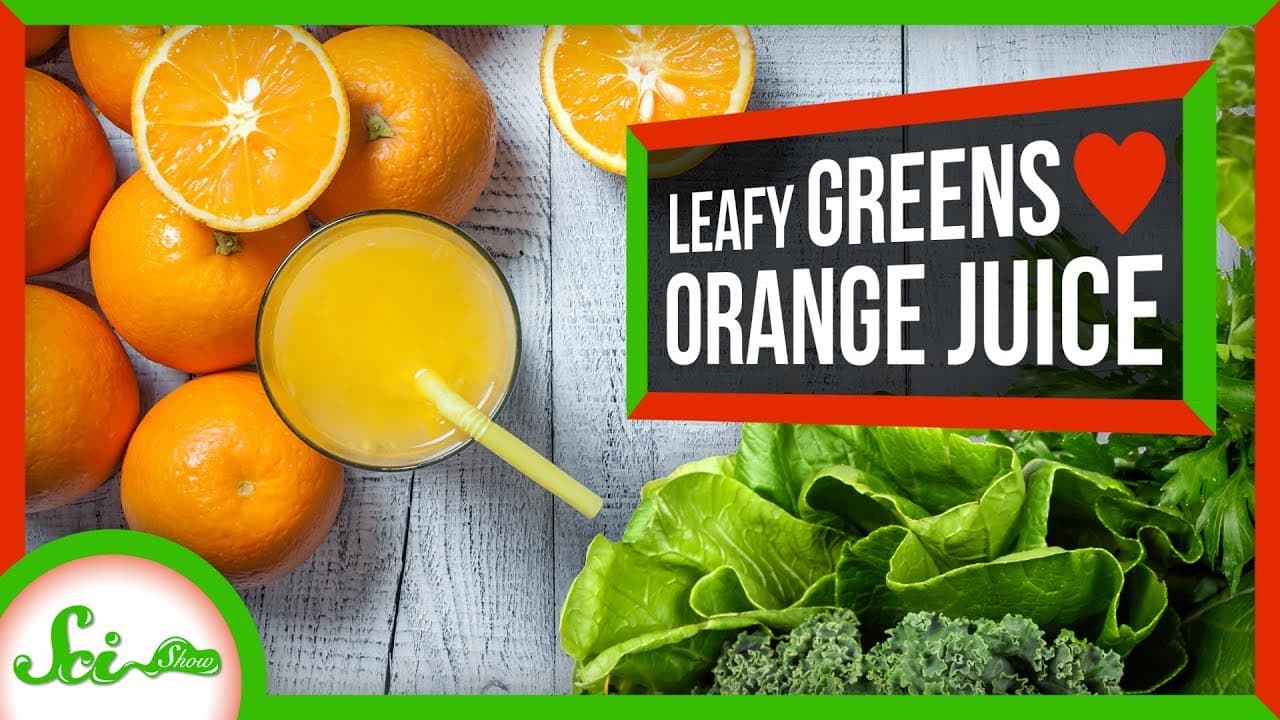
Orange juice can make kale and spinach more beneficial by helping the body absorb their non-heme iron. Its vitamin C shares an electron with the iron and forms a complex that keeps it soluble long enough for absorption. Vitamin C also helps ferritin receive and store iron inside cells, so read on to understand the food chemistry behind this pairing.
Transcript
This episode of SciShow is sponsored by Wix. Go to wix.com/go/scishow to create your own website. [♪ INTRO] Now, there’s no shortage of classic food pairings out there: peanut butter and jelly, chicken and waffles, spinach and orange juice... Wait, what? Well, that’s right. Thanks to a bit of food chemistry, spinach and orange juice are a nutrition... Read More
Key Insights
- 🟠 Spinach and orange juice make a beneficial food pairing due to the ability of vitamin C in orange juice to enhance the absorption of iron from spinach.
- ♻️ Iron comes in two forms: heme iron from animal products and non-heme iron from plant sources, including leafy greens.
- 😘 Non-heme iron has lower bioavailability, but vitamin C can increase its absorption by reducing its charge and forming a complex with it.
- ♻️ Vitamin C also supports iron storage in cells and helps regulate iron levels in the body.
- 😋 Increasing the intake of foods rich in vitamin C, such as oranges and other citrus fruits, can aid in iron absorption from plant-based sources.
- ♻️ Understanding the different types of dietary iron and their bioavailability is crucial for maintaining an adequate iron intake.
- 🧡 The combination of spinach and orange juice can be a healthy choice, especially for individuals with iron deficiency or anemia.
Install to Summarize YouTube Videos and Get Transcripts
Explore YouTube Video Summarizer or Get YouTube Transcript Extractor
Questions & Answers
Q: How can orange juice make kale better?
The vitamin C in orange juice can increase the bioavailability of non-heme iron from plant sources such as kale and spinach. It helps keep the iron in a soluble form that the body can absorb.
Q: Why are spinach and orange juice a beneficial food pairing?
Spinach provides non-heme iron, while orange juice provides vitamin C that helps the body absorb that iron. Together, they form what the episode describes as a nutritional pairing based on food chemistry.
Q: What is the difference between heme and non-heme iron?
Heme iron comes attached to a chemical structure bound within various proteins and generally comes from animal products. Non-heme iron lacks those attachments and generally comes from plant sources, including leafy greens.
Q: Why is non-heme iron harder for the body to absorb?
Non-heme iron has much lower bioavailability than heme iron. It can lose electrons and change into a more positively charged form that is insoluble in the blood, limiting how much enters the bloodstream.
Q: How does vitamin C improve non-heme iron absorption?
Vitamin C shares an electron with the iron, producing a less positively charged form that is easier to absorb. This increases the bioavailability of non-heme iron.
Q: How does vitamin C keep iron soluble?
The ascorbate molecule in vitamin C forms a complex with non-heme iron. That complex keeps the iron soluble long enough for the body to absorb it.
Q: Does meat contain non-heme iron?
Yes, the episode says meat contains quite a bit of non-heme iron even though heme iron generally comes from animal products. Non-heme iron remains the more common dietary form and has lower bioavailability.
Q: How does vitamin C support iron storage in cells?
At the cellular level, ascorbate helps ferritin, a protein that receives and stores iron. Ferritin acts like a storage closet for iron inside the cell.
Summary & Key Takeaways
-
Orange juice, due to its vitamin C content, can aid in the absorption of iron from vegetables like spinach.
-
Iron comes in two main varieties: heme iron found in animal products and non-heme iron found in plant sources like spinach.
-
Non-heme iron, which is more common in our diets, has lower bioavailability, but vitamin C in orange juice can increase its absorption.
Read in Other Languages (beta)
Share This Summary 📚
Summarize YouTube Videos and Get Video Transcripts with 1-Click
Try YouTube Summary with ChatGPT & Claude or YouTube Transcript Generator
Explore More Summaries from SciShow 📚


Summarize YouTube Videos and Get Video Transcripts with 1-Click
Try YouTube Summary with ChatGPT & Claude or YouTube Transcript Generator