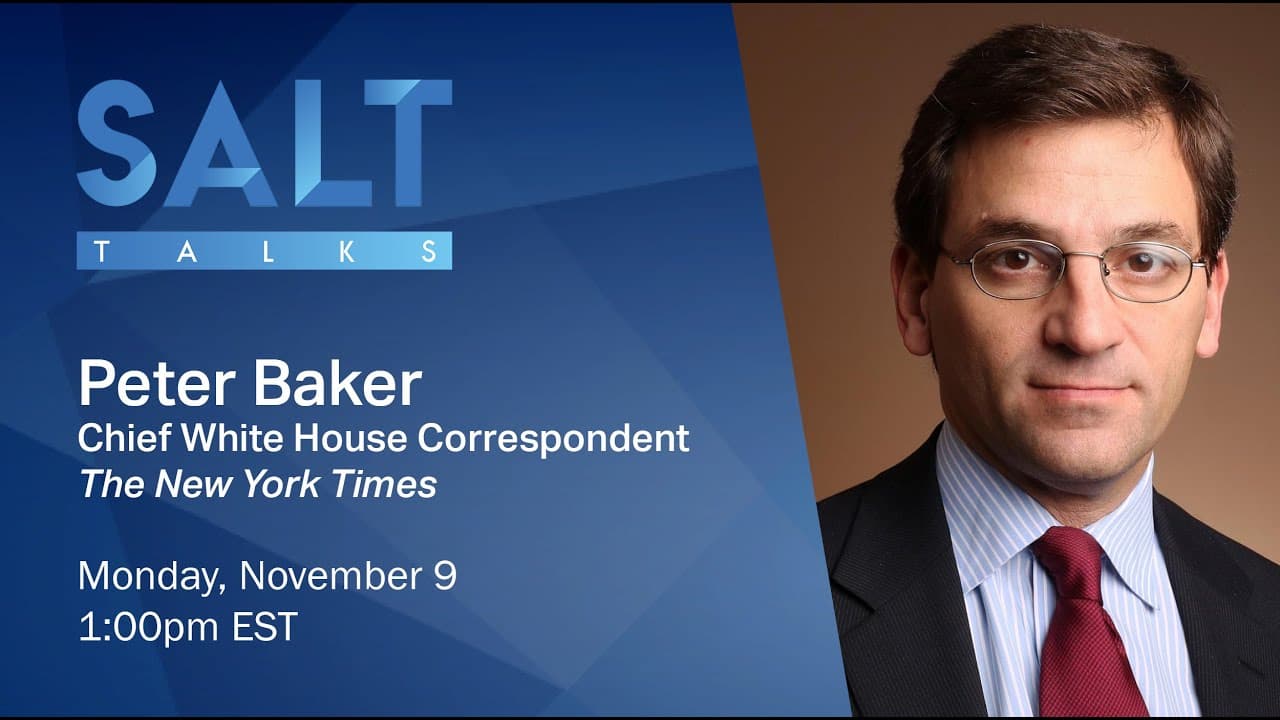
Who Was James Baker? Peter Baker of @nytimes and Susan Glasser Discuss “The Man Who Ran Washington” | SALT Talks #106
TL;DR
James Baker was a pragmatic Republican power broker who prioritized making deals and getting results over ideological purity. From the end of Watergate to the end of the Cold War, he ran five presidential campaigns, served twice as White House chief of staff, and held the offices of Treasury secretary and secretary of state. Read on to understand his accomplishments, worldview, and continuing political relevance.
Transcript
hello everyone and welcome back to salt talks my name is john darcy i'm the managing director of salt which is a global thought leadership forum and networking platform at the intersection of finance technology and public policy salt talks are a digital interview series that we launched during the work from home period with leading investors creato... Read More
Key Insights
- "he actually ran five different national presidential campaigns" (3:22)
- "he's the only person ever to be chief of staff twice" (3:47)
- "but for baker compromise was how you got things done" (4:48)
Install to Summarize YouTube Videos and Get Transcripts
Explore YouTube Video Summarizer or Get YouTube Transcript Extractor
Questions & Answers
Q: Who was James Baker?
James Baker was a national political figure whose period at the height of power stretched from the end of Watergate to the end of the Cold War. He ran five national presidential campaigns and became a principal with a seat at the table in Washington.
Q: What were James Baker's major political accomplishments?
Baker served as White House chief of staff under Ronald Reagan and later George H.W. Bush, making him the only person described in the interview as holding that role twice. He was also Treasury secretary during the successful negotiation of the 1986 tax reform bill and secretary of state from 1989 to 1992.
Q: What was James Baker's political worldview?
Baker was characterized as a small-c Texas conservative and a pragmatist. His guiding approach was to make things happen, get things done, and move the ball down the field, even when that required compromise.
Q: Why did Peter Baker and Susan Glasser write “The Man Who Ran Washington”?
They wanted to use James Baker's career to examine how Washington became dysfunctional and gridlocked. Susan Glasser said Baker also became unexpectedly relevant to the political moment, although Donald Trump had not yet entered Washington politics when they began the project seven years earlier.
Q: How did James Baker use compromise to get things done?
Baker viewed compromise as a practical way to produce results rather than as a betrayal. After fighting elections aggressively, he would sit down with the other side and pursue agreements on taxes, Social Security, and the Contra war.
Q: How did James Baker influence foreign policy?
As secretary of state from 1989 to 1992, Baker operated during the momentous end of the Cold War. He negotiated with the Soviets and Germans, as well as with Arabs and Israelis.
Q: Did James Baker ever hold elected office?
The discussion compares Baker to Robert Moses as someone who did not hold elected office but remained central to major decisions and policy. Baker exercised influence through presidential campaigns and senior roles including chief of staff, Treasury secretary, and secretary of state.
Q: What did James Baker say and do about Donald Trump?
The interview says Baker called Donald Trump crazy in 2016 but still voted for him. It also says Baker refused to break away from Trump during the 2020 election, prompting a discussion about Baker and the allure of power in Washington.
Summary & Key Takeaways
-
James Baker's career spanned from the end of Watergate to the end of the Cold War, during which he served as White House Chief of Staff, Secretary of the Treasury, and Secretary of State.
-
Baker was a pragmatic politician who prioritized compromise and getting things done, regardless of ideology.
-
His friendship and partnership with George H.W. Bush played a significant role in shaping US foreign policy during this period.
Read in Other Languages (beta)
Share This Summary 📚
Summarize YouTube Videos and Get Video Transcripts with 1-Click
Try YouTube Summary with ChatGPT & Claude or YouTube Transcript Generator
Explore More Summaries from SALT 📚



Summarize YouTube Videos and Get Video Transcripts with 1-Click
Try YouTube Summary with ChatGPT & Claude or YouTube Transcript Generator