How to Utilize Traditional ML for Graph Tasks
TL;DR
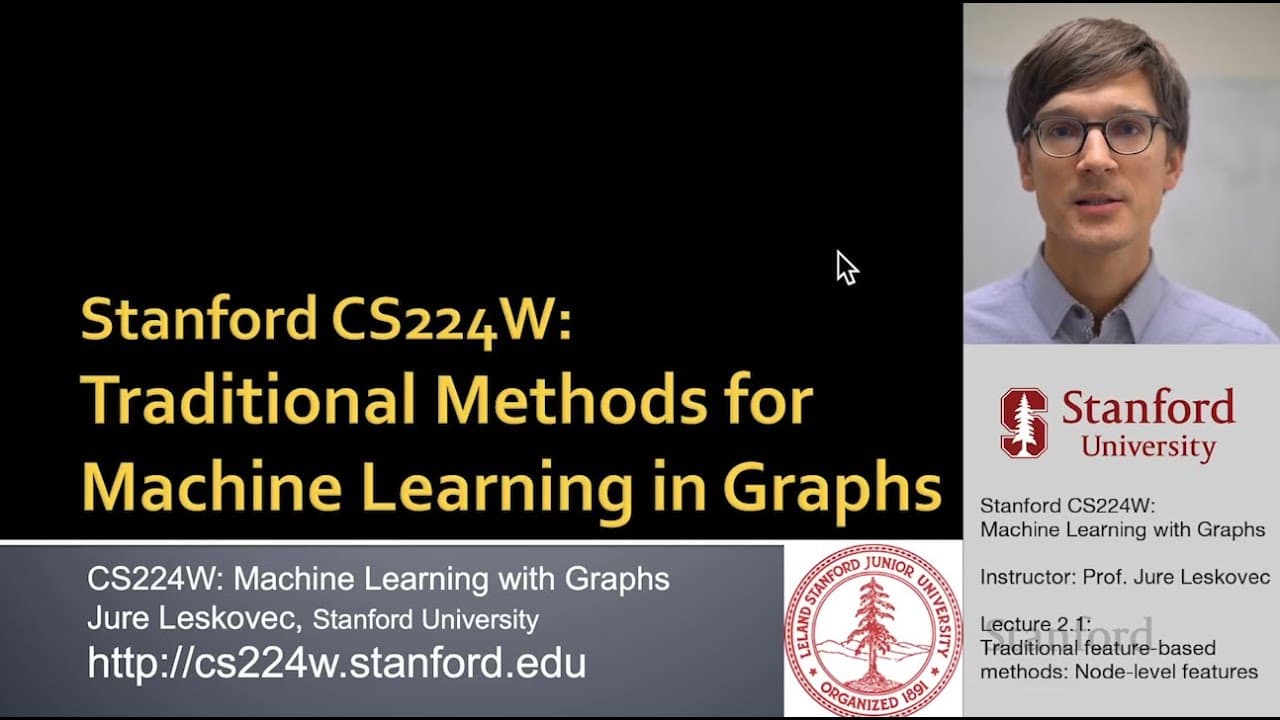
Traditional machine learning in graphs relies on effective feature design that incorporates both node attributes and topology. Key features such as node degree, various centrality measures, and clustering coefficients enable predictions at the node, link, and graph levels, while graphlet degree vectors provide a nuanced way to analyze network structures.
Transcript
welcome to the class today we are going to talk about traditional methods for machine learning in graphs and in particular what we are going to investigate is different levels of tasks that we can have in the graph in particular we can think about the node level prediction tasks we can think about the link level or edge level prediction tasks that ... Read More
Key Insights
- 💁 Traditional machine learning in graphs involves designing features that capture both attributes and topology information.
- ❓ The structure and importance of nodes can be characterized using features like node degree, centrality measures, clustering coefficient, and graphlet degree vector.
- 🎚️ Different levels of tasks, such as node-level prediction, link-level prediction, and graph-level prediction, require different feature design approaches.
- 💨 Graphlets offer a more sophisticated way to analyze local network structures beyond simple triangles or paths.
- ⚾ Feature vectors based on graphlet degree can be used to compare and classify nodes in different networks.
- 😥 Traditional machine learning pipelines involve representing data points with feature vectors and training classifiers or models.
Install to Summarize YouTube Videos and Get Transcripts
Explore YouTube Video Summarizer or Get YouTube Transcript Extractor
Questions & Answers
Q: What are the two types of features considered in traditional machine learning in graphs?
The two types of features are attributes describing the properties of individual nodes and features describing the structure and topology of the network.
Q: How are traditional machine learning pipelines typically structured?
Traditional machine learning pipelines involve representing data points as feature vectors, followed by training a classifier or model using machine learning algorithms like random forest or support vector machines.
Q: What is the difference between node degree and node centrality measures?
Node degree counts the number of edges that a node has, while node centrality measures capture the importance of a node in the network based on factors like connections to other important nodes or its position in the shortest paths.
Q: What does the clustering coefficient measure?
The clustering coefficient measures how connected a node's neighbors are, specifically counting the number of triangles in the node's neighborhood.
Q: How does the graphlet degree vector capture the local network structure?
The graphlet degree vector counts the number of instances of different graphlets in a node's neighborhood, providing a detailed measure of the local topological similarity between nodes.
Summary & Key Takeaways
-
Traditional machine learning in graphs involves designing proper features, including attributes and topology information.
-
Features can describe individual nodes, pairs of nodes, and the structure of entire graphs.
-
Different methods, such as node degree, centrality measures, clustering coefficient, and graphlet degree vector, can be used to capture the structure and importance of nodes in the network.
Read in Other Languages (beta)
Share This Summary 📚
Summarize YouTube Videos and Get Video Transcripts with 1-Click
Try YouTube Summary with ChatGPT & Claude or YouTube Transcript Generator
Explore More Summaries from Stanford Online 📚

Summarize YouTube Videos and Get Video Transcripts with 1-Click
Try YouTube Summary with ChatGPT & Claude or YouTube Transcript Generator