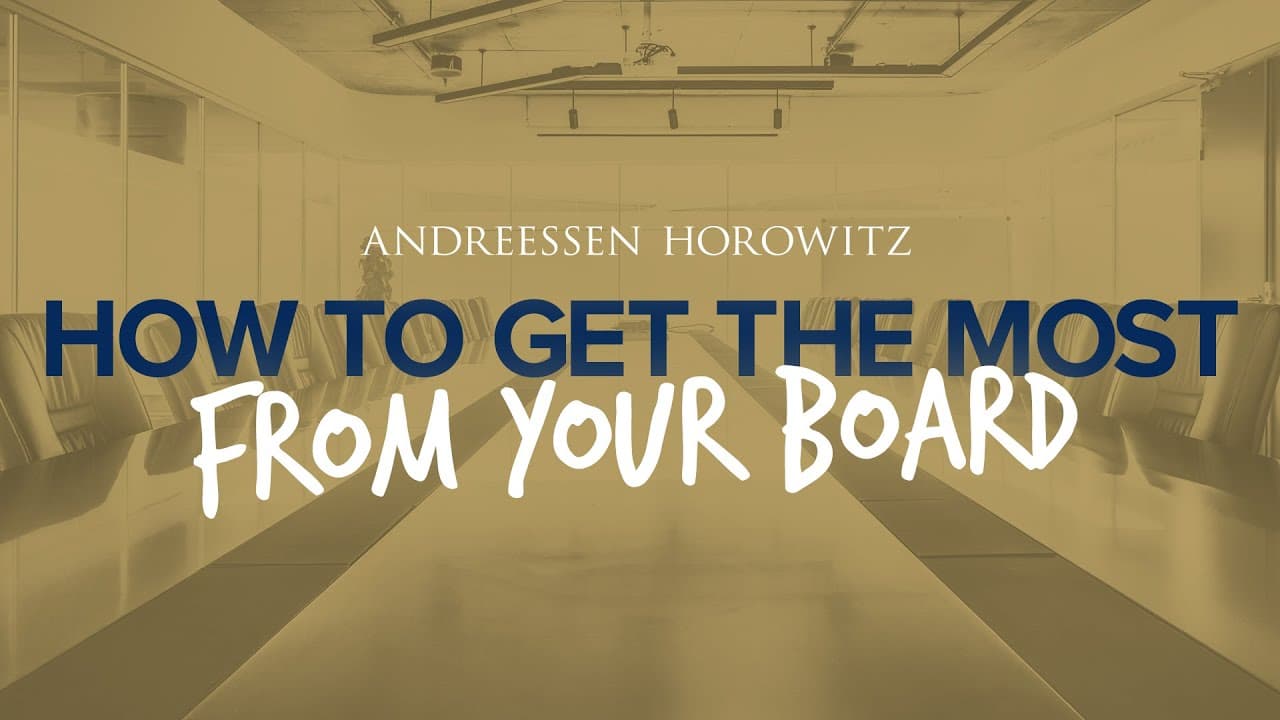
How to Get the Most from Your Board
TL;DR
Get the most from your board by choosing investors who can coach you, guide strategic decisions, and actively accelerate growth through introductions and hiring advice. Because a venture-investor relationship may last 8, 10, or 12 years, build enough trust to discuss problems openly while understanding each investor’s incentives. Read on for practical guidance on board relationships, CEO accountability, governance, and conflicting investor interests.
Transcript
hi welcome to the a 16z youtube channel I'm Frank Chen today I'm here with Scott Cooper and we are now in part 3 of 3 of our demystifying Silicon Valley this part is all about living with your investor as Scott will point out the average length of time that you will work with a venture investor 8 10 12 years is longer than the average marriage terr... Read More
Key Insights
- 💪 Building a strong relationship with your investor is essential for long-term success.
- 🥳 Understanding the incentives of both parties helps navigate challenging situations.
- ❓ Clear communication and transparency are vital in the entrepreneur-investor relationship.
- 🧑🏭 In an acquisition, consider factors like economic interest, future business prospects, and retention bonuses for employees.
- 🍭 Investment banks may have conflicts of interest between their clients, but their role is crucial in preparing for an IPO.
- 🤪 The board's role shifts after going public, focusing more on governance and compliance activities.
- 🥅 Entrepreneurs should prioritize understanding their investor's incentives and goals.
Install to Summarize YouTube Videos and Get Transcripts
Explore YouTube Video Summarizer or Get YouTube Transcript Extractor
Questions & Answers
Q: How can I get the most from my board and venture investors?
Treat investors as coaches, mentors, and sounding boards who can help with major strategic decisions. Ask them to contribute beyond board meetings through customer introductions, executive-hiring guidance, and advice about PR and marketing.
Q: What should I want from an investor who joins my board?
Look for someone who is a good coach, mentor, and steward of corporate governance. The investor should also help accelerate the business and support the shared goal of building an important, long-standing, ideally independent and publicly traded company.
Q: How long might an entrepreneur work with a venture investor?
The discussion says the relationship may last 8, 10, or 12 years. That long horizon makes it important to choose an investor you can work with productively over time.
Q: How transparent should a CEO be with the board?
A CEO should share enough information to receive useful advice and help, even when that requires vulnerability. The transcript argues that most venture capitalists will help address a disclosed problem rather than automatically punish the CEO.
Q: Can a venture investor fire the CEO?
The board’s fundamental powers include hiring and firing the CEO. However, when the CEO and other common shareholders control the board, venture investors cannot act unilaterally and must build consensus with a broader group.
Q: How can investors help accelerate a company’s growth?
Investors can make customer introductions and advise on when and how to hire a CFO or head of sales. They can also help the company navigate PR and marketing and identify useful press relationships.
Q: Why can the CEO-board relationship feel conflicted?
A board member can serve as both the CEO’s adviser and, effectively, the CEO’s boss. That creates tension because the CEO needs candid guidance while knowing the board may have the power to replace them.
Q: How should a CEO approach conflicting investor interests?
Start by understanding that Series A, B, and C investors may have different economic interests and timelines. One investor may press for a sale to obtain liquidity while others prefer pursuing a larger outcome, so the CEO must recognize those incentives and work toward consensus.
Summary
In this video, Frank Chen and Scott Cooper discuss the relationship between entrepreneurs and venture investors. They cover topics such as what entrepreneurs should look for in an investor, the importance of transparency and trust, managing situations where the economic interests of investors diverge, and advice for different scenarios including tough times, acquisition, and going public.
Questions & Answers
Q: What are the big things entrepreneurs look for in their board members/investors?
Entrepreneurs want board members who can provide coaching, mentorship, and strategic decision-making guidance. They also hope for value from investors that can help accelerate the growth of the business through customer introductions, operational expertise, and navigating the PR and marketing world.
Q: How should entrepreneurs handle the tension between wanting advice from their board members and the fear of being fired?
Entrepreneurs need to build a relationship with their board members where they feel comfortable sharing enough information to get advice and help. While there is a risk of vulnerability, most VCs are rational and understand that sharing weaknesses or mistakes does not mean punishment or job loss.
Q: How should entrepreneurs manage situations where the economic interests of investors differ, such as in a bridge round or acquisition?
In situations where investors have different economic interests, it is important for entrepreneurs to understand the incentives and timeframes of everyone involved. Open and honest discussions must be held to find common ground and determine the best course of action that aligns with the long-term goals of the business.
Q: What should entrepreneurs consider when going through an acquisition?
Entrepreneurs should consider the economic interest they will receive from the acquisition, whether it is in the form of cash or stock. They should also assess the go-forward business and what the acquisition means for employees. Retention bonuses and discussions on terms of stock options should be part of the negotiation process.
Q: What are some potential conflicts that arise when working with an investment bank for an IPO?
Investment banks have the dual role of representing the company going public and the institutional investors buying shares. This can create conflicts of interest when determining the IPO price, as the company wants a high price for less dilution while the investors want a lower price for more upside. However, conflicts are often a result of the difficulty in accurately forecasting demand and pricing for the IPO.
Takeaways
The most important takeaway from this video series is for entrepreneurs to understand their investors and build strong relationships with them. It is crucial to be transparent and have open discussions about conflicting interests. The success of the business depends on the alignment and cooperation between entrepreneurs and investors.
Summary & Key Takeaways
-
Understand what you want from your investor, including their role as a coach, mentor, and steward of corporate governance.
-
Look for value beyond just being a board member, such as making customer introductions and providing guidance on strategic decisions.
-
Transparency and trust are important in your relationship with your investor, even though they have the power to fire you as the CEO.
Read in Other Languages (beta)
Share This Summary 📚
Summarize YouTube Videos and Get Video Transcripts with 1-Click
Try YouTube Summary with ChatGPT & Claude or YouTube Transcript Generator
Explore More Summaries from a16z 📚





Summarize YouTube Videos and Get Video Transcripts with 1-Click
Try YouTube Summary with ChatGPT & Claude or YouTube Transcript Generator