Products
Features
YouTube Video Summarizer
Summarize YouTube videos
Web & PDF Highlighter
Highlight web pages & PDFs
Chat with PDF
Ask any PDF questions with AI
Ask AI Clone
Chat with your highlights & memories
Audio Transcriber
Transcribe audio files to text
Glasp Reader
Read and highlight articles
Kindle Highlight Export
Export your Kindle highlights
Idea Hatch
Hatch ideas from your highlights
Integrations
Obsidian Plugin
Notion Integration
Pocket Integration
Instapaper Integration
Medium Integration
Readwise Integration
Snipd Integration
Hypothesis Integration
Apps & Extensions
Chrome Extension
Safari Extension
Edge Add-ons
Firefox Add-ons
iOS App
Android App
Discover
Discover
Ideas
Discover new ideas and insights
Articles
Curated articles and insights
Books
Book recommendations by great minds
Posts
Essays and notes from readers
Quotes
Inspiring quotes collection
Videos
Curated videos and summaries
Explore Glasp
Glasp Newsletter
Weekly insights and updates
Glasp Talk
Interview series with great minds
Glasp Blog
Latest news and articles
Glasp Use Cases
Learn how others use Glasp
Build & Support
Glasp API
Access Glasp's API for developers
MCP Connector
Connect Glasp to Claude & ChatGPT
Community
Glasp Reddit Community
Students
Student discount and benefits
FAQs
Frequently Asked Questions
AboutPricing
DashboardLog inSign up

7.2.1 Latency and Throughput

July 12, 2019
by
MIT OpenCourseWare
YouTube video player
7.2.1 Latency and Throughput

TL;DR

Performance analysis and improvement in circuits can be understood through the analogy of laundry processing, with metrics like latency and throughput playing a crucial role.

Transcript

In this chapter our goal is to introduce some metrics for measuring the performance of a circuit and then investigate ways to improve that performance. We'll start by putting aside circuits for a moment and look at an everyday example that will help us understand the proposed performance metrics. Laundry is a processing task we all have to face at ... Read More

Key Insights

  • 📈 Performance metrics like latency and throughput are crucial in circuit analysis.
  • ❓ Pipelined systems can improve efficiency by overlapping processing steps.
  • ☠️ The rate of processing in a pipeline is determined by the slowest stage.
  • ❓ There is a tradeoff between latency and throughput in pipelined systems.
  • ✋ The system with higher throughput is favored when larger quantities need to be processed quickly.

Install to Summarize YouTube Videos and Get Transcripts

Explore YouTube Video Summarizer or Get YouTube Transcript Extractor

Questions & Answers

Q: What is the analogy used to explain performance analysis in circuits?

The analogy used is a laundry system, where the input is dirty laundry loads and the output is washed, dried, and folded loads.

Q: How is the performance of a single load of laundry analyzed?

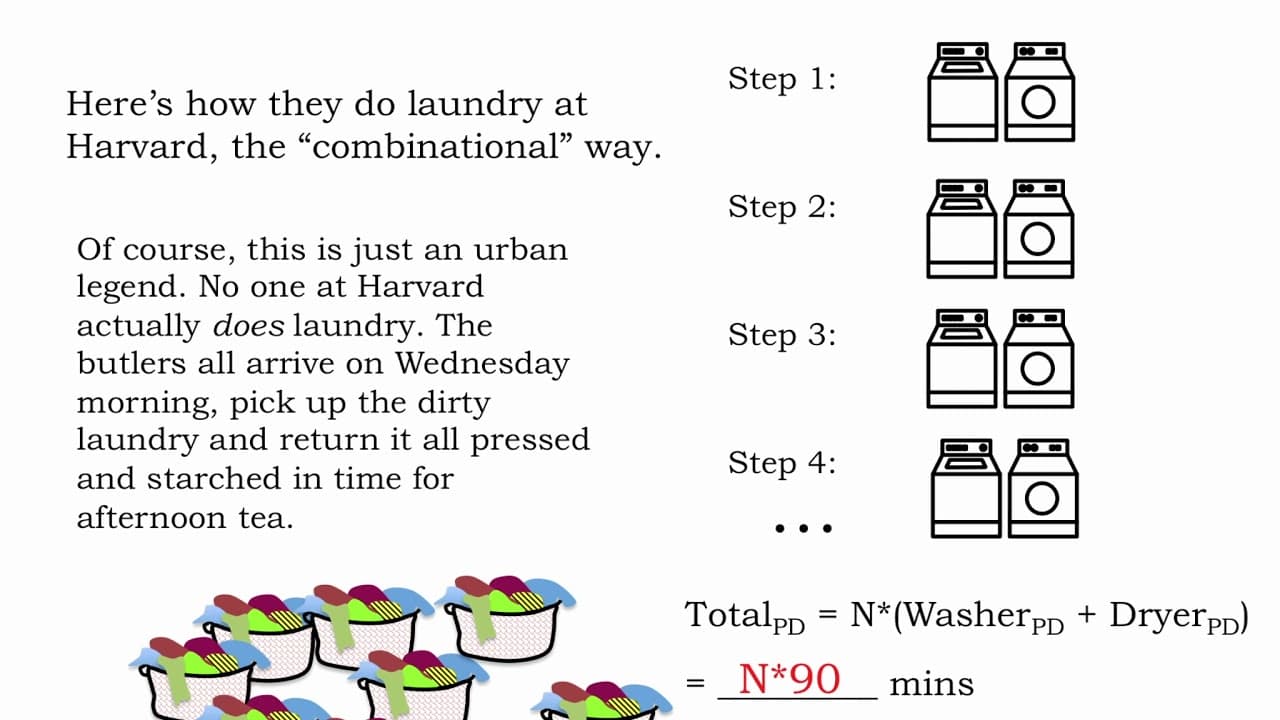
The propagation delay is calculated, which refers to the total time it takes for a load to go through the washer and dryer (in this case, 90 minutes).

Q: How does the approach to processing N loads differ between Harvard and MIT?

Harvard follows a combinational recipe, processing each load sequentially, while MIT overlaps washing and drying for better efficiency.

Q: What is the difference between the Harvard and MIT laundry systems in terms of latency and throughput?

Harvard has lower latency (90 minutes for a load), while MIT has better throughput (1 load every 60 minutes).

Summary & Key Takeaways

  • The content introduces the concept of performance metrics by using a laundry system as an example.

  • It discusses the efficiency of processing single loads of laundry and the time it takes for N loads to be processed.

  • It explains the concept of pipelined systems and the tradeoff between latency and throughput.


Read in Other Languages (beta)

English

Share This Summary 📚

Summarize YouTube Videos and Get Video Transcripts with 1-Click

Download browser extensions on:

Try YouTube Summary with ChatGPT & Claude or YouTube Transcript Generator

Explore More Summaries from MIT OpenCourseWare 📚

Lecture 3: Single-Vertex Crease Patterns thumbnail
Lecture 3: Single-Vertex Crease Patterns
MIT OpenCourseWare
17. Orthogonal Matrices and Gram-Schmidt thumbnail
17. Orthogonal Matrices and Gram-Schmidt
MIT OpenCourseWare
L5.5 Assembling the fine-structure corrections thumbnail
L5.5 Assembling the fine-structure corrections
MIT OpenCourseWare
Getting Started: Icebreaker thumbnail
Getting Started: Icebreaker
MIT OpenCourseWare
31. Eigenvectors of Circulant Matrices: Fourier Matrix thumbnail
31. Eigenvectors of Circulant Matrices: Fourier Matrix
MIT OpenCourseWare
7A. Protein 1: 3D Structural Genomics, Homology, Catalytic and Regulatory Dynamics, Fun... thumbnail
7A. Protein 1: 3D Structural Genomics, Homology, Catalytic and Regulatory Dynamics, Fun...
MIT OpenCourseWare

Summarize YouTube Videos and Get Video Transcripts with 1-Click

Download browser extensions on:

Try YouTube Summary with ChatGPT & Claude or YouTube Transcript Generator

Apps & Extensions

  • Chrome Extension
  • Safari Extension
  • Edge Add-ons
  • Firefox Add-ons
  • iOS App
  • Android App

Key Features

  • YouTube Video Summarizer
  • Web & PDF Summarizer
  • Web & PDF Highlighter
  • Chat with PDF
  • Ask AI Clone
  • Audio Transcriber
  • Glasp Reader
  • Kindle Highlight Export
  • Idea Hatch

Integrations

  • Obsidian Plugin
  • Notion Integration
  • Pocket Integration
  • Instapaper Integration
  • Medium Integration
  • Readwise Integration
  • Snipd Integration
  • Hypothesis Integration

More Features

  • APIs
  • MCP Connector
  • Blog & Post
  • Embed Links
  • Image Highlight
  • Personality Test
  • Quote Shots

Company

  • About us
  • Blog
  • Community
  • FAQs
  • Job Board
  • Newsletter
  • Pricing
Terms

•

Privacy

•

Guidelines

© 2026 Glasp Inc. All rights reserved.