How North Korea's Songbun and Juche Systems Work
TL;DR
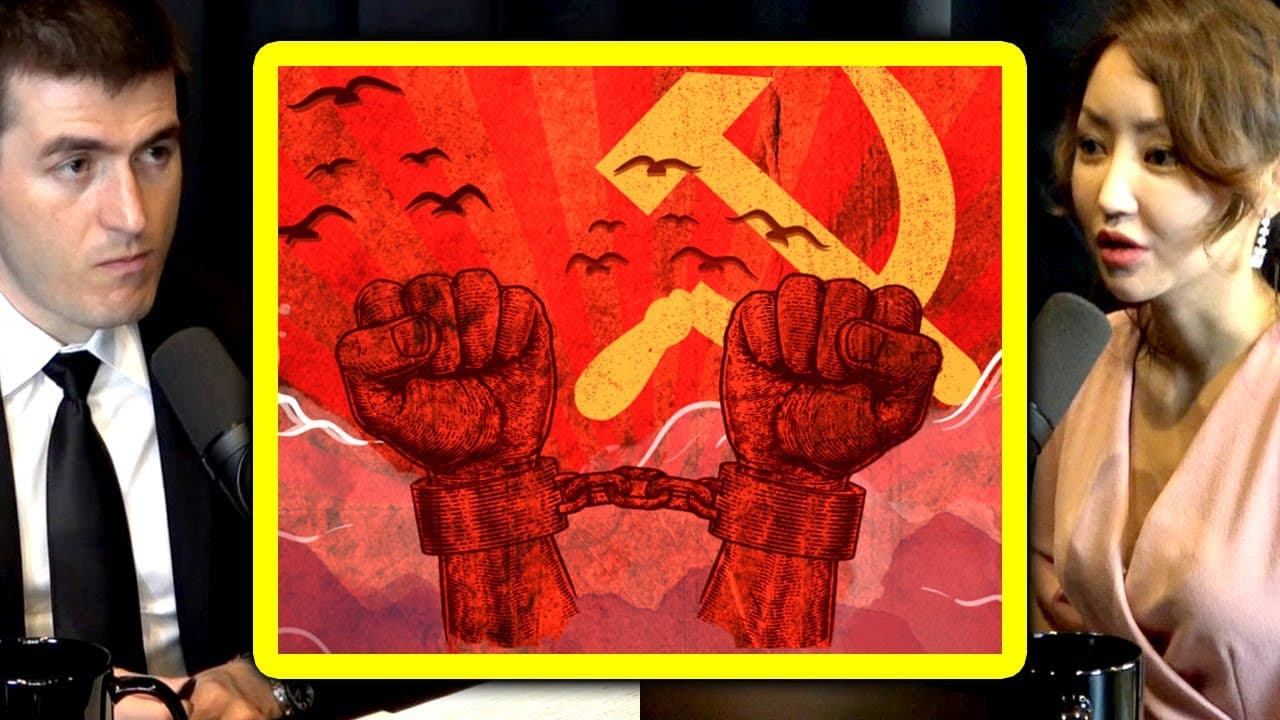
North Korea's songbun system assigns a person's prospects before birth through a secret family classification, while Juche demands self-reliance without surrendering state control. Yeonmi Park argues that these systems transformed a promise of equality into extreme hierarchy and allowed the regime to withdraw rations while restricting trade and preserving the leader's authority.
Transcript
Let me, uh, ask you some aspects about North Korean life. Mm. Can you describe the songbun system of, uh, ascribed status used in North Korea? Yeah. So that's a very interesting thing, right? Right now there are a lot of people playing with this ideology of, like, democratic socialism, socialism, communism, whatever you call it, Marxism, Leninism, ... Read More
Key Insights
- Songbun is a family caste system that assigns North Koreans to three broad categories called warrior, wavering, and hostile. Yeonmi Park says these categories are divided further into 50 classes that shape each person's opportunities and future.
- A person's exact songbun classification is recorded in a secret government document, according to Park. Because this inherited status determines future prospects before birth, individuals may not even know the precise class through which the government evaluates them.
- North Korea's promised equality produced a highly unequal hierarchy, Park argues. The state began with Marxist and Leninist ideals of collective provision, yet developed 50 social classes and placed a single leader at the top with the status of a god.
- North Korea depended heavily on Soviet aid until the Soviet Union collapsed in 1991, according to Park. The loss of that support preceded a crisis in which she says 3 million people died on the streets and the government stopped supplying rations.
- Juche means self-reliance in Park's account of North Korean ideology. She says the regime adopted it when the state could no longer provide rations, telling citizens to find their own means of survival while still surrendering every right to the government.
- Trade remained illegal even after state rations ended, according to Park. Citizens were instructed to survive independently despite restrictions on the activity that could help them obtain necessities, illustrating the contradiction between proclaimed self-reliance and continuing state control.
- Hunger can prevent people from considering wider questions or ambitions because finding the next meal consumes their attention, Park argues. She characterizes starvation outside Pyongyang as deliberate and describes the resulting famine as man-made rather than merely accidental.
- Leader worship protects the regime's claims from ordinary tests of consistency, according to Park. When a ruler is treated as a god rather than a political leader, contradictory policies can be presented as unquestionable and people cannot openly challenge whether those policies make sense.
- More videos with Yeonmi Park:
Install to Summarize YouTube Videos and Get Transcripts
Explore YouTube Video Summarizer or Get YouTube Transcript Extractor
Questions & Answers
Q: What is North Korea's songbun system?
North Korea's songbun system is a family-based caste structure, according to Yeonmi Park. It divides the population into three broad categories called warrior, wavering, and hostile, then separates those groups into 50 more specific classes. The government keeps each person's exact classification in a secret document and uses it to determine that person's future, meaning life prospects are assigned before birth.
Q: How does songbun determine a person's future?
Songbun determines a person's future by assigning inherited status through government records tied to family background. Park says the exact class is secret, so many people do not know where they fall among the 50 classifications. Nevertheless, the state uses that classification to decide their future. In her account, this means an individual's prospects are established before that person is born.
Q: Why does Park call North Korea an unequal society?
Park calls North Korea unequal because its stated goal of creating an equal communist society produced a rigid hierarchy instead. The songbun system divides people into 50 classes, while one man at the top is treated as a god. She connects this contradiction to Animal Farm, where proclaimed equality masks a system in which some beings possess greater status than others.
Q: What did North Korea promise under Marxism and Leninism?
Under the Marxist and Leninist model described by Park, the North Korean state promised to act as a provider and father figure. It would supply education, healthcare, livelihood, and rations while people worked collectively on farms and in workplaces. Citizens were told to transfer power to the state in exchange for equal treatment, material support, and progress toward a promised collective paradise.
Q: Why did Juche become important in North Korea?
Juche became important around the 1990s after the Soviet Union collapsed and stopped providing the aid that had heavily subsidized North Korea, according to Park. Because the North Korean government could no longer distribute rations, it adopted self-reliance as its message. Citizens were told to find their own way to survive, even as the government retained their rights and continued prohibiting trade.
Q: What does Juche mean in Yeonmi Park's account?
Juche means self-reliance in Park's account. She says the government used the ideology to tell citizens that the state would no longer provide rations and that they had to survive by their own efforts. At the same time, citizens were still expected to surrender every right to the regime, and trade remained illegal, creating a fundamental contradiction between responsibility and freedom.
Q: How does Park describe the role of hunger in political control?
Park argues that hunger narrows people's attention to the immediate search for their next meal. Someone struggling to survive is less able to think about the meaning of life or pursue larger ambitions. She says people outside Pyongyang were deliberately starved and calls the famine man-made, presenting food deprivation as a purposeful feature of political control rather than an unavoidable condition.
Q: Why does leader worship make North Korean ideology difficult to challenge?
Leader worship makes the ideology difficult to challenge because the ruler is treated as a god rather than an accountable political leader, according to Park. A leader would normally be questioned when policies contradict one another or fail to make sense. A deified ruler, however, can be portrayed as operating beyond human understanding, making the regime's claims effectively unfalsifiable and resistant to criticism.
Summary & Key Takeaways
-
Yeonmi Park describes songbun as a family caste system that places North Koreans into three broad categories: warrior, wavering, and hostile. These categories are further divided into 50 classes. A person's precise classification is contained in secret government records and is used to determine that person's future before birth.
-
Park presents songbun as a contradiction of North Korea's founding promise to create an equal communist society. Instead of eliminating hierarchy, the regime established dozens of hereditary classifications and elevated one leader above everyone else. The discussion compares this outcome with the unequal hierarchy depicted in Animal Farm.
-
Park says Juche emerged around the 1990s after the Soviet Union collapsed and its aid to North Korea ended. The regime stopped providing rations, prohibited trade, and instructed people to survive through self-reliance while retaining their rights. She argues that leader worship made these contradictions difficult or impossible to challenge.
Read in Other Languages (beta)
Share This Summary 📚
Summarize YouTube Videos and Get Video Transcripts with 1-Click
Try YouTube Summary with ChatGPT & Claude or YouTube Transcript Generator
Explore More Summaries from Lex Clips 📚




Summarize YouTube Videos and Get Video Transcripts with 1-Click
Try YouTube Summary with ChatGPT & Claude or YouTube Transcript Generator