How Do Resistor Capacitor Models Explain Neuron Behavior?
TL;DR
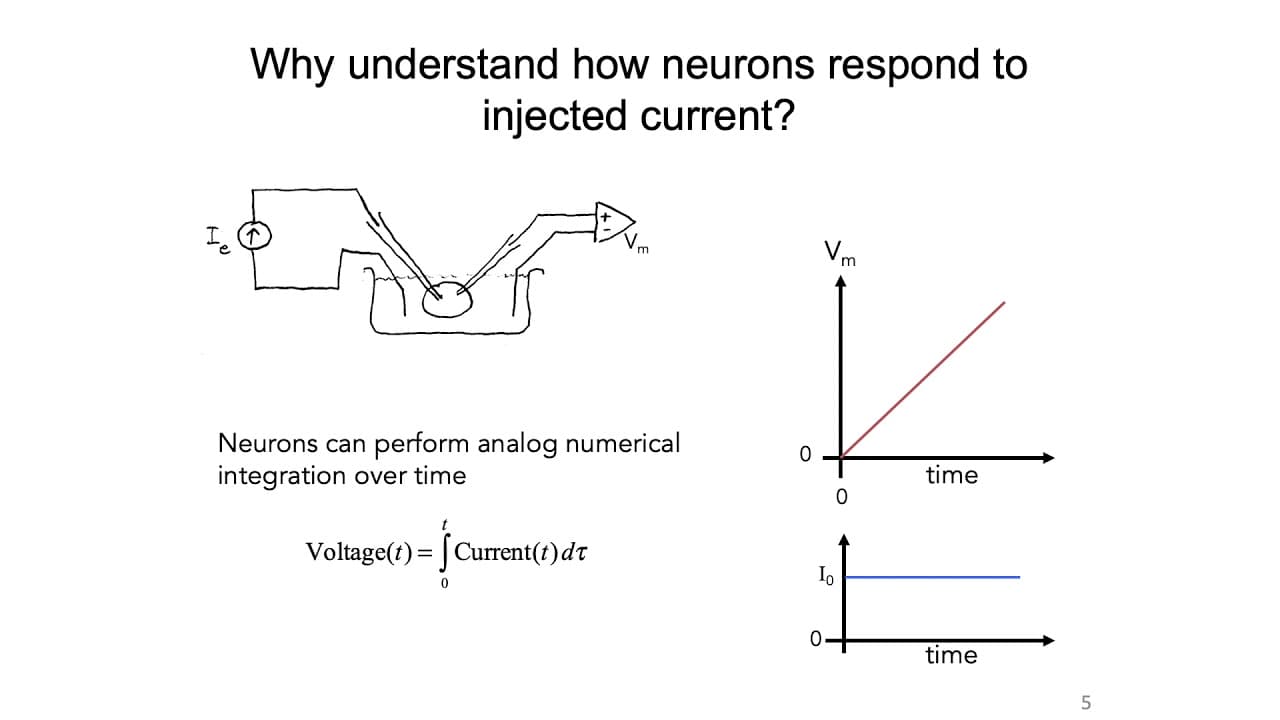
Resistor-capacitor models help explain neuron behavior by illustrating how voltage changes in response to current injections. Key components like conductance and capacitance determine how neurons integrate inputs over time and manage their voltage. Understanding these relationships is essential for grasping fundamental neuron functions.
Transcript
MICHALE FEE: OK, good morning, everyone. OK, so today we are going to continue the process of building our equivalent circuit model of a neuron. This model was actually developed in the late '40s and early '50s by Alan Hodgkin and Andrew Huxley, who started working on the problem of understanding how neurons make action potentials. And so they stud... Read More
Key Insights
- 🏛️ Neuron models can be built using equivalent circuit models with batteries, conductivity components, and capacitors.
- 🤩 Conductance and capacitance are key factors in understanding neuron behavior and voltage changes.
- 👻 Batteries allow neurons to change their own voltage and respond to current injections.
- 😑 Ion concentration gradients and ion channel permeability play a role in neuron voltage changes.
Install to Summarize YouTube Videos and Get Transcripts
Explore YouTube Video Summarizer or Get YouTube Transcript Extractor
Questions & Answers
Q: How did adding batteries to the neuron model solve the problem of voltage remaining at zero?
Batteries allow the neuron to change its own voltage, as they provide the power needed to control voltage changes.
Q: Why is it important to understand how the neuron transforms current input into voltage changes?
Current inputs from other cells and the sensory periphery are critical for neurons to function properly. Understanding this transformation helps to understand how neurons integrate and process information.
Q: How does ion concentration affect voltage changes in a neuron?
Ion concentration gradients create voltage gradients across the neuron membrane, which affect how much voltage changes in response to current injections.
Q: How does capacitance contribute to neuron behavior?
Capacitance allows neurons to integrate their inputs over time and filter their inputs. It plays a role in smoothing voltage changes over time, leading to the resistor-capacitor model of a neuron.
Summary & Key Takeaways
-
Neuron models can be built using equivalent circuit models that include batteries, conductivity components, and capacitors.
-
By adding batteries to the model, neurons can control their own voltage and respond to current injections.
-
Conductance and capacitance are key elements in neuron models, with conductance determining the flow of current and capacitance determining how voltage changes over time.
Read in Other Languages (beta)
Share This Summary 📚
Summarize YouTube Videos and Get Video Transcripts with 1-Click
Try YouTube Summary with ChatGPT & Claude or YouTube Transcript Generator
Explore More Summaries from MIT OpenCourseWare 📚


Summarize YouTube Videos and Get Video Transcripts with 1-Click
Try YouTube Summary with ChatGPT & Claude or YouTube Transcript Generator