What Are Organometallic Compounds and How Are They Made?
TL;DR
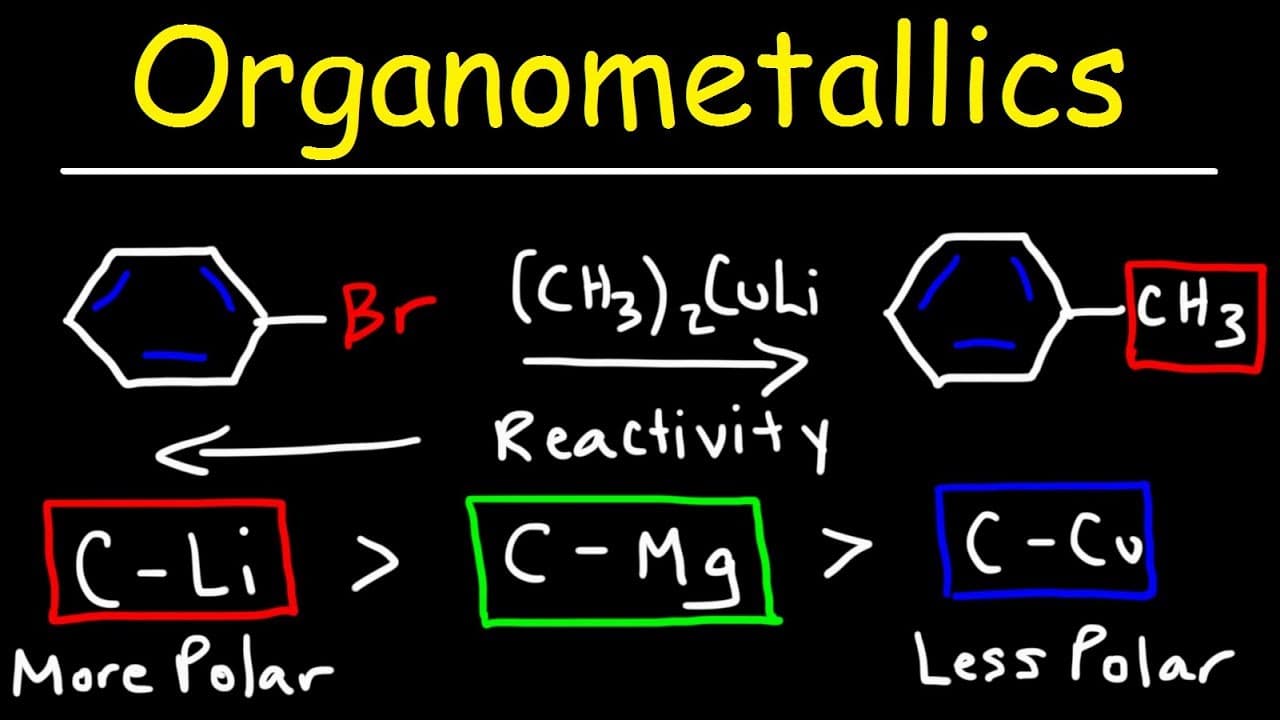
Organometallic compounds, such as organolithium reagents and organocuprates, are formed by reacting alkyl halides with metals like magnesium and lithium. These compounds, characterized by nucleophilic carbon atoms, can react with various functional groups, and their reactivity is influenced by the polarity of the carbon-metal bond.
Transcript
in this video we're going to go over organometallic compounds just a simple introduction into this topic so let's say we have an alkyl halide one bromobutane and we're going to react it with magnesium what's going to happen well this process allows us to form something called the grenade reagent and the magnesium is going to insert itself between t... Read More
Key Insights
- 🤘 Organometallic compounds, like organolithium reagents and organocuprates, can be formed by reacting alkyl halides with certain metals.
- 🤘 The reactivity of organometallic compounds is determined by the polarity of the carbon-metal bond.
- 👻 Ether solvents are commonly used with organometallic compounds to allow them to dissolve in solution.
- 🫀 Protic solvents, containing acidic hydrogen atoms, should be avoided with organometallic compounds to prevent deactivation or destruction of the compound.
- 💁 Organometallic compounds can be used to form carbon-carbon bonds by reacting with various functional groups.
- ❓ Organolithium reagents are more reactive than organocuprates and gilman reagents.
Install to Summarize YouTube Videos and Get Transcripts
Explore YouTube Video Summarizer or Get YouTube Transcript Extractor
Questions & Answers
Q: How is an organometallic compound formed?
Organometallic compounds are formed by reacting alkyl halides with metals like magnesium or lithium. This reaction results in compounds like organolithium reagents or organocuprates.
Q: What is the reactivity of organometallic compounds?
The reactivity of organometallic compounds depends on the polarity of the carbon-metal bond. Compounds with more polar carbon-metal bonds, like organolithium reagents, are more reactive than those with less polar bonds, like organocuprates.
Q: How does the use of ether as a solvent affect organometallic compounds?
Ether solvents, such as diethyl ether or tetrahydrofuran (THF), form complexes with organometallic compounds. This allows the compounds to dissolve in the solution, making ether a common solvent for reactions involving organometallic compounds.
Q: Why should protic solvents be avoided when using organometallic compounds?
Protic solvents, which have acidic hydrogen atoms, should be avoided when using organometallic compounds. These solvents can react with the nucleophilic carbon atom of the compound, deactivating it and potentially destroying the compound.
Q: How can organometallic compounds be used to form carbon-carbon bonds?
Organometallic compounds, such as organolithium reagents, can be used to form carbon-carbon bonds by reacting with functional groups like aldehydes, ketones, acid chlorides, and esters. The nucleophilic carbon atom of the organometallic compound reacts with the electrophilic carbon of the functional group, resulting in the formation of a carbon-carbon bond.
Summary & Key Takeaways
-
Organometallic compounds can be formed by reacting alkyl halides with metals like magnesium and lithium, resulting in compounds like organolithium reagents and organocuprates.
-
These compounds have nucleophilic carbon atoms and can react with various functional groups.
-
The reactivity of organometallic compounds depends on the polarity of the carbon-metal bond.
Read in Other Languages (beta)
Share This Summary 📚
Summarize YouTube Videos and Get Video Transcripts with 1-Click
Try YouTube Summary with ChatGPT & Claude or YouTube Transcript Generator
Explore More Summaries from The Organic Chemistry Tutor 📚




Summarize YouTube Videos and Get Video Transcripts with 1-Click
Try YouTube Summary with ChatGPT & Claude or YouTube Transcript Generator