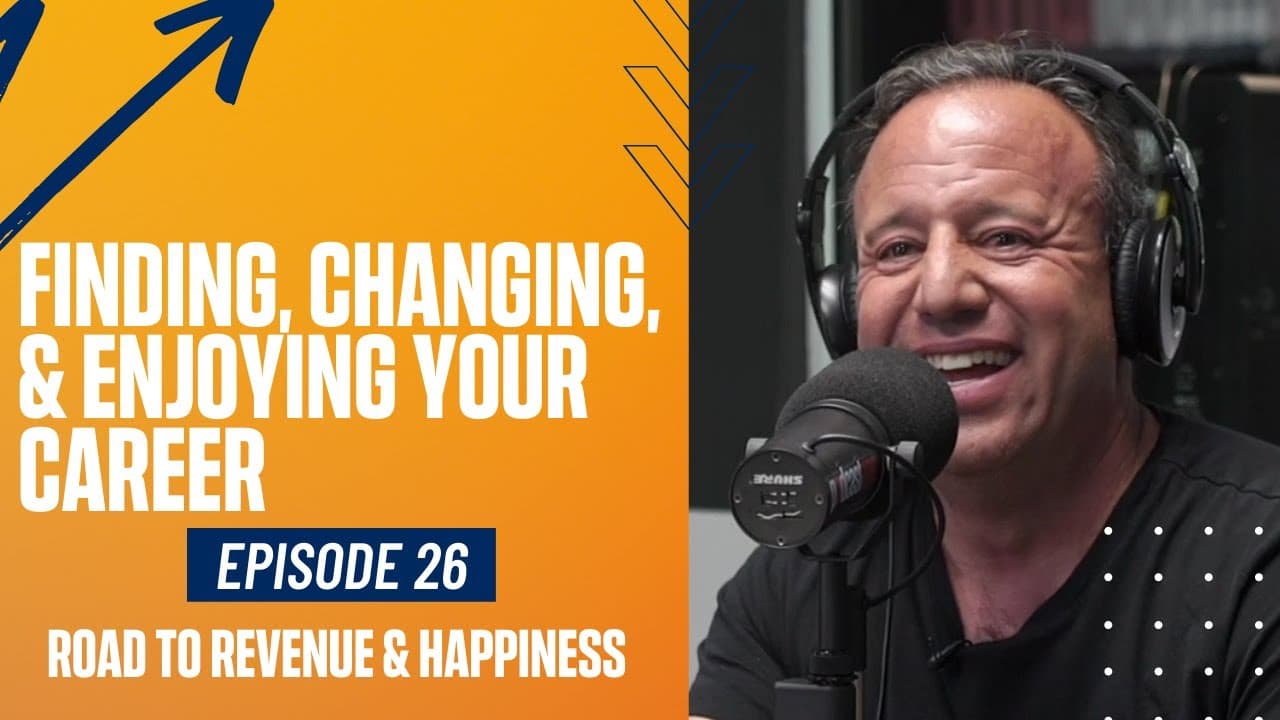
How Do You Navigate Personal and Professional Transitions? | Road to Revenue & Happiness #26
TL;DR
Navigating personal and professional transitions requires moving through four stages: awareness, resistance, research, and commitment. The Triple A Strategy adds alignment, action, and adjustment, beginning with identifying your values and aligning internal beliefs with external circumstances. Because transition is often slower than change, timing, consistent effort, and a willingness to adjust matter. Read on for a practical framework for handling expected and unexpected change.
Transcript
transition there's four phases or stages of transition and the first stage is awareness uh we talk about a lot the senses are way we see hear smell taste and feel are faulty systems they don't allow us to see incremental growth changes and they don't allow us to see transition our memories are faulty we can't remember exactly where we were exact ti... Read More
Key Insights
- Transition involves four stages: awareness, resistance, research, and commitment. Understanding these stages can help navigate personal and professional changes effectively.
- Change can be expected or unexpected, but transition is often a slow process that requires careful timing and awareness of values.
- The Triple A Strategy involves alignment, action, and adjustment, helping individuals navigate transitions by aligning internal beliefs with external circumstances.
- Daily practices such as taking inventory of values, asking for help, studying, and maintaining gratitude are essential for managing transitions.
- Pain is an indicator of the need for adjustment, not a stop sign. Using pain as a guide can help in angling towards better outcomes.
- Building trust and vetting information is crucial for making stable decisions during transitions, ensuring alignment with personal and professional goals.
- Capabilities analysis involves evaluating skills, knowledge, and adaptability to identify opportunities and align with stable or growing industries.
- Networking and seeking mentorship are vital for gaining insights and accelerating growth during transitions, leveraging the experiences of those with situational knowledge.
Install to Summarize YouTube Videos and Get Transcripts
Explore YouTube Video Summarizer or Get YouTube Transcript Extractor
Questions & Answers
Q: What are the four stages of personal and professional transition?
The four stages are awareness, resistance, research, and commitment. First recognize the transition, then move beyond ego-based denial and resistance, research by being more interested than interesting, and finally commit to the consistent, persistent pursuit of your potential.
Q: How is transition different from change?
Change can happen quickly and on a large scale, while transition tends to unfold more slowly than people want. Because transition takes time, the speaker emphasizes that timing is especially important.
Q: What types of change can cause a transition?
The episode identifies expected and unexpected change as two causes of transition. Even an expected event can produce unexpected circumstances when the timing, amount, closing, or terms change.
Q: What is the Triple A Strategy for navigating transitions?
The Triple A Strategy consists of alignment, action, and adjustment. It addresses both internal transition and external circumstances, helping a person align beliefs and values, act, and keep angling toward a desired outcome.
Q: How do you create alignment during a transition?
Start by knowing your values and examining how your internal beliefs fit the external circumstances. The recommended perspective is to accept where you are while continuing to move toward where you want to be.
Q: How do you take action during a transition?
The action stage begins with taking inventory of your internal and personal values. That inventory should identify what matters to you and clarify your non-negotiables.
Q: Why does resistance follow awareness during a transition?
Once people become aware of a transition, ego-based denial can arise and create resistance. The episode associates this stage with voids, shortages, obstacles, and difficulty achieving what is wanted.
Q: Why is research important when navigating a transition?
Research begins after you recognize the transition and move beyond ego-based resistance. At this stage, the episode recommends opening your mind and being more interested than interesting before making a commitment.
Summary & Key Takeaways
-
Transitioning involves four key stages: awareness, resistance, research, and commitment. Understanding these stages helps in navigating changes effectively.
-
The Triple A Strategy—alignment, action, and adjustment—facilitates transition by aligning internal beliefs with external changes, promoting personal and professional growth.
-
Daily practices like taking inventory of values, asking for help, and maintaining gratitude are crucial for managing transitions and achieving long-term success.
Read in Other Languages (beta)
Share This Summary 📚
Summarize YouTube Videos and Get Video Transcripts with 1-Click
Try YouTube Summary with ChatGPT & Claude or YouTube Transcript Generator
Explore More Summaries from David Meltzer 📚

Summarize YouTube Videos and Get Video Transcripts with 1-Click
Try YouTube Summary with ChatGPT & Claude or YouTube Transcript Generator