Signal Flow Graph | SFG | Terminology | CS | Control Systems | Lec - 09
TL;DR
Signal flow graphs help analyze system characteristics and transfer functions effectively.
Transcript
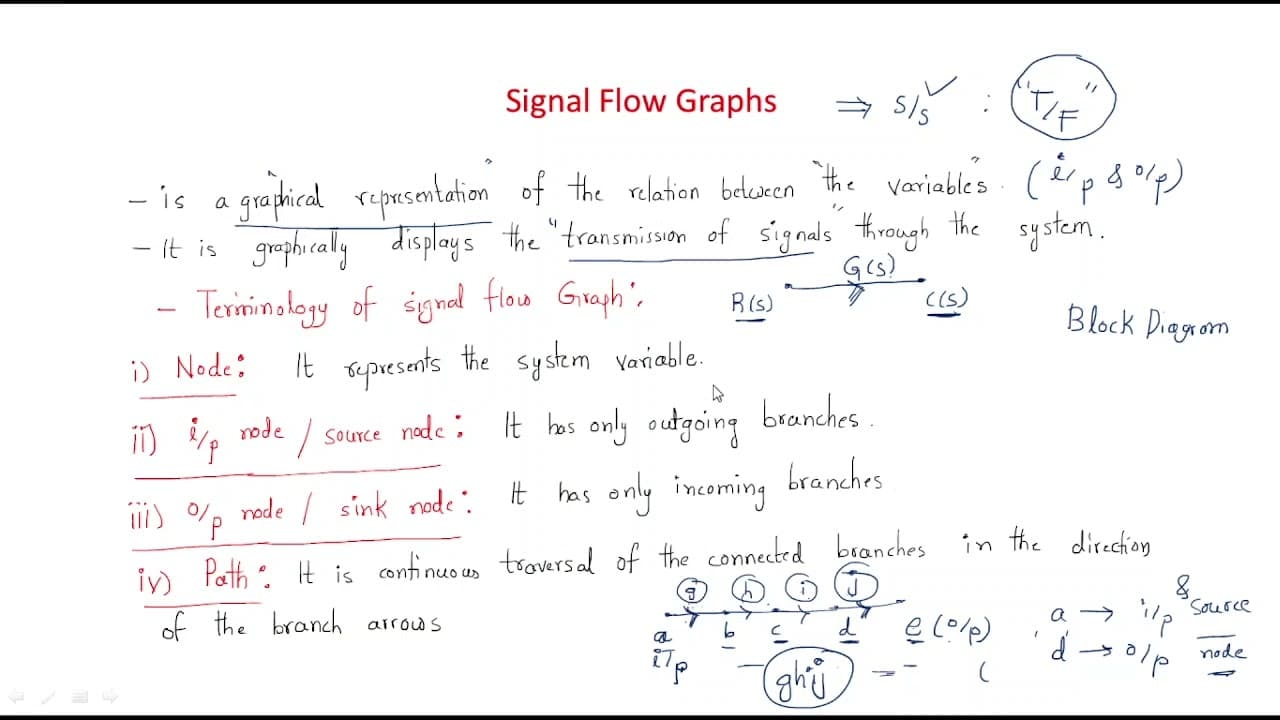
hello everyone in this session we will discuss about the signal flow graphs signal flow graphs is also a representation of a system and it is useful for to find out the transfer function of the system so whenever we are finding the transfer function automatically it will give the system characteristics that means system input system outputs how the... Read More
Key Insights
- 🉐 Signal flow graphs simplify the representation of dynamic systems, offering advantages over block diagrams in certain analyses.
- 💦 Understanding the definitions and roles of nodes, input/output nodes, paths, and loops is fundamental in working with signal flow graphs.
- 📡 The graphical nature of signal flow graphs aids in visualizing signal transmission, which may enhance comprehension for engineers and students alike.
- 💐 The transfer function derived from a signal flow graph encapsulates essential characteristics of the system’s behavior under various conditions.
- 📡 Paths and loops within a signal flow graph each contribute to the overall transfer function, influencing how input signals are modified.
- 📡 The versatility of signal flow graphs allows them to be used in various engineering fields, particularly in control systems and signal processing.
- 🉐 Calculating the path gain involves multiplying the branch gains along a specific path, demonstrating direct relationships between nodes.
Install to Summarize YouTube Videos and Get Transcripts
Explore YouTube Video Summarizer or Get YouTube Transcript Extractor
Questions & Answers
Q: What is a signal flow graph and why is it used?
A signal flow graph is a graphical representation of a system that illustrates the relationships between input and output variables. It is used to visualize and analyze how signals transmit through a system, facilitating the determination of the transfer function. This makes it easier to understand system characteristics compared to traditional block diagrams.
Q: What do nodes represent in a signal flow graph?
In a signal flow graph, nodes represent system variables. Each node can be an input, output, or intermediary variable that connects with other elements through branches. Nodes are crucial for establishing relationships between the various components of the system, thus playing a foundational role in analyzing the flow of signals.
Q: How are forward paths and loops defined in signal flow graphs?
Forward paths represent the continuous traversal from an input node to an output node without retracing any steps. Loops, on the other hand, originate and terminate at the same node, passing through other nodes without repeating any. Both concepts are essential for calculating system behavior, especially when applying Mason's gain formula.
Q: Can you explain Mason's gain formula and its importance?
Mason's gain formula is used to compute the transfer function of a signal flow graph. It combines information from forward paths and loops to express the overall system response. The formula considers individual loop gains and their interactions with forward paths, making it vital for understanding complex systems in control theory and signal processing.
Summary & Key Takeaways
-
Signal flow graphs provide a graphical representation of system variables, illustrating the relationship between inputs and outputs in a clear manner.
-
Key components of signal flow graphs include nodes, input/output nodes, paths, and loops, each serving specific roles in the depiction of system dynamics.
-
The session covers Mason's gain formula, used to determine the transfer function from the signal flow graph, emphasizing the calculation of forward paths and loop gains.
Read in Other Languages (beta)
Share This Summary 📚
Summarize YouTube Videos and Get Video Transcripts with 1-Click
Try YouTube Summary with ChatGPT & Claude or YouTube Transcript Generator